• The move to the new server is done. There are some software and database maintenance updates in process. This has us passing the hat around to help out. We appreciate any donations. Seriously, even a dollar helps. The payment page may be found here - https://www.audiokarma.org/support.html

Klipsch Modifications

@Martin 530 , here's my edited screenie with pipe insulation highlighted. Maybe whomever owns this thing is here and will chime-in. Start a thread if you're still around here and you'll likely get better action--I missed your post completely until today. There are about as many configs as people (ranging to building a whole dressed-up rear-end/false corner.

foam_pipe_insul_seal_khorn_rear_eg_enhcol_.jpg
 
@Martin 530 , here's my edited screenie with pipe insulation highlighted. Maybe whomever owns this thing is here and will chime-in. Start a thread if you're still around here and you'll likely get better action--I missed your post completely until today. There are about as many configs as people (ranging to building a whole dressed-up rear-end/false corner.

View attachment 2745874
Thank u for the photo.
Hope this thread takes off.
I have perfect corners just looking for a tighter seal.
 
I meant to start your own thread for better visibility. If your walls are good, gasket them however is convenient and that's that for many people.

I remember a guy that had hardware to suck the thing in tight against his gasket, too--many variants exist. Several people sealed the top of the basshorn bit in the corner with small triangles or a whole top--depends what you're seeking, how bad you want it, how big the room is (to get the bass you want), what your walls are comprised-of, etc. For example, lowest bass can go right through walls and so on, so some people have tested reinforcing their own wall/corners ala this (another thing that's not mine):

semi_false_1.jpg

Talk some about what's missing or better yet, start the thread with that and it'll get better visibility and people should pile-on.
 
Here is my offering, I made this center channel beauty base this on a well known fact that Klipsch Heritage series speakers have a timber that is not easily matched by a center channel that can be positioned correctly.

Of course we all know that the Heresy started as a center channel way before the purpose of a center channel became defined as a dialogue predominant speakers. In the world of Surround sound it's a fact that position is a huge factor for making the system work properly. This sets limitations on what can be used in each spot. No spot is more sensitive than the center, it can make things very difficult to create that illusion the surround brings if the center is not in the correct spot or it fails to timber match the front speakers.

Now I've been through the entire surround fad from the start, right up to when they decided 7 speakers was simply not enough to do the job properly. I've always felt that 5 was perfect and 7 seemed like a gimmick to get you to buy more speakers. I bought a Mirage M series 5.1 set up that cost too much for what I got, then added another set of bookshelves to the rear.

The thing I noticed was the center (even with exact matching drivers as the fronts) never sounded the same as the fronts? I figured it was because they made the cabinets different and for some reason added an extra woofer to the mix even though the cabinet was smaller with less volume. Was I the only one who thought this was defeating the purpose?

I never could get it to sound like it should have for the money I spent, after trying 10 different receivers which all but a few seemed to die an early death (thank you for charging me for protection circuitry, that seemed to be what was causing me from using it) I still couldn't match the sound.

Now back to this, I had 3 series 1 Hersey's laying around all needed attention to the cabinets, peeling veneer, cupping from water, etc..

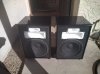
I did this to the matched pair.
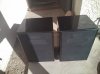
IMG_20221028_150417.jpg
IMG_20221028_150500.jpg

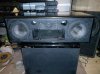
I also made a center channel that I matched the horns to these but had a buyer who wanted them to be black. I made changes but the cabinets had a few bad spots on them from hanging around in the way for a few years. I decided to fix them hoping I'd be done in a week or so.

That's always just a dream with black lacquer. After a month and a half I finished it but made some changes along the way that added quite a bit of difficulty to the task. I cut the rounded edge off and made it a flat facet like edge. That proved to be very difficult to keep those parallel lines straight after 50 coats of black. Keeping the paint thin was the best approach but lead to sanding through very easily on those high edges. I was done at one point and had it still on the rotisserie for a few days. I rested my hands and went out to find the entire clear coat had cracked right down to the color layer! It was my mistake for using a can of MinWax clear lacquer I had laying around after I went to buy more WATCO and couldn't find any locally. I never tried minwax and I didn't feel I should have used it so at that time I waited till I got WATCO and kept going. But with all the sanding through I found myself at a point where I could be done after a few thick coats of clear. I have a perfect finish going and it was late at night and I went for it.

I found out that minwax is not made to cover anything but bare wood! Now why isn't that on the can? Minwax told me after I emailed them asking for a reason my project had become a wreck.

I made the mistake and I'm letting you all know not to do the same. What got me was how perfect it looked when I shot it, it was the most perfect smooth finish I ever saw while it was wet and the next day it was so easy to sand and polish I was so happy. My polishing time was cut to about 10% of what I normally do.

Then it sat for 3 days without looking at it or thinking about it. When I went to remove it from the rotisserie it was cracked from front to back even around the front lip. The cracks went around down the sides and bottom. Needless to say I had to start over.

After much work I ended up with this.
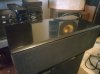
IMG_20221231_151956_HDR.jpg IMG_20221231_192032.jpg IMG_20221231_192042.jpg IMG_20221231_192049.jpg
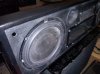
I used some Atlantic Technologies woofers, I have a number of 6" drivers that would fit the bill but the others (PSB, KEF, DMC, BIC and a few unmarked that I can't remember where they came from) either had strange mounting that kept them from fitting properly or they didn't sound right. I was limited to drivers that had a 4 ohm cv or dual 8s like the DMC.

The Atlantic read 5 ohms but I'm sure they drop down once power is applied. I made no changes to the E2 crossover, I have recently tested 5 Heresy crossovers and found not 1 component has changed in value more than 1%. Only 1 cap read close to 1% the rest were nearly dead on spec! This is why I keep saying "test everything before you start screwing around with the crossovers" the meter is $20 and it wi save you more money and time than ever. I have 3 meters that I use to check each of the other meters results so it's not just 1 meter telling me this. Of course 2 of my fluke meters decided to quit working on me last year, I vowed to never buy them again. That has left me searching for a decent meter that can read resistance down to 0.00 but have found there's not many that can go to the second 0. I have a few that are very cool and have a rechargable battery in it and does everything but what I don't like is it's automatic. You find yourself trying to figure out what exactly the results are when it shows 0.135 meg ohms? Now why not just ohms? I see this constantly and I'm tired of these mystery numbers. The next test will show another reading that's using a different scale. I've ordered a few with turn dails that have scales I select.

I made another test cabinet that I can fit larger drivers in but the size is a big wider and the drivers are tight against each other. I tested them all and found the ATs to be the best over all. I can get to 68Hz at reference levels and have a fairly flat response up to the crossover point. There's a bump (could be my test set up i used) at 2000 to 6000. I just got a new mic and had to get a phantom powered interface for it.


I haven't tested this again but I simply don't care for the REW program at all. I feel like it's not working correctly and gives a way to blurry plot compared to anything I've ever seen when testing my main speakers. Basically shows a flat (once smoothing is applied) line with a dip at 54Hz. But without smoothing it's showing a hair comb looking plot with exaggerated peaks and valleys every other Hz. I don't like using a computer to run sweeps. Mine is noisy and adds tiny noises into the power lines. Fans are loud too. Without a definite noise floor removal (which it says it's doing) that I can see for sure I'm not sure it's correct. I report back.
I also have a saw tune up that I want to share for Ryobis precision 10" table saw conversion from their sliding crosscut to a Rockwell sled.

 
There's an old saying: "Software is never as good as the demo, but never as bad as the worst of users might have you believe." 99% of the people that have used REW for 16 years would disagree with you. Including me.

Could they make a simple program less user friendly? The first few times I tried it I couldn't get it to pass the starting page. Then found out that all that initial set up wasn't even needed to get started. That right there made me question what was going on with it.

I have 2 other programs I'm going to be comparing to each other, I'll see if I get 2 of the same results out of 3. I'm willing to bet that if I use the same source signal that's not part of any of those 3 prograns, I'll get 3 different results. I only say this because out of the 25 or more apps available for Android using the same calibrated Dayton microphone, I can't get 2 similar results. Plus if I change devices, I get different results from each different phone or tablet.

This casts doubt on the entire idea of a program being trusted. As Amir over at Audio Science (who lives his life based on results from REW) has stated, when he stated using REW, he started with known results and had to work backwards to try and figure out how to get the program to come to those results.

So without a second program that can confirm results, I can only say they have little value. Once I start changing EQ settings in accordinsnce to test results I lose overall tonal quality and balance. I have taken an average of a bunch of apps to see if there is a trend that develops that can show which apps are more likely to be correct but they're so different I decided a flat EQ with a slight cut at 50Hz and another tiny dip at 6kHz is all that's needed. No room modes, no bass traps, no dsp tuning. All analog adjustments take seconds to complete in real time.

I can see that your response has been well received by others, I just wish there was a program that was correct, just to make things easier on me when I'm putting together a speaker.

But my own testing has proven that each program shows different results even the same programs show different results depending on what device or computer they are ran from. Most require using their own test tones to see any results at all. That leaves no way to confirm those results so those programs have no merit.

One more thing to consider is that each program has some type of agenda, whether it's to sell their add-ons or get people to buy certain pieces of equipment (mic or interface) or to promote a certain speaker company by favoring a particular sound curve that shows flat but is incorrect for any real tests. Focal has a set of test tones, but first the tones need to be verified. How can that be done without a proven tester? See that's where it all begins, how do you know the original basis for the standard of all results is not flawed from the start?

Test programs cannot be trusted and should not be a part of home stereo except when the results can be verified with 2 other tests results matching. That's just my own common sense take on this. Maybe you trust what 1 program says as gospel and have faith in it I have seen way too much hard proof that none of them can be trusted.

Like I said these are my own thoughts and I'm not trying to argue, I have too much proof to think any other way. If you have proof that you have been able to get 2 programs to show the exact results I'd like to know so I can test them myself.
 
Like I said these are my own thoughts and I'm not trying to argue, I have too much proof to think any other way. If you have proof that you have been able to get 2 programs to show the exact results I'd like to know so I can test them myself.
No argument or further testing required. If it/they work for you use them. If they don't work, don't use them. Simple. I'm not an absolutist, but a realist, so further R&D in this area is a waste of time for me. I'm too busy building and modding real speakers to bother. Good luck in your Audio Quests.
 
On the CW4 Klipsch uses a pair of 2 x 4's from the front to back at the 10:00 and 2:00 position about 2" past the woofer cutout. A solution that works well and has been used on their pro KPT-456 and KPT-904 double 15" woofer cabinets.
So I tried this on my Cornwalls, per our talking about it when I ordered my SMAHLS from you. It made them sound dull and detail was not as sharp and clear. Needless to say, the braces came out. The SMAHLS on the other hand....love them!
 
So I tried this on my Cornwalls, per our talking about it when I ordered my SMAHLS from you. It made them sound dull and detail was not as sharp and clear. Needless to say, the braces came out. The SMAHLS on the other hand....love them!
That surprises me on the bracing. It was one of the things Klipsch did themselves on the CW4 and where my idea for this came from. It might boil down to personal preference on the sound characteristics and those vary from person to person. I guess I will change my recommendation to "you may like bracing"
 
That surprises me on the bracing. It was one of the things Klipsch did themselves on the CW4 and where my idea for this came from. It might boil down to personal preference on the sound characteristics and those vary from person to person. I guess I will change my recommendation to "you may like bracing"
Yeah, I found it kind of puzzling. They just sounded dull and lifeless and, to me at least, there was a marked loss of detail. Not what I was expecting, for sure. Without th braces I think they sound very dynamic.
 
There was a guy on the Klipsch forum who was very technical and he has had most high end Klipsch gear, at least the Pro stuff, and has designed and built many projects. He really likes the KPT-942/4's and loves the bass. I on the other hand love the bass on things like the MCM-1900's and my self built Super MWM's. 942/4's are rock and roll thumpin thunder and the other's I mention are far more accurate and true to real life. I have a set of 942's in the shop right now and next to the S-MWM's which are also in the shop right now they are muddy sounding to me.

It has been very interesting to see what people are attracted too in audio. When I used to find and fix old Heritage Klipsch for instance the Chorus 1's I would find would often find their way to older men with health problems. Most were widowers with limited living space and they loved music which predominantly was classical stringed instruments and those Chorus speakers would give them great fidelity at low volumes. I can relate to that as I find myself listening to music by myself often as my wife could care less about anything outside of Youtube. Space and volume are not problems here but 75 to 80db max is normal any more in my shop. Louder seems to diminish definition which I have come to value.
 
There was a guy on the Klipsch forum who was very technical and he has had most high end Klipsch gear, at least the Pro stuff, and has designed and built many projects. He really likes the KPT-942/4's and loves the bass. I on the other hand love the bass on things like the MCM-1900's and my self built Super MWM's. 942/4's are rock and roll thumpin thunder and the other's I mention are far more accurate and true to real life. I have a set of 942's in the shop right now and next to the S-MWM's which are also in the shop right now they are muddy sounding to me.

It has been very interesting to see what people are attracted too in audio. When I used to find and fix old Heritage Klipsch for instance the Chorus 1's I would find would often find their way to older men with health problems. Most were widowers with limited living space and they loved music which predominantly was classical stringed instruments and those Chorus speakers would give them great fidelity at low volumes. I can relate to that as I find myself listening to music by myself often as my wife could care less about anything outside of Youtube. Space and volume are not problems here but 75 to 80db max is normal any more in my shop. Louder seems to diminish definition which I have come to value.
The reason you prefer a single 15 in a Big Horn (thank you for building my design) versus Bass Reflex with 4-15's is the Low Intermodulation Distortion coupled with a Cohesive, minimum phase, TRANSIENT response from a cone that only needs to move 1/10th as far to produce a given bass note vs. a Direct Radiator.

Something PWK won a Silver Medal for in the 70's from the Audio Engneering Society. No speaker manufacturer ever talks about or specifies it, because it never looks good on paper.
IM Distortion can only be tamed by horn loading to minimize cone motion. This form of Distortion (AM and FM) creates Sidebands that are not present in the original music recordings, which is way worse than Total Harmonic Distortion yet that is the only one that is ever presented, if at all.

The woofer is the worst offender because it move way more than a tweeter. Yet it's the last place anyone wants to horn load because it requires a lot of lumber and space to do well. My Edgarhorn Titans are the best sounding speaker's I've ever owned. I'm almost done tweaking the crossover by eliminating the Hysteresis cause by Iron/Ferrite Core Inductors. I just got some 14 AWG Air cores to replace the custom one I have now. I will have 3X the DCR I had with the P-core Janzens but it will still be only about 3 1/2% of the woofer/horn impedance. A good trade off, I hope. We shall know by tomorrow.
 
…on a quiet night, La Scalas at 70 db are surreal

A LaScala is about a 2.7 foot folded horn (short horn). My EdgarHorn Titan II's are a 3 foot long short horn with a straight axis. I got a similar experience last night from additional midbass/midrange detail by getting rid of Hysteresis in the passive network, which is inherent in all iron/ferrite core Inductors. I spent about $95 for a pair of14 AWG, Air Core Inductors (tax and shipping included). I priced out a few hundred feet of 14 AWG magnet wire to make my own, but the cost was the same as the Daytons, so zero savings vs. getting them already wound.

The midass horn is pretty flat to 600 Hz. (unlike the LaScala that barely makes it to 400 with 5 db less output there). So it's a 500 Hz. crossover point to the Salad Bowl Midrange. The active, Mono, Seismic Subwoofer with an 18" JBL driver takes care of the bass below 80 Hz. (LaScala is not a Horn below 104 Hz., but a sealed box in a tight "corner" which is a clever design by PWK. Using an Eminence Kappa 15C iinstgead of a K-33 will improve the midrange, and using a horn sub will make everything "right as rain" with a LaScala...........which I prefer over the Khorn (had those for 30 years).

The improvement in micro detail and imaging was immediately apparent in the Titans. I'll be using other Air Cores I got a few weeks back in a new Super Heresy 4.0 that will go lower in bass, without (hopefully) sacrificing the improvement we all gained from using more sensitive woofers in those litte boxes. I may be able to squeeze and extra 5 Hz. out of that (I have 2 pairs waiting for holes in the rear, and lots of plastic ports).
 
Last edited:
Are the Cornwalls resting on the slab? Attached? What’s the theory here?
Yes, on the slab
Not attached
Ok, so there are multiple reasons :

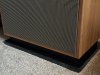
The bottom of a CW is a frame (ie not flat surface) and this combined with my unusually thick carpet and 10lb pad, creates a somewhat of an unstable foundation. This is one (and probably the biggest) reason for this. I can get the speakers completely level and stable.
Additionally, the granite is Absolute Black, which is one of the heaviest and most dense granites. This is a great surface for the speaker to play on as its pretty much inert and does not give into vibrations like the carpet would. This has given (as proof with my listening for two days after) more impact in the mid bass region.
Lastly, the bases have been cut to the exact size of the speaker box. When combined with the recessed base, it gives it almost a pedestal look. Which I really dig.
 
Yes, on the slab
Not attached
Ok, so there are multiple reasons :

The bottom of a CW is a frame (ie not flat surface) and this combined with my unusually thick carpet and 10lb pad, creates a somewhat of an unstable foundation. This is one (and probably the biggest) reason for this. I can get the speakers completely level and stable.
Additionally, the granite is Absolute Black, which is one of the heaviest and most dense granites. This is a great surface for the speaker to play on as its pretty much inert and does not give into vibrations like the carpet would. This has given (as proof with my listening for two days after) more impact in the mid bass region.
Lastly, the bases have been cut to the exact size of the speaker box. When combined with the recessed base, it gives it almost a pedestal look. Which I really dig.
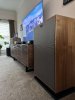
I did exactly the same thing about a month ago with my Cornwall 1 decorators. Check post #936 on Picture from your listening spot right now in Members Systems. My theory was that the speaker would have a solid bearing rather than squishy bearing on the carpet. And with Cornwall riser base, spiking is not really an option. My concern was that since the cabinets are not attached, there may be minute movement between speaker and granite. But so far so good. Funny, mine are Absolute Black as well.
 
Back
Top Bottom