

You are using an out of date browser. It may not display this or other websites correctly.
You should upgrade or use an alternative browser.
You should upgrade or use an alternative browser.
Register to hide this ad

mfrench
Addicted Member
Its a light platter idler. It has everything that the heavy platter models have, with the exception of the light platter and light bearing. Some people like them in stock form. But, Lencos are best noted for their heavy platter decks.
With that said, they are quite easy to convert to a heavy platter deck, if you can access a heavy platter platter and heavy bearing.
My daily driver is such a conversion. Mine is a B51, which is a light platter deck. I converted it to a heavy platter deck. It is a very easy conversion, requiring a dremel and hand drill.
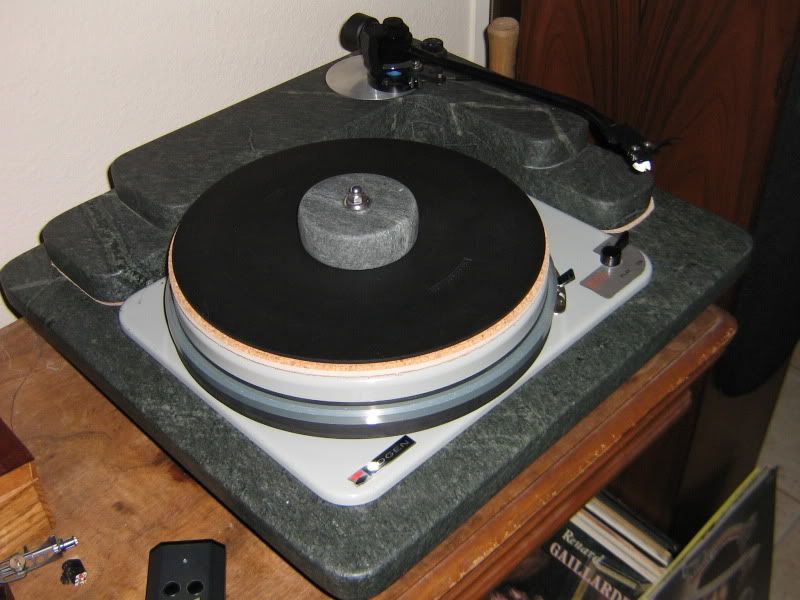
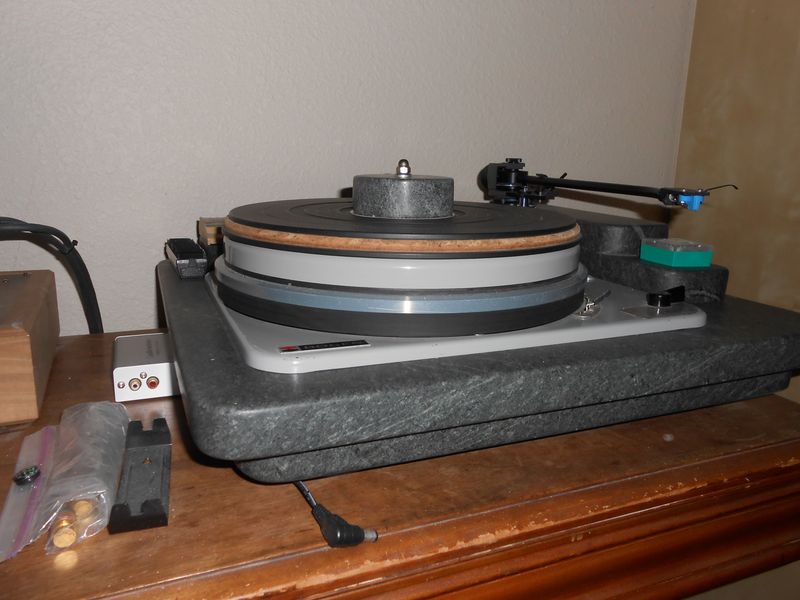
Light to heavy conversion; and what can be done with the light platter versions in conversion:
With that said, they are quite easy to convert to a heavy platter deck, if you can access a heavy platter platter and heavy bearing.
My daily driver is such a conversion. Mine is a B51, which is a light platter deck. I converted it to a heavy platter deck. It is a very easy conversion, requiring a dremel and hand drill.
Light to heavy conversion; and what can be done with the light platter versions in conversion:
mfrench
Addicted Member
The conversion is simple. There are three screw holes that hold either of the light or heavy bearings, and a center hole. You need to grind the center hole just slightly larger (easy job), and elongate grind the screw holes just a little bit; sort of make them oval, rather than round.
This is after the grinding, and refitting of a heavy platter bearing:

The amount of material removed is slight. A set of washers disguises the hole elongations. Yu can see the washers in the above image; those cover the elongated holes. The center hole is left exposed.
The heavy bearing is just slightly larger, and the screw mount holes just slightly wider diameter as well.
This is the heavy bearing. The light bearing is similar, but smaller.

On top of the mounting flange (which seats below the top plate), you can see a ring. You need to enlarge the center hole to fit that larger ring.
The advantage,.... rotational force inertia via added mass. Once to speed, it maintains speed more efficiently. This helps in countering needle drag in thick musical passages. The light platter is around 3.5lbs (forgive me, but its been years since I reviewed the numbers), and the heavy latter is around 8lbs.
A lot of Lenco enthusiasts double the platters to achieve an even greater rotational benefit. Mine is a double-stacked platter, but I used the original platter, with an MDF ring fitted inside of it to add mass.
A big advantage of the L55(B55) is that it already has a metal wheel, whereas the earlier models have a plastic wheel; so that saves you from that added expense. my B51 came with a plastic wheel, which I upgraded to a metal (aluminum) wheel.
The retrofit used to be on the cheap, but, Lencos have become popular in recent years, and the parts harder to find these days. They come up fairly regularly on eBay, and are available at www.lencoheaven.net quite frequently as well ( a better choice, much like BarterTown here at AK).
This is after the grinding, and refitting of a heavy platter bearing:
The amount of material removed is slight. A set of washers disguises the hole elongations. Yu can see the washers in the above image; those cover the elongated holes. The center hole is left exposed.
The heavy bearing is just slightly larger, and the screw mount holes just slightly wider diameter as well.
This is the heavy bearing. The light bearing is similar, but smaller.
On top of the mounting flange (which seats below the top plate), you can see a ring. You need to enlarge the center hole to fit that larger ring.
The advantage,.... rotational force inertia via added mass. Once to speed, it maintains speed more efficiently. This helps in countering needle drag in thick musical passages. The light platter is around 3.5lbs (forgive me, but its been years since I reviewed the numbers), and the heavy latter is around 8lbs.
A lot of Lenco enthusiasts double the platters to achieve an even greater rotational benefit. Mine is a double-stacked platter, but I used the original platter, with an MDF ring fitted inside of it to add mass.
A big advantage of the L55(B55) is that it already has a metal wheel, whereas the earlier models have a plastic wheel; so that saves you from that added expense. my B51 came with a plastic wheel, which I upgraded to a metal (aluminum) wheel.
The retrofit used to be on the cheap, but, Lencos have become popular in recent years, and the parts harder to find these days. They come up fairly regularly on eBay, and are available at www.lencoheaven.net quite frequently as well ( a better choice, much like BarterTown here at AK).
mfrench
Addicted Member
You'd need to get a Lenco heavy platter and its matching bearing.
If you're good at retrofitting, and don't mind seeing the works under the platter, another platter might work; for example, a Presto platter might work, but, I'm straight up guessing (and finding one would be a fairly long and rarified search).
A Lenco wheel runs in a vertical attitude, meaning that the wheel drives the platter from the horizontal underside of the platter, and not the rim. So any platter would need to be machined cleanly on the underside, and not the rim. Lencos are different in this regard, which might limit your choices of useable "other" platters.
Ultimately, I'd suggest finding a Lenco heavy platter and its heavy bearing to do any conversion with. Doing anything else would take an easy hour conversion job and complicate it to an extreme degree, with no guarantee of it working. That hour would be if you took your time, and had a coffee/smoke break mid-way thru it; its a simple conversion.
Here is a thread where a Lenco enthusiast tried to fit a different platter. Its called a Lenco on a Mission.
Its 16 pages long, and, you'll find that it wasn't an easy fit.
http://www.lencoheaven.net/forum/index.php?topic=2250.0
If you're good at retrofitting, and don't mind seeing the works under the platter, another platter might work; for example, a Presto platter might work, but, I'm straight up guessing (and finding one would be a fairly long and rarified search).
A Lenco wheel runs in a vertical attitude, meaning that the wheel drives the platter from the horizontal underside of the platter, and not the rim. So any platter would need to be machined cleanly on the underside, and not the rim. Lencos are different in this regard, which might limit your choices of useable "other" platters.
Ultimately, I'd suggest finding a Lenco heavy platter and its heavy bearing to do any conversion with. Doing anything else would take an easy hour conversion job and complicate it to an extreme degree, with no guarantee of it working. That hour would be if you took your time, and had a coffee/smoke break mid-way thru it; its a simple conversion.
Here is a thread where a Lenco enthusiast tried to fit a different platter. Its called a Lenco on a Mission.
Its 16 pages long, and, you'll find that it wasn't an easy fit.
http://www.lencoheaven.net/forum/index.php?topic=2250.0
mfrench
Addicted Member
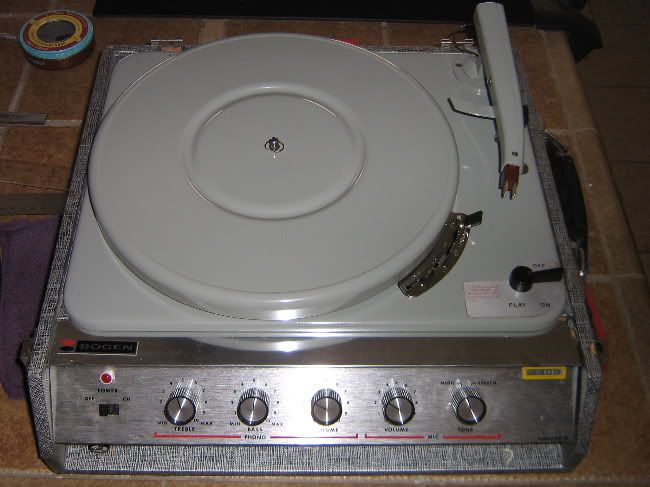
I'm going to guess that you're in Canada (not a far stretch, I reckon). In North America, there was Lenco, and, Bogen-Presto. B-P's were rebadged Lencos; same deck, just carrying the B-P tag. They slightly changed the naming scheme, to include a "B" in some decks, reflecting the Bogen branding. This is not across the board, but, is in many instances. They also changed some of the numbers; as example: A Lenco L70 is also a B-P B62
You will also want to confirm that the deck that you're interested in is a 60hz machine. The Euro decks are 50hz, and the North American decks are 60hz. A 50hz motor will not work properly in N.A., without a spindle modification (another fairly easy mod that we can talk you thru, if necessary).
The 60hz decks are more rare, and will carry a bit more of a price tag as a result.
You will also want to confirm that the deck that you're interested in is a 60hz machine. The Euro decks are 50hz, and the North American decks are 60hz. A 50hz motor will not work properly in N.A., without a spindle modification (another fairly easy mod that we can talk you thru, if necessary).
The 60hz decks are more rare, and will carry a bit more of a price tag as a result.
So I did end up buying the lenco l55s . Been using it as is . But now interested in making the modification . Can't find much as far as heavy platters and heavy bearings . I found one on eBay but they want 50usd for the bearing and 100usd for the platter ! This seems a bit steep does it not ? Does anyone else know we're I could find one ?
Ok so it has been a few years now and I’m ready to make this conversion happen. Just want to make sure these are the right parts.
https://m.ebay.ca/itm/GOLDRING-LENC...bCCP&_nkw=lenco+heavy+bearing&_from=R40&rt=nc
https://m.ebay.ca/itm/GOLDRING-LENC...57.m4084.l1313.TR1.TRC0.A0.H0.Xlenco+hea.TRS0
https://m.ebay.ca/itm/GOLDRING-LENC...bCCP&_nkw=lenco+heavy+bearing&_from=R40&rt=nc
https://m.ebay.ca/itm/GOLDRING-LENC...57.m4084.l1313.TR1.TRC0.A0.H0.Xlenco+hea.TRS0

Patrice B
Super Member
For the combined price of the two parts, maybe you could find an used L75 or L78 in need of work and keep the L55 
Maybe on kijiji or Craigslist?
Myself, I have a light platter (B52) and heavy one (L75). I could not say which one is the best, they are equally good IMHO. Some may have other opinions but your L55 is no slouch!
Maybe on kijiji or Craigslist?
Myself, I have a light platter (B52) and heavy one (L75). I could not say which one is the best, they are equally good IMHO. Some may have other opinions but your L55 is no slouch!


sachu888
Spare the tigers, kill me
Congratulations!! you should yourself get registered at Lencoheaven.net, tons of info there for Lenco. You can post wanted thread there for bearing and platter. You might get it at much lesser price or a complete L75/78 TT.So I did end up buying the lenco l55s . Been using it as is . But now interested in making the modification . Can't find much as far as heavy platters and heavy bearings . I found one on eBay but they want 50usd for the bearing and 100usd for the platter ! This seems a bit steep does it not ? Does anyone else know we're I could find one ?
Regards
Sachin


