• The move to the new server is done. There are some software and database maintenance updates in process. This has us passing the hat around to help out. We appreciate any donations. Seriously, even a dollar helps. The payment page may be found here - https://www.audiokarma.org/support.html

Magnepan MG-IIA Rebuild

When I repair Magnepans, they play nude for a few days or more as I verify that everything that needs to be repaired is repaired. Good to see this project getting done and your opportunity to enjoy the speakers just around the corner.

Thanks for the encouragement Blue Shadow. Indeed we are in the home-stretch.

I probably should have run them nude for a bit to make sure but I went ahead and put everything back together. I did do some bench testing on each panel and was fairly confident that they would not buzz or rattle.

We'll give them some real power tonight and see, I guess.
 
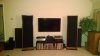
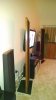
Got everything moved around last evening and ready for an audition. They make the DCM Timeframe-700's look absolutely small by comparison.

They are pushed back against the wall now just to keep them a bit protected from Murray the Wonder Mutt. He seems to have the uncanny knack of knocking over anything. He often will stand in front of the right Dahlquist - I'm convinced just to screw-up the imaging.

Anywho, I will pull them out more into the room so they can breathe this evening. Got a playlist in my head to see how they do. :music:
 

Attachments

  • murray3.jpg
    murray3.jpg
    86.7 KB · Views: 57
  • MG_IIa_1.jpg
    MG_IIa_1.jpg
    41.3 KB · Views: 66
  • mg_iia_3.jpg
    mg_iia_3.jpg
    41.9 KB · Views: 67
Thanks automojo. It was your suggestion to try Xylene that headed me in that direction. Don't know what happened to your original post, but luckily I remembered enough to recall the solvent name!

I agree that the standard Magnepan method of wire attachment seems to work well, but it does take a little practice. Getting a feel for when to do what and how long to let things get tacky comes with experience. I think I could do a much better job next time (and stay tuned... that "next time" may be right around the corner). :smoke:

Glad to help.
Sorry about the last post, as somehow I deleted it.
Xylene won't damage mylar-it's just very toxic and vaporous.
Acetone is bad enough-but nothing like Xylene.
When it gives you a headache after a minute-it's not good.
Glad to hear you got the hang of things-tedious work, but not so difficult.
 
Last edited:
According to the spec sheet of mylar, Xylene is safe to use. I did not notice any ill-effects from the Xylene on my mylar as well. I would use it again if straight Acetone did not remove the crud first. I am real curious if Xylene would have removed the gunk on the first panel - which I think was some type of Epoxy.


That seems to be the case. It is a milky-white when first applied but it does turn a little less opaque as it dries. I don't think it ever becomes totally transparent though (clear).

Great. Looking forward to your review of how they performed.
 
Maggie Audition Results

Lets hear what you think!

Well... first of all, let's get one thing out in the open. I think panel #1 was compromised by all the previous work (butchering) and my attempt to revive it. My gut feeling is that the mylar bonded to the magnets from a previous repair and the additional tape needed to cover pricks and tears has made the panel less "lively". Added to this, I may have been a bit liberal in applying the FastBond adhesive. I had nothing to go by, so I just did what looked reasonable at the time.

The result of this is I have to adjust the right channel output on my amp to give slightly more juice to panel #1 for it to match the sonic output of panel #2. #1 seems to have a slightly less rounded sound that panel #2 also. Not terrible by any means though.

Aside from that.... these things are frickin' awesome! :music::thmbsp:

Bass? No problem. I'm not sure what people are talking about here. They may not go real low, but what is there is room-filling bass everywhere.

Mids? Smooth and juicy. The wife described it as "lush" which I think is very appropriate. I listened to some k.d. lang last night and I would swear she was right there in the room! Put on Tears for Fears, Songs from the Big Chair CD and I heard things I have never heard on that disc before - and I have listened to it many times.

Treble? I think this is the weakest point, but not bad - just takes some getting use to. The highs are there for the most part, just very laid back and... well, "mellow" would be a good description. Given this, I think you could listen to Maggies forever without fatigue. The sound is very natural.

The truly amazing thing to me is how the music is just everywhere. Sure, there is absolutely a sweet-spot that is picky about distance from the wall, toe-in, listening position etc, but anywhere in the room sounds good. In the sweet-spot, they sound great!

I had worried I would not have enough amp to get them to open-up but in all fairness, I don't think they are any more power-hungry than the Dahlquist DQ-10's. Half volume fills the room to a nice full level of sound.

We have a new dog and for weeks I have been sitting on the floor to play with him (keep him occupied) as I listed to music. The Dahlquist were the daily drivers and they sounded fantastic down there. It was almost like near-field listening with Dahlquist! How awesome is that?

Well, with the Maggies, that seated position is horrible. Since the tweeter wire is above ear-level when I am on the floor, the high end is AWOL. Sounds terrible, but the dog will grow out of the puppy stage and I will be back in my normal location on the couch soon enough. Certainly not a knock on the Maggies.

There will be much more auditioning before I pass final judgement, but I think I can safely say that these rank up there with some of the best sounding speakers I have owned.

Happy I did it? Heck yeah. Once I had some success on panel #1, it was down-hill from there. I probably have too much money invested in them to get it back, but I know how to restring Planers now! If the opportunity arises, I can move up the Maggie food-chain with this new-found skill - after all, I still have half-bottle of FastBond left :D

Thanks to all who offered encouragement, advice and support. It was a fun project and even more fun when you have good folks rooting for you!

-Jay

 
Last edited:
Yeaaaaa! Enjoy.
not to get you thinking or anything but is there a chance the difference in sound might be a crossover/cap issue?
 
Well done Reverb! Welcome to the Maggie club.

Thanks Man. I think I will be a life-long member. Damn these things sound nice. "Effortless" is the best way I can describe the sound.

I must admit I was about ready to toss in the towel but you guys kept me going.
 
Yeaaaaa! Enjoy.
not to get you thinking or anything but is there a chance the difference in sound might be a crossover/cap issue?

Thanks Drugolf!

Oddly enough, the right speaker *seems* to be loosening-up some. Is this to be expected? Does a rewire have a break-in period? I wouldn't think so, but who knows? Maybe it's just my imagination (or wishful thinking).

At any rate, you may be correct on the caps. I replaced the electrolytics in each panel but left the polys alone. I got lazy and didn't even check them. Could be one has drifted and is choking the output. Maybe I'll strip them down at some point and revisit this.

Right now I am just going to enjoy :music:
 
The green areas are where the old adhesive is failing.
The golden/reddish areas are fine.
I'm thinking your first speaker was repaired with DAP, acetone won't touch it.
DAP doesn't guarantee the bass wires won't lift, and then your forced to use a much more toxic chemical to remove it.
Or for those, like you who were unaware of the adhesive used- a nightmare.
The stock Magnepan setup works fine IMHO, never has a issue with them lifting, and can be much more easily repaired.
Good job by the way!:thmbsp:

The stock Magnepan method from which year? Personally, I disliked Miloxane and much prefer their new method. I do not think the original problem repair in this particular case was caused by an organo-solvent based contact cement such as Dap Weldwood. I've never seen the application of acetone cause the physical change to Weldwood like was shown here in the above pictures.

To the OP: Great job on the repair. They are great speakers and it's very difficult to find conventional speakers that compare at a reasonable price.
 
Last edited:
Personally, I disliked Miloxane and much prefer their new method.
Care to elaborate? I'm just about to start a re-wire on my MGIIB's

Glenn
 
The stock Magnepan method from which year? Personally, I disliked Miloxane and much prefer their new method.

I curious about the new method also. When I spoke to Magnepan, they led me to believe that Super 77 and Miloxane were still the bonding adhesives used. The only caveat being they have an additive they put in the Miloxane so UV does not break it down as it use to.

I've never seen the application of acetone cause the physical change to Weldwood like was shown here in the above pictures.

To the OP: Great job on the repair. They are great speakers and it's very difficult to find conventional speakers that compare at a reasonable price.

Yeah, man... it was some more nasty stuff~! I don't think it was Weldwood either. My guess (and it is only a guess) is that is was some sort of two-part epoxy.

Thanks for the kind words. I have very much enjoyed listening to them the last few days. I think I am a planar-man for life now.
 
I may have to add some of this to my 3M 30NF:
http://product-finder.basf.com/group/corporate/product-finder/en/brand/TINUVIN
One of our chemists here at work recommended it. Of course you have to guess as to the amount to use.

You can buy it on the big auction site for adding to candle wax to prevent color fading.

Interesting. I didn't think about asking Magnepan what they product they add & how much - they probably would tell you though. Very nice people and super helpful.

Let us know what you decide. You should start a thread for your rebuild once it starts. I would love to follow along!
 
I curious about the new method also. When I spoke to Magnepan, they led me to believe that Super 77 and Miloxane were still the bonding adhesives used. The only caveat being they have an additive they put in the Miloxane so UV does not break it down as it use to.


Yeah, man... it was some more nasty stuff~! I don't think it was Weldwood either. My guess (and it is only a guess) is that is was some sort of two-part epoxy.

Thanks for the kind words. I have very much enjoyed listening to them the last few days. I think I am a planar-man for life now.

I believe they switched in the mid 2000s to the 3M Fastbond water based contact cement, but still use 3m 77 Aerosol to initially hold the wires. I have also found 3M 77 to be failure prone over time.

If you want to know more about adhesives, the following is a great place to start:

Adhesives Technology Handbook, Second Edition Hardcover August 21, 2008
by Arthur H. Landrock & Sina Ebnesajjad

I know it's expensive, but it can usually be found at a university library.

Enjoy the speakers.
 
Personally, I disliked Miloxane and much prefer their new method.
Care to elaborate? I'm just about to start a re-wire on my MGIIB's

Glenn

3M Fastbond is not Milloxane and the 3M product is the current choice. Come to think of it, is Polyurethane Specialties still making Milloxane. Magnepan used Milloxane because it was likely the best choice available 45 years ago. I always thought that Milloxane resulted in too much weight added to the diaphragm; however, I have no data.

The real beauty of Winey's design is the simplicity of the panels and the relatively ease of repair. I'm currently working on some ESLs and they are significantly more complex considering the problems caused by the high voltage on the stators and membrane.

Good luck with your rebuild!
 
Last edited:
I believe they switched in the mid 2000s to the 3M Fastbond water based contact cement, but still use 3m 77 Aerosol to initially hold the wires. I have also found 3M 77 to be failure prone over time.

I agree. That's why I advise not using the 77 at all when doing the rewire, instead use a power supply to energize the wires so they snap into place over the magnets. Then simply apply the Fastbond while they are held in place.

That's how I did my MGIIB, and didn't use any spray glue of any kind. The power supply was $15.
 
Interesting to know bhunter.

I always thought that Milloxane and FastBond 30-NF were one in the same.
 
I agree. That's why I advise not using the 77 at all when doing the rewire, instead use a power supply to energize the wires so they snap into place over the magnets. Then simply apply the Fastbond while they are held in place.

That's how I did my MGIIB, and didn't use any spray glue of any kind. The power supply was $15.

What sort of voltage and amperage are we talking about here, kirk57? I have heard of using this method for the tweeter wire but I don't think I remember reading about doing the bass wire this way. Would be a heck of a lot less messy :yes:
 
Back
Top Bottom