

You are using an out of date browser. It may not display this or other websites correctly.
You should upgrade or use an alternative browser.
You should upgrade or use an alternative browser.

MarantzRefrb
Super Member
You would've had to reset the Bias trimmer values anyhow. But the DC clipping trimmers can be a problem if you don't have a scope.
I seem to vaguely recall there was a voltage setting, and a location, that you could roughly set the clipping values to, if you don't have a scope. If I found it by searching long ago, I'm sure you can too.
I seem to vaguely recall there was a voltage setting, and a location, that you could roughly set the clipping values to, if you don't have a scope. If I found it by searching long ago, I'm sure you can too.
MarantzRefrb
Super Member
Might be worth measuring your old clipping trimmers to see how far apart they are. May just try those values on the new ones. The wrong clipping values can't harm your 2215 like an incorrect Bias trimmer setting potentially could.
Yeah, I think this is the thread: https://audiokarma.org/forums/index.php?threads/marantz-2230-diff-pair-trans.349086/#post-4366599
MarantzRefrb
Super Member
Catrafter, Tom, was and is the Man.
Wow, I'm a bit confused about the trim pots now.
R729 & R730 (for bias adjustment)
- Original schematic: 470 Ohms
- Original part list: 100K Ohms
- Hi-res schematic from the AK database: 100K Ohms, along with a note about there being a mismatch between the original schematic and parts list. (confusingly, the hi-res schematic says the original part list had 470 Ohms, but it listed 100K)
- On my actual receiver: 470 Ohms
(And the exact opposite for R724 and R723)
I also tried checking and adjusting the bias before trying to rebuild the board, and I noticed that if I *barely* adjusted the trimmer, it resulted in huge swings in the bias voltage. So now I'm not sure which one is correct -- do I go with what was actually on the board and original schematic or what's on the "hi res" schematic and original parts list?
R729 & R730 (for bias adjustment)
- Original schematic: 470 Ohms
- Original part list: 100K Ohms
- Hi-res schematic from the AK database: 100K Ohms, along with a note about there being a mismatch between the original schematic and parts list. (confusingly, the hi-res schematic says the original part list had 470 Ohms, but it listed 100K)
- On my actual receiver: 470 Ohms
(And the exact opposite for R724 and R723)
I also tried checking and adjusting the bias before trying to rebuild the board, and I noticed that if I *barely* adjusted the trimmer, it resulted in huge swings in the bias voltage. So now I'm not sure which one is correct -- do I go with what was actually on the board and original schematic or what's on the "hi res" schematic and original parts list?
Last edited:
Looking at your photos from your project, @MarantzRefrb, it looks like R729 and R730 are supposed to be the 470 Ohm pots. This might also explain why my dim-bulb tester lit up when turned on the amp (the varistor is also a possible cause) -- I have the two trimmers swapped on my board.
Last edited:
MarantzRefrb
Super Member
That's the reason I always take pictures of the boards, before and after, and post them here, so I can't possibly mess things up. I still messed it up here and there, and ordered the wrong parts a couple of times. Getting the right trimmers took me a while.
If I'm working on a completely stock amp, I'd reference the Service Manual, but strictly follow the components that were removed physically.
Doing the 2215 parts list took forever because the SM and parts/values were different from the board at times. I always go with the physical, the schematic/parts list/SM could be a different revision.
I choose to only buy/work on ones that haven't been hacked on in the past.
If I'm working on a completely stock amp, I'd reference the Service Manual, but strictly follow the components that were removed physically.
Doing the 2215 parts list took forever because the SM and parts/values were different from the board at times. I always go with the physical, the schematic/parts list/SM could be a different revision.
I choose to only buy/work on ones that haven't been hacked on in the past.
Well, I re-installed the trim pots in the correct spots, soldered in the fixed varistor (I checked it with the diode function on my DMM), found a little solder bridge on the back of the board where some solder must have dripped from the iron, but there still appears to be a short. When I fire it up, the dim-bulb tester goes bright and then dims just a little, and the receiver flickers on and then goes off.
I checked every solder pad and its neighboring solder pads for shorts, checked between various "J" pins, checked for shorts on the output transistors and with the varistors, etc.
I also double-checked the orientation of the transistors and capacitors.
I'm hopefully missing something obvious, but at this point I'm not sure what the next step should be. I'm open to any and all suggestions, including an eye exam.
thanks!
I checked every solder pad and its neighboring solder pads for shorts, checked between various "J" pins, checked for shorts on the output transistors and with the varistors, etc.
I also double-checked the orientation of the transistors and capacitors.
I'm hopefully missing something obvious, but at this point I'm not sure what the next step should be. I'm open to any and all suggestions, including an eye exam.
thanks!
MarantzRefrb
Super Member
What wattage bulb do you have in your DBT?
It’s a variable 30-70-100W bulb. I have some regular 75-watt bulbs on the way.
It worked ok with the dim-bulb tester after I finished the power supply board, and I tested it with another receiver (Kenwood KR-5600), and it worked there — but it also glowed a bit, but not nearly as much.
It worked ok with the dim-bulb tester after I finished the power supply board, and I tested it with another receiver (Kenwood KR-5600), and it worked there — but it also glowed a bit, but not nearly as much.
MarantzRefrb
Super Member
Never seen a variable wattage, incandescent bulb before. Is it set at the highest, or 75W? Fixed wattage, incandescent is the way to go.
If the bulb appears to go dim, that generally means no shorts. It's when the bulb gets brighter and brighter, or never dims, that it's drawing a high amount of current, and indicating a short.
Did you replace the three big caps?
If the bulb appears to go dim, that generally means no shorts. It's when the bulb gets brighter and brighter, or never dims, that it's drawing a high amount of current, and indicating a short.
Did you replace the three big caps?
I think it’s variable in that it can be dimmed maybe. Not sure. There’s no setting on it.Never seen a variable wattage, incandescent bulb before. Is it set at the highest, or 75W? Fixed wattage, incandescent is the way to go.
If the bulb appears to go dim, that generally means no shorts. It's when the bulb gets brighter and brighter, or never dims, that it's drawing a high amount of current, and indicating a short.
Did you replace the three big caps?
It starts out bright and then dims a little, but when it dims the receiver lights also turn off.
I did replace the big caps.
Attachments
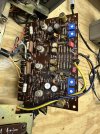
MarantzRefrb
Super Member
If you're still concerned something could be wrong, like the direction of a cap, or the orientation of a replacement transistor's collector leg being in the wrong spot - I'd wait for the true 75W incandescent bulb, for insurance.
I've had it happen to me that powering the amp on a DBT with too small of a wattage bulb, 60W with a 2275 specifically, limited the current so much I couldn't supply the correct current to the 2275 to operate correctly. Once I took the DBT out, it ran like it was supposed to. 100W bulb was much better with 2275 and below.
I've had it happen to me that powering the amp on a DBT with too small of a wattage bulb, 60W with a 2275 specifically, limited the current so much I couldn't supply the correct current to the 2275 to operate correctly. Once I took the DBT out, it ran like it was supposed to. 100W bulb was much better with 2275 and below.
Thanks, that’s good to know. I’ve certainly been tempted to test without the DBT, but it looks like my regular 75W bulbs arrive tomorrow.If you're still concerned something could be wrong, like the direction of a cap, or the orientation of a replacement transistor's collector leg being in the wrong spot - I'd wait for the true 75W incandescent bulb, for insurance.
I've had it happen to me that powering the amp on a DBT with too small of a wattage bulb, 60W with a 2275 specifically, limited the current so much I couldn't supply the correct current to the 2275 to operate correctly. Once I took the DBT out, it ran like it was supposed to.
The bulb I have now is a G.E. 97784 fwiw
MarantzRefrb
Super Member
If it were in 30W mode, that GE bulb, you'd get that symptom you're describing, as your 2215 transformer is at least 30W RMS, probably more.
The 75W fixed watt bulb should provide the proof you want.
The 75W fixed watt bulb should provide the proof you want.

I can' tell from the photo, but did you verify that the replacement transistors are installed with the correct leads connected. Some look like they are twisted to install. Please list the H# and replacement transistor for each that you changed. I apologize if you already listed it earlier in the thread.
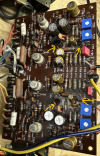
Sure, I'll do that in a bit. I carefully checked the pinouts and made sure the pins were in the right holes, which did require some twisting. I'll get some better pictures too.I can' tell from the photo, but did you verify that the replacement transistors are installed with the correct leads connected. Some look like they are twisted to install. Please list the H# and replacement transistor for each that you changed. I apologize if you already listed it earlier in the thread.
View attachment 2985798