• The move to the new server is done. There are some software and database maintenance updates in process. This has us passing the hat around to help out. We appreciate any donations. Seriously, even a dollar helps. The payment page may be found here - https://www.audiokarma.org/support.html

Micro Seiki owner's club

Ah, gotcha.

I haven’t done much with model kits honestly. More with HO trains with my son. And there it’s more “aftermarket” enhancements such as new decals or rails etc.

But back in the day I did a lot of model building. image.jpg
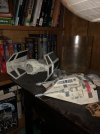
Vader’s TIE actually won me an “out of box” award- no kit bashing, just paint and other details but nothing added that wasn’t in the box. Snow speeder I detailed to match Luke’s from Empire freeze framing the movie (spoiler: it’s not consistent throughout the scene)

Then Mopar muscle:
image.jpg

I have two box boxes of partially built and sealed model kits…
 
Nice models j!m, I like the weathering on the Snowspeeder a lot.

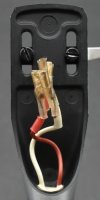
Hi all, what’s the proper way to wire an H-808X headshell to a cart? I’ve never dealt with one like this, with two wires and then two smaller wires extending from those. Thanks!
 
These use coaxial wires. The inner is signal and outer is shield. From memory, right is red and left is white but it can be confirmed via balance control or removing a mono amp on one channel.

So the inner would go to your positive cartridge output for the channel and shield to the negative. And then same for the other side.

I use these exclusively and although I like it, I think it makes much more sense to run twisted pairs for each channel in a fully balanced configuration, not unlike a microphone.
 
IMG_4487.jpeg
Solid wire is “positive” and the adjacent uncovered/bare wire is the shield. This should be easy to see…
 
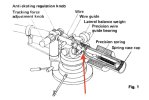
I have a question about the MA-505 tonearm,
specifically about the "Precision wire guid bearing"

You see I was changing the tungsten-wire in a one of these tone arms, and I noticed this piece does not move at all;
does anyone know if that is correct?
The piece in question is a little roller that looks as if it's made from neoprene.
Is this roller supposed to roll?
or is it's job to remain fixed?

Anyone happen to have experience with these?

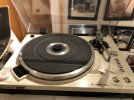
[ The tonearm in question is part of a DD-40 turntable ]

ma-505-wire-bearing.jpg
 
First, where did you find a replacement wire? I’ve never seen one for sale.

As to the roller, it may be rubber, or plastic. Rubber would make sense as the movement is very small here and it would dampen the vibration of the wire.

I don’t know if it is supposed to turn, and I’m not sure it could be changed without damaging the arm. Pretty sure the wire is fed through and attached at the spring. An analytical balance is needed to set the scale on the roller accurately. I found mine tracked incredibly well until it was near the top of the scale, where it started to read heavier than the setting. But it was impressive since it was never apart since it was made.
 
Thinking about it more, in order for the ring to rotate on the shaft there needs to be clearance. With clearance comes the possibility of vibration.

I say it was never intended to move and the label is due to the marketing department.
 
Thinking about it more, in order for the ring to rotate on the shaft there needs to be clearance. With clearance comes the possibility of vibration.

I say it was never intended to move and the label is due to the marketing department.

Hi, thanks for the response j!m;

I took the wire off of my other MA-505
– I'm going to DIY the replacement for that one: planning 0.1mm tungsten wire and conventional electronics solder for the ends.

Regarding the "guide bearing";
it is a conundrum.
Having it fixed against any vibration is a good argument,
but the anti-skate on this arm seems to be behaving a bit odd, and I'm wondering if it's not having something to do that.
 
If you are running a modern hyper-elliptical cartridge, you can't get enough anti-skate out of the arm, especially if you are running tracking force near (or above) 2g.

I can get a barely acceptable condition running a V15-V (0.75-1.5g tracking force) at "full blast" anti-skate. These high-contact shapes really weren't a thing in the 70's- more surface area creates more skate, and therefore more anti-skate is needed. The MA-505 is a fantastic arm but was designed before these shapes were big. Spherical styli were still the norm. I believe the Shure V15 series are such a good match to the MA-505 because of the low tracking force and that effect on anti-skate requirements rather than the (more typical) compliance pairing of cartridge and arm. But I haven't done extensive testing other than noting these old tables/arms need a LOT more anti-skate than they were capable of providing for "fancy" cartridges.

On a Kenwood turntable I restored, I made a new anti-skate weight of brass to replace the original aluminum one. And that was for a simple AT VM95 ML cartridge. It needed to be significantly heavier to provide enough anti-skate for that stylus. The pre-testing involved taping a nickel to the anti-skate arm to get the inner groove sibilance acceptable. I transferred that mass to brass and made a new weight for the arm.

Here's the 'table with the original aluminum weight, as I was trying to figure out where the problem actually resided...

JLJE5874.JPG
 
You can just see the brass weight here. This is me wringing every last bit of performance out of this tab


Ah yes, I see,
perhaps adding to the counter-balance weight will help (with the heavier tracking force).
The main problem I notice was when lowering the arm, it skates to the left just before touching the record : |


But so,
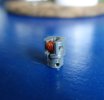
here is the guide-bearing,
poor thing – it wants to move but was kind of jammed up against the housing – and could use some oil.

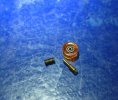
The wheel has a ballbearing and is held in place with a brass screw - axel - sleeve kind of a thing.


guide-bearing-1-DSC02067.jpegguide-bearing-DSC02071.jpeg
 
Wow! I am very surprised they put a roller bearing in there! If anything, I’d expect a sintered bronze bushing.

Some thought has to go into the lubricant used here. Dry it may rattle. Too heavy it won’t turn freely. Too light it may run out.

Maybe some clock oil, such as Moebius 8000, which is easy to get. Their synthetics are harder to get and more costly.

After oiling, I’d let it sit overnight and see how much migration you get.
 
After oiling, I’d let it sit overnight and see how much migration you get.


I do have some moebius 8000 yes;
but I'm thinking to use some Etsyntha 992 (clock-oil) on this – as it's (mostly?) synthetic and friendly to bearings;

And I might just use that for the vertical bearings on the tone arm also - since I've had to open those to get to the guidebearing anyway.
 
I used 9010 on the arm bearings. Mine were loose ball and preloaded by the conical needle. That counterbalance shaft on mine was bent, so I had to take it apart to straighten it. I was surprised they had balls here too- I was expecting a ruby. But there is a lot more motion here than against that wire.
 
Back in service,
smooth as silk : )

I was planning to sell this deck,
but having some second thoughts on that.
 

Attachments

  • DSC01861.JPG
    DSC01861.JPG
    68.6 KB · Views: 28
Congratulations. You’ve taken apart the MA-505 arm more than anyone else I’ve seen. How did you do it please?
 
That's some really nice veneer on there... Was it redone at some point?

It's the original; but yeah it's really in quite good shape.


Congratulations. You’ve taken apart the MA-505 arm more than anyone else I’ve seen. How did you do it please?

Ah not so much, but thanks : )

It was done with a lot of care – and a good quality watchmaker's screwdriver set also.

After removing the wire, I only removed the spring-case really;
For that it's just 3 relatively big screw-bolts, but accessing those requires removal of those conical-needles that the vertical bearings pivot on;

After applying some acetone, I removed the pivots with an improvised 2-pin screwdriver;
The holes are 1mm
I keep a collection of broken HSS drill-bits of various sizes, always handy for this kind of thing;
actually for this one I used some spare screwdriver bits, a little smaller than 1mm; and held them with a vice-grip. That was for one side,
the other side (with the counterweight) I opened with a flat screwdriver since the end of the shaft allows for that.

In the spring-case there's the piece holding the wire guide-bearing, that is held with a screw-bolt on the underside
There are also some (2mm) tapped holes on the side of the spring-case;
I found only one set-screw there,
my other MA-505 has two – so I guess the idea is to have both (?)
 
Looking at your parts above, as I've not disassembled the balance spring stuff, only the arm pivot, I'd say one screw, with the axle, comes in from one side and the other screw work together to set the wheel at the "right" position within the tube.

And., thinking further, I bet you could allow higher anti-skate by pushing the wheel as far as possible to one side, to add a bit more adjustment range to the original anti-skate wire offset adjustment up top.

But you probably can't move it much before the wheel fouls on the inner tube wall.
 
Back
Top Bottom