• The move to the new server is done. There are some software and database maintenance updates in process. This has us passing the hat around to help out. We appreciate any donations. Seriously, even a dollar helps. The payment page may be found here - https://www.audiokarma.org/support.html

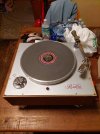
N.O.S. Rek O Kut B12H

Parts are starting to arrive for the build. Motor mounts and an arm. The arm is missing pieces but looks new. I need to find the mounting/pal nut, side bob weight and armrest. A head shell is on the way. An early stereo head shell I hope will fit the later production arm. Anyone who has parts please chime in.
If I recall correctly the Stereo ROK MicroPoise headshell stayed the same up to the last ROK MicroPoise arms built by Broadcast Electronics in 1992. If anyone here knows otherwise, let me know. The S-330 and it's 16" variant stayed in production many years, through several ROK owners. If I recall correctly, the bob weight was for the Omni Balance system. Armrests if I recall correctly stayed unchanged from mono models through the last MicroPoise models made. Best wishes on your ROK B12H build.
 
If I recall correctly the Stereo ROK MicroPoise headshell stayed the same up to the last ROK MicroPoise arms built by Broadcast Electronics in 1992
This is what I have gleamed also. The arm is from 1988 made by Broadcast Electronics. Does anyone know the thread size for the nut that holds the arm base to the table? I am missing that also.
 
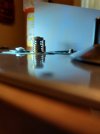
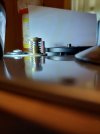
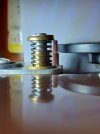
Some progress on the build. The Teflon washers arrived. Played with the height of the idler on the contact point of spindle. Pictures below.
 

Attachments

  • Aligning idler to spindle (4).jpg
    Aligning idler to spindle (4).jpg
    109.5 KB · Views: 36
  • 78rpmAligning idler to spindle (3).jpg
    78rpmAligning idler to spindle (3).jpg
    51.2 KB · Views: 37
  • 45rpmAligning idler to spindle (1).jpg
    45rpmAligning idler to spindle (1).jpg
    55.2 KB · Views: 35
  • 33rpmAligning idler to spindle (2).jpg
    33rpmAligning idler to spindle (2).jpg
    60.7 KB · Views: 36
I'm interested to see that two of the three grommets have washers above them. That may give more ability to adjust speed/position on the pulley than without them. I may try the arrangement with my belt drive ROKs, which have a pretty limited amount of adjustment possible.
Break in wear (5).jpg

Assuming you're talking about these washers?
Could you explain why this would offer more range in setting the speed? I don't see how they could be connected. I don't doubt your theory I'd just like to understand it because I have some ROKs that I can't get to run at the right speed.

For the record I'm only talking about hysteresis models trying-- to get the death cube to run the right speed is a conversation I've permanently exited.


Enjoying this thread!~
 
Assuming you're talking about these washers?
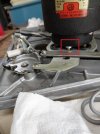
The washers are under the idler. The fiber washer under it was replaced with the Teflon washers. This screw on the motor plate adjusts the angle of the spindle to idler. Red indicates the screw.
 

Attachments

  • Disassembly for bushes (19).jpg
    Disassembly for bushes (19).jpg
    112 KB · Views: 16
  • Disassembly for bushes (4).jpg
    Disassembly for bushes (4).jpg
    105 KB · Views: 16
The red arrow is where the Teflon washers go.
 

Attachments

  • Break in wear (5).jpg
    Break in wear (5).jpg
    132.8 KB · Views: 7
I'm talking about the steel washers above the grommets. They have to raise one side of the motor higher than the other, which gives more adjustment range than without them - my thinking is that changing the angle both tilts the pulley further out than the horizontal adjustment that is provided in the belt drives, but it probably changes where on the pulley the belt rides - the two factors may cancel each other out, but also might not not.
 
There are four spacers between the motor and the ferules of the mounts. The two washers are also on the ferules of the mounts. Do you have a belt driven ROK? This one has an idler wheel. This is what I shimmed to align the wheel to spindle contact.
I'm talking about the steel washers above the grommets.
 
When people think of ROK, they assume idler drive, but they did make some belt drive tables, but unlike some belt drives that use small motors and relatively light platters, the ROKs used the same motors and what looks like almost same platters, so they are pretty beefy.
 
I love ROK belt drives! Thanks for clarifying, I've never noticed that screw before or considered the washers on the motor mounts as impacting speed. Clearly there is more experimenting to do.

I'm enjoying this thread, keep up the work!
 
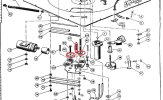
My theory on the screw and washer above the mounts. If the rubber fails completely they will keep the motor from dropping out. Early Chevy small blocks would jump around if the mounts /rubber failed. A temporary fix was a cable from the "A" arm to the block. Later revisions added a metal bracket to rubber mount. The items are highlighted in red below.
 

Attachments

  • view of parts.jpg
    view of parts.jpg
    100.9 KB · Views: 10
My theory on the screw and washer above the mounts. If the rubber fails completely they will keep the motor from dropping out. Early Chevy small blocks would jump around if the mounts /rubber failed. A temporary fix was a cable from the "A" arm to the block. Later revisions added a metal bracket to rubber mount. The items are highlighted in red below.
This is a plausible and interesting theory ... I love these tables and am enjoying hearing your discoveries unpacking a brand new one.
 
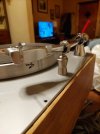
Parts are arriving for the build. The nut for the tonearm base is here. The tonearm was missing the arm stand. A trip to the hardware store got me a knob and key hook. Here is the result of my "Frankstand".
 

Attachments

  • Making an arm stand (5).jpg
    Making an arm stand (5).jpg
    122.2 KB · Views: 42
  • Arm and stand on (1).jpg
    Arm and stand on (1).jpg
    116.7 KB · Views: 42
  • Arm and stand on (2).jpg
    Arm and stand on (2).jpg
    66.6 KB · Views: 42
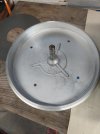
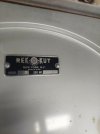
No date I can discern.
 

Attachments

  • Platter.jpg
    Platter.jpg
    102.9 KB · Views: 13
  • Serial number (2).jpg
    Serial number (2).jpg
    62.5 KB · Views: 13
That's too bad. The ones I've restored were stamped but perhaps they are older. Hopefully someone can decode s/n for you. Great table. You'll enjoy when it's completed.
 
Just checking my older TR12H and TR43H platter, they don’t have any dates on the underside, they are mid to late 50s ….unfortunately there’s not a Rondine here anymore and no photos of the underside of my early Rondine Deluxe. However it’s known that early Rondine Deluxe had a larger size idler shaft, that information (shaft size) is probably listed somewhere in the giant ROK thread ;)
 
Back
Top Bottom