• The move to the new server is done. There are some software and database maintenance updates in process. This has us passing the hat around to help out. We appreciate any donations. Seriously, even a dollar helps. The payment page may be found here - https://www.audiokarma.org/support.html

NAD 1300 Recap/Restoration

If somebody has the time for experimenting than in theory replacing the 20V zeners in regulated PS with some lower voltage type (15-17V) could bring down the supply voltage for opamps and allow using more accessible modern opamps. Not sure what it would do with the rest of the circuit.
 
If somebody has the time for experimenting than in theory replacing the 20V zeners in regulated PS with some lower voltage type (15-17V) could bring down the supply voltage for opamps and allow using more accessible modern opamps. Not sure what it would do with the rest of the circuit.
Hello and thank you for documenting your recap. I just picked up a NAD 1300 with the intent to recap as well. I hope you don't mind, I will be using your experiences to help guide me through this process. i have just opened up the case case cleaned off a whole bunch of gunk off the solder side of the main board, also did a quick touch up of some weak looking solder joints. I recapped an 1155 about a year ago and I have to say the build quality severely dropped on the 1300. Most of the components are crooked, assembly glue all over the place, and some very sketchy soldering. I have a hum on the Phono input as well, other than that it sounds quite dull. I am hopeful I can get some decent sound out of it.
 
Go for it :).

My NAD1300 is still in my main setup and I still like it the sound.

Let us know about your progress and also make some photos if you can (in your own thread or here if you like).
 
Go for it :).

My NAD1300 is still in my main setup and I still like it the sound.

Let us know about your progress and also make some photos if you can (in your own thread or here if you like).
Nearly finished with recap. I have about a half dozen caps that I have to order, I always seem to miss a few. I still have considerable noise on the phono. Did you ever work that out? Mine sounds like 60 cycle hum with some type of steady static. I have only replaced electrolytics, let me know if there were any additional components you replaced. Thanks.
 
No additional components. Just e-lytics and cold solder joints. I have also resoldered nad cleaned all RCA connectors and cleaned the phono switches.

Ensure following following precautions when examining phono hum:

- put all metal covers on
- switch it do MM mode
- check the hum with phono inputs shorted
- check the hum with TT cartridge connected (switched to whatever cartridge type you have)
 
I put the bottom cover on loosely, most of the noise went away. I guess I'll just wait till I get the rest of the caps, reassemble, and see how it works out. This is my third recap of a preamp, I was able to run the other two without covers, with out noise. Thanks again, I really appreciate the help.
 
Yep, I have run in the same "pitfall", phono circuit on this unit is very sensitive to the "cover" presence.

Two widely known recommendations, which were applied also in my unit:

- put 105 degree caps in places where they are more thermally stressed (PSU in this unit)
- use "audio" caps in the signal path (I have used Nichicon KA and Nichicon Muse BP)

This units sound will be improved significantly also with regular caps, because the originals aged so badly, but you can help it a little bit more if you want.
 
Last edited:
I also find it useful to replace the ceramic caps, either with WIMA FKP or Panasonic polyprop or MLCC (NP0) ceramics depending on value, size and location
 
I also find it useful to replace the ceramic caps, either with WIMA FKP or Panasonic polyprop or MLCC (NP0) ceramics depending on value, size and location
I like to do that as well. Unfortunately, the components are so crowded together, I've had to make my choices based on size. I was able to shoehorn in a few Elna Simlac II's, but it's mostly Nichicon UFW's I'm putting in. Order from Digikey arriving tomorrow with the last of the electrolytics, will post some pics.
 
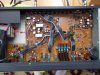
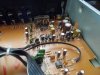
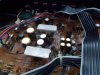
OK, recap complete! Noise in phono section is gone, of course it was the last two caps I was waiting for today, those 1000mf 10v. Sounds quite good, going to run it in awhile. Let me know what else you might replace.
 

Attachments

  • NAD 1300 recap.JPG
    NAD 1300 recap.JPG
    120.3 KB · Views: 99
  • NAD 1300 phono recap.JPG
    NAD 1300 phono recap.JPG
    101.7 KB · Views: 95
  • NAD 1300 power recap.JPG
    NAD 1300 power recap.JPG
    98.4 KB · Views: 94
Hi, congratulations.

It needs to play couple of hours, at least by my unit the sound changed a little to the better after some play time.

I see that you used "audio" caps also on positions that do not benefit from so much. But it does no real harm, so why not :). Only additional thing that was changed on my unit was relay (the original one is not sealed).

My pragmatic recommendation is to take a break and listen to it for couple of weeks. If you like the sound, let it be and enjoy the results of relatively inexpensive restoration.

If you want to have something on bench, recap also the power amp (NAD 2600PE) if you did not already.

 
Last edited:
Hi, congratulations.

It needs to play couple of hours, at least by my unit the sound change a little to the better after some play time.

I see that you used "audio" caps also on positions that do not benefit from so much. But it does no real harm, so why not :). Only additional thing that was changed on my unit was relay (the original one is not sealed).

My pragmatic recommendation is to take a break and listen to it for couple of weeks. If you like the sound, let it be and enjoy the results of relatively inexpensive restoration.

If you want to have something on bench, recap also the power amp (NAD 2600PE) if you did not already.
The 2600 PE is next on the list. I have already recapped the input board and upgraded the opamps. I am working on getting a Sansui 771 up and running to use while I recap the 2600.
 
Hi, congratulations.

It needs to play couple of hours, at least by my unit the sound changed a little to the better after some play time.

I see that you used "audio" caps also on positions that do not benefit from so much. But it does no real harm, so why not :). Only additional thing that was changed on my unit was relay (the original one is not sealed).

My pragmatic recommendation is to take a break and listen to it for couple of weeks. If you like the sound, let it be and enjoy the results of relatively inexpensive restoration.

If you want to have something on bench, recap also the power amp (NAD 2600PE) if you did not already.
I have noticed that Q601 and Q602 are seriously hot. Just wondering if you had experienced the same. These are the TO-126 with the tiny heatsinks on them.
 
OK, recap complete! Noise in phono section is gone, of course it was the last two caps I was waiting for today, those 1000mf 10v. Sounds quite good, going to run it in awhile. Let me know what else you might replace

+1 on the earlier mention of UES, UKW, UFW, UKA, RFS caps. They are all among my favorite electrolytics to use as well, and consistently sound good.

It looks like it's sounding pretty great now. If you wanted to keep improving the sound, I'd look at replacing all the single-layer ceramic disc capacitors with the potted, polypropylene box caps. Then, mylars could be improved in the same way, but between replacing the ceramics and mylars, you are likelier to hear more benefit from replacing the ceramics. There are other very good cap materials which can be used besides mkp, fkp etc.. but they may be more expensive, vintage, or harder to find. pps, pio, mkc, polystyrene also sound very very good in these small values. Good luck with the project.
 
+1 on the earlier mention of UES, UKW, UFW, UKA, RFS caps. They are all among my favorite electrolytics to use as well, and consistently sound good.

It looks like it's sounding pretty great now. If you wanted to keep improving the sound, I'd look at replacing all the single-layer ceramic disc capacitors with the potted, polypropylene box caps. Then, mylars could be improved in the same way, but between replacing the ceramics and mylars, you are likelier to hear more benefit from replacing the ceramics. There are other very good cap materials which can be used besides mkp, fkp etc.. but they may be more expensive, vintage, or harder to find. pps, pio, mkc, polystyrene also sound very very good in these small values. Good luck with the project.
The problem I've run into with replacing ceramics is size. Wimas are usually way to big and sometimes even Kemets are too large. What would you recommend for these cases where size matters? BTW, the 1300 is sounding very nice now and I may want to keep it to replace the Adcom I'm presently using.
 
Well, you can always upgrade them all to the multi-layer ceramic COG/NP0 types which are quite small and an improvement to single-layer type.

Depending on the voltage ratings of your small value single-layer ceramics, the polypropylene potted types are generally reasonably small up to 63-100V. Any voltage ratings larger than this and they start getting quite big (if you don't have the available space for them). Sometimes you can mount them on the underside of pcbs if there isn't the space for them up above.

PPS caps are generally quite small and suitable, but may be hard to find in the sizes you need (at least from Digikey) although I haven't tried Mouser- they might have some. Otherwise the MLCCs are a solid choice for general improvement and quite small.

Another quick and dirty upgrade for an amp or receiver is to look at any diodes in the rectifier. Look up specs on what it has, and if they're rated as "standard-recovery", they can be upgraded to the "ultra-fast" type, just make sure to replace with the same exact specifications as your originals, but look for the faster recovery time. This has greatly enhanced performance in noticeable ways every time I've done this to a piece of equipment.
 
+1 on the diodes- using UF types reduces the contribution of the power supply to any distortion- and yes this is something I do on most all units. The WIMA FKP caps are ideal, and Mouser are my main source.
 
@Audiobro Q601 and Q602 are regulated supply pass devices, expected to run hot. You can renew the thermal compound or fit in bigger heatsinks if you like.

I am curious myself about the improvements mentioned above (more caps replacemnt, fast diodes, ...), my guess is that the sound improvement will be maybe noticable but not so significant. With high risk of "confirmation bias" error since you do not have two equal units to compare and you will compare to your memory "sound" after a lot of work.

Regarding the faster diodes, If i understand it right, the power supply in this preamp is pretty well filtered and regulated. So again the improvement should be not very big if any.

Just my 2c.
 
I like to figure out where corners were cut in the original part selection process, whether it was to save on on production costs, or because better materials simply didn't exist at the time of manufacture. Units are built to a price point and can almost always be improved upon in meaningful ways when given the attention they deserve which would've made them more expensive (and more marketable as "higher-end") to begin with.

It can be taken as far as one wants. I always keep it simple just be focusing on a few types of component material swaps. For instance, I rarely mess with replacing carbon film resistors to higher tolerance metal film, but I could, and improvements could be heard here as well if a colder, more exacting sound was preferred.

I found focusing on things like getting rid of those single-layer ceramic discs (not in a tuner section) should practically be a first order of business and replaced with higher quality films.
Same goes for all those "1Nxxxx" diodes (and others) replaced with their direct "'UFxxxx" equivalents. Even though current technically stays the same, by improving recovery speed, you increase the ability of the music to hit harder and faster, which shows up as increased dynamic range and headroom, which gives the impression of higher current. The faster that same current is able to recover to a specified value, the more current it sounds like it actually has.

This same effect (to some extent) can also be experienced by keeping capacitance the same, and increasing voltage ratings (and thus available LF/HF ripple current) more than a few times over on power filter supply capacitors. They would almost always be physically bigger than their (original) lower voltage counterparts and have a higher capacity or increased ability (not actual capacitance value per se), to store/ release that same amount of energy which can lead to the earlier onset of HF clipping/sibilance/listener fatigue (at volume) if you, let's say, were to replace two main 10,000uf 16V power filter caps with two 10,000uf 80V ones.

The opposite of "let's swap this out" is when I see old polystyrenes in vintage equipment. They should never be removed unless you suspect they're heat-damaged, as they are just about the best caps I've heard in any vintage equipment I've come across and extremely hard to surpass and improve upon. They are highly detailed and natural sounding, I would describe them as that old, vintage HiFi sound at its best. Many/most cheap polypropylene caps are not going to improve upon them and seem to have the effect of "smoothing" the signal a little at the expense of losing a bit of detail.
 
I am the original owner of a 1300 I bought back in 1988, it was used sparingly for a while, and it has been in storage for almost 2 decades. I came across this article and decided to check the condition of the amp as I have planned to put it back in service in the spring. The condition of my caps was exactly as what thoresui had described, with the exception of the two largest filter caps, every one of the YEC cap only has 1/2 or 2/3 of the stated value, and ESR are up in the 10's of ohms. The two large filter caps are still in spec, interestingly, the degradation in the other caps are fairly uniform across each capacitance value, as it they all degrade uniformly over time (or never in spec to begin with).

All the Rubicon caps are spot on in all values.

I used Nichicon UKZ caps to replace all the YECs, it required some shoehorning as the larger UKZs are quite a bit larger than the YECs. Although I had planned and purchased all the necessary caps, I had to leave the Rubicon caps in place as the UKZs are physically too large to fit.

After recapping the amp, I powered it up, CD/Video/Tuner inputs are absolutely silent at even the highest level. On the phono, I get some hiss when it turned it passed 12 o'clock, but no hum. The amp sounds good and performed flawlessly.

Incidentally, I also have a Kenwood KA-52B I bought back in college, it was a cheap amp just to power a set of speakers in the dorm. I also plan to recap it, when I opened it up, I found all the caps are ELNA caps, it would be interesting to see how this much cheaper and even older amp holds up against the NAD.

So the odd is if you own an original 1300, the YEC caps are all shot and you should really look into recapping.
 
Back
Top Bottom