• The move to the new server is done. There are some software and database maintenance updates in process. This has us passing the hat around to help out. We appreciate any donations. Seriously, even a dollar helps. The payment page may be found here - https://www.audiokarma.org/support.html

Need 3-way Crossovers.

John Carr

Active Member
I just recently finished building some custom speakers, but i only had a 2-way crossover on hand to try them out. I have done a fair amount of research trying to find some quality passive 3-way crossover units.I have spent a good amount of money on other parts and am limiting myself to not spend over $60 for the both of them. Does anyone know a good source or have a suggestion?
 
Register to hide this ad
If as shared you've "spent a good amount of money on other parts", you may want to revisit your logic of "not to spend over $60" for Xovers.

Just to keep all components in equal quality.


Just sayin'.


Q
 
If you're speakers are custom made, then you'll need custom crossovers to match each driver. An off the shelf crossover would most likely be a bad match for the speakers.
Ok. That's good, but where is a good site to buy the specific capacitors?
 
If as shared you've "spent a good amount of money on other parts", you may want to revisit your logic of "not to spend over $60" for Xovers.

Just to keep all components in equal quality.


Just sayin'.


Q
I agree. I was just trying to say that I am budgeted.
 
I agree. I was just trying to say that I am budgeted.


Are you thinking a no-name or a product well known? This could be the most expensive link in your speakers. $60, I don't think will buy much for what you are looking for esp to keep them inline with what you've built.

Q
 
Last edited:
Are you thinking a no-name or a product well known? This could be the most expensive link in your speakers. $60, I don't think will buy much for what you are looking for esp to keep them inline with what you've built.

Q
I am leaning towards building my own crossover, so that it will fit my speakers better.
 
If you've never designed or built a crossover before, you are probably biting off more than you can chew. A two-way crossover is difficult enough. A three-way even more difficult. Crossover components, especially inductors, can get pretty pricy. A woofer circuit could require a 3 or 5 mH inductor. Those would run $30 or $40 each. If you're on a budget, crossover components for a pair of 3way crossovers could easily run $300. In any case, a crossover has to be designed for your specific set of speakers. An off the shelf one simply won't do.
 
I'm wondering if this particular custom system would even need a large woofer filter inductor.

Consider this woofer is designed to be a subwoofer with frequency response rated only up to 350 Hz -- suggesting a fair degree of roll-off above that. Also consider all the highly regarded classic speakers having no woofer filter at all. I'm thinking some EPI models, some Boston Acoustics, big RTR's etc. Others equally well regarded have but a small inductor for the woofer; 2-way KLH 6 and 3-way AR 3 for example use a 0.4mH series inductor -- probably about a $4.00 Madisound item.

Appears that Jensen has published neither FR nor impedance plots for J12W. Though perhaps if the OP has an opportunity to measure an output sweep of woofer alone, it might be determined if there's enough energy beyond the target crossover frequency to need any low pass filter.
 
I suppose a stupid question but, why not go with an active crossover? This way, when you (with a passive) decide that you have a wrong part, you can simply dial in an adjustment verses having to pay for more parts as you figure it out.

Genuine speaker companies have things like engineers, software, anechoic chambers to test things.... Just seems to me an active hands you MANY crossover parts because of its adjustability rather than trying to figure it out piecemeal.

Yeah, you need another amp or two... so I get that part too. (I use an active).
 
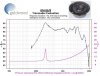
Goldwood has published some data for the 5¼" mid (not a mere speaker -- it's a "transcuder")

GM-858 graph.jpg

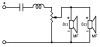
I wonder if this can be trusted enough as a place to start. How about a basic cap and coil band-pass filter based on this data? Roll off high pass from about 700Hz (Z ≈ 3.8Ω) to pull down that peak at 450Hz -- maybe 60µF? And if taken out to about 7000Hz (Z ≈ 7Ω) 0.15mH might work on the low pass side. Could look like this:

Mid bandpass.png

With expected 6dB gain from two of these in parallel the mids might run hot and need attenuation. Could be series resistor or potentiometer, fixed L-pad or even a variable L-pad.

With a potentiometer wired as a voltage divider it looks a lot like an AR-3 midrange filter.

level-pot.png

Though an L-pad offers impedance stability and using a dual gang item would make it special

level-L-pad.png

Looks easy on paper. What could go wrong? ;)
 
I'm wondering if this particular custom system would even need a large woofer filter inductor.

Consider this woofer is designed to be a subwoofer with frequency response rated only up to 350 Hz -- suggesting a fair degree of roll-off above that. Also consider all the highly regarded classic speakers having no woofer filter at all. I'm thinking some EPI models, some Boston Acoustics, big RTR's etc. Others equally well regarded have but a small inductor for the woofer; 2-way KLH 6 and 3-way AR 3 for example use a 0.4mH series inductor -- probably about a $4.00 Madisound item.

Appears that Jensen has published neither FR nor impedance plots for J12W. Though perhaps if the OP has an opportunity to measure an output sweep of woofer alone, it might be determined if there's enough energy beyond the target crossover frequency to need any low pass filter.
The woofer actually goes quite a bit higher around 800hz is where it's starts to sound wrong. Thanks for the idea, I'll look into it.
 
I suppose a stupid question but, why not go with an active crossover? This way, when you (with a passive) decide that you have a wrong part, you can simply dial in an adjustment verses having to pay for more parts as you figure it out.

Genuine speaker companies have things like engineers, software, anechoic chambers to test things.... Just seems to me an active hands you MANY crossover parts because of its adjustability rather than trying to figure it out piecemeal.

Yeah, you need another amp or two... so I get that part too. (I use an active).
That doesn't sound like a bad idea! Do you have any suggestions? [Can't be too expensive]
 
I suppose a stupid question but, why not go with an active crossover? This way, when you (with a passive) decide that you have a wrong part, you can simply dial in an adjustment verses having to pay for more parts as you figure it out.

Genuine speaker companies have things like engineers, software, anechoic chambers to test things.... Just seems to me an active hands you MANY crossover parts because of its adjustability rather than trying to figure it out piecemeal.

Yeah, you need another amp or two... so I get that part too. (I use an active).
Also, I am looking at some of theme and they all have rca connections. How does that work with my crossover-less speakers?
 
Goldwood has published some data for the 5¼" mid (not a mere speaker -- it's a "transcuder")

View attachment 2470147

I wonder if this can be trusted enough as a place to start. How about a basic cap and coil band-pass filter based on this data? Roll off high pass from about 700Hz (Z ≈ 3.8Ω) to pull down that peak at 450Hz -- maybe 60µF? And if taken out to about 7000Hz (Z ≈ 7Ω) 0.15mH might work on the low pass side. Could look like this:

View attachment 2470192

With expected 6dB gain from two of these in parallel the mids might run hot and need attenuation. Could be series resistor or potentiometer, fixed L-pad or even a variable L-pad.

With a potentiometer wired as a voltage divider it looks a lot like an AR-3 midrange filter.

View attachment 2470240

Though an L-pad offers impedance stability and using a dual gang item would make it special

View attachment 2470244

Looks easy on paper. What could go wrong? ;)
This looks interesting and complicated. Might be too advanced for me.
 
This looks interesting and complicated. Might be too advanced for me.
You're standing on the threshold, looking in to the reality of what's involved in engineering a speaker system versus tossing some random drivers in a box and hoping for the best.

some of theme and they all have rca connections. How does that work with my crossover-less speakers?
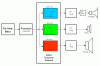
Active crossover goes between source and amplifiers, each driver is individually powered by it's own amplifier channel.

tri-amp_diag.gif
 
I am not so pessimistic that you can't find a decent 3-way crossover that will work. But you need to do your research ahead of time to find out what the preferred or recommended crossover points are for those drivers. That is very important information. It is a lot easier to do in a 2-way design since there is only one crossover point. Also it helps if the drivers "play well together", that is do they all produce about the same level of sound when they get the same level of power. I built a set of two way speakers about a year or so ago and I ended up having to employ an L-pad design for the tweeter since it played a bit louder than the woofer. So a resistor in parallel along with a resistor in series was employed to tame the tweeter and that worked quite well.

Anyway, if you want to go the cheap route and some trial and error then there are some fairly inexpensive three way crossovers available on the Bay. Some of those come from China. You would want to make sure that they are using quality components as well. It is possible to snag a pair of 3-way crossovers for about $60. The crossovers I saw at Parts Express were more expensive.

I guess it depends what you want out of this project. Are you willing to experiment with the possibility that the first attempt may not be quite perfect? If you are then you can learn a good deal about speakers.
 
To add to Bowtie above, then you might find with with XLR/balanced connections...

The only ones I've had/used have XLR connectors. If you pursue this lane, then it might be reasonable to say that the active crossover is similar to the heart of the sound.... you'd want to get a nicer "sounding" one (low noise kind of thing) Some allow you to delay the signal if that's appropriate for you, some are all analog, some digital.. it's another can of worms.

Reason I mentioned it was it does allow you to change values on the fly without having to stop, take speaker apart, pull crossover out, yank part "X" and replace part "X" with part "X plus .3% difference" and then put back together, only to realize you might not like that and do it all over again.

Much easier (strictly from playing with dials verses parts) to change a dial on a crossover than to swap parts. It might not be the most cost efficient lane for you though. You can get low cost crossovers. They may not sound as nice as higher value versions..... you can easily reach and cross over the $1,000 threshold (been there,l done that). This is where buying used online might be a friend. My EV Dx38 cost me $1,200 when I bought it new. I have since bought a couple others for roughly $400 each if I recall. Don't look at that unit though as it's only 2-in 4-out so would NOT accomodate two 3-way speakers (need SIX out, not four) unless you did a passive between your mids and tweets.

Yeah, there's a reason I don't delve into the designing of this stuff!
 
Back
Top Bottom