• The move to the new server is done. There are some software and database maintenance updates in process. This has us passing the hat around to help out. We appreciate any donations. Seriously, even a dollar helps. The payment page may be found here - https://www.audiokarma.org/support.html

Need some input on Dim bulb tester behavior

Donguri

Active Member
Hi
I recently acquired an Vintage Harman Kardon HK560 that behaved a bit different upon testing it on my DBT:
Start bright, goes dim but after 5-10 seconds starts to light up until it is maybe 50 or 60% bright, not really full bright.

Is it safe to power up without DBT or is there an indication of a short somewhere that engages?Anyone knows what this behavior mean?

My line here is 240V, the receiver is 40 watts and I'm using a 60 watt bulb.

Any input is appreciated
 
Last edited:
Register to hide this ad
Not familiar with the HK***, I'd monitor bias making sure it is well under specification, re-adjust on DBT if necessary to maybe 10% of spec value. EDIT: Basic health check of power supply voltages, again on DBT not a bad idea.
 
Last edited:
Something is causing excessive current draw 10-15 sec after initial start. Does that unit have a speaker protection relay, and does the increase in light happen after the relay pulls in? If so, look for shorts at the outputs. Could also be run-away bias issues. Check the ouputs for excess heat.

DO NOT fire it up off the DBT until find out why the excess draw. Bulb should stay pretty dim on a 40 W reciever.
 
Thank you for the replies.
I´m an amateur when it comes to tinkering around, but I'm learning, I know how to set/monitor bias but not 100% sure how to check power voltages yet..

Can I trust to let it be powered on the DBT while I check heat and bias or should I keep it on at an minimum amount of time?

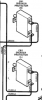
@HPMguy it doesn't have the classic relay but has an speaker protection box as the attached picture.
I´ll investigate more tomorrow regarding when the increase occur since its late over here.

Excuse my ignorance, Shorts at the outputs I guessing it means checking shorts on the output transistors correct? This is done powered down?
I've got DMM with mini grabbers to measure safely.
 

Attachments

  • HK560 speaker protector.png
    HK560 speaker protector.png
    42.8 KB · Views: 50
Yes, shorts on the output transistors. Also speaker switches and wiring -- I've had a mystery short due to chips of conductive material getting in switches or between pins. Wires rub through as well sometimes against the chassis.

Most likely a run-away bias issue though.
 
And expect (or set) the bias at a lower level when using a DBT. All the voltages will raise when you run the unit at full power. I'd set it at 50% of the target value.

Some units don't perform as expected when connected to a DBT. But you need to discard a major problem and study the schematic. The common sense is to keep it with the DBT. If you don't find any short, and dc at the output and the bias are near specs, you should try a larger bulb. I run most of the amps with a 56W bulb and sometimes I need a larger bulb.
 
Bulb wattage ideally should match the power consumption of unit under test at moderate throttle. Too-low watt bulb will go too bright & possibly yield inaccurate results, although it sounds like you're OK there. I'd set bias, DC offsets etc using proper line (mains) voltage into unit in question.
 
I took your advice and tested the unit´s Bias on DBT:

Powered up, Initially DMM´s showed nothing/0.00 mV for maybe 5-10 Seconds and as the bulb started to light up Dmm´s engaged to read fast climbing mV.
It reached about 39mV and 42mV which must be well over healthy considering on DBT?
(Spec says 33mV on full line)
I dialed them down quite a lot to around 16mV on DBT,
after 30 min monitoring one channel is stable 17,4mV but the other is slowly drifting upwards to 22+mV.

What would be the next step?
Btw is it normal for the Outputs not to engage directly upon Power up?
 
Since you've adjusted the bias, power up the amp and note DBT behaviour, does the bulb light up after the 5-10 seconds as above of has it stabilised/remains dim.

Btw is it normal for the Outputs not to engage directly upon Power up?
Not sure what you mean, are you talking about the speaker protection relay? Do you hear a faint click 3-8seconds after power ON?
Might be caused by DBT, rails not up to spec?
 
Yes it lights up in the same manner after 5-10 sec but stays a bit dimmer than before.
The drifting channels trim pot is almost fully counter clockwise, can't lower it much more.

Not sure what you mean, are you talking about the speaker protection relay? Do you hear a faint click 3-8seconds after power ON?
Might be caused by DBT, rails not up to spec?

Pardon if I was a bit unclear,
I ment the Output transistors, they don't "engage" until after 5-10 seconds, which explains the DBT behavior I think, but on other units I've measured the output transistors to emit voltage directly upon power on.
No relay on this unit.
 
  • Like
Reactions: mbz
If bias can be adjusted as you did, and you don't have a high voltage at the speakers output (check if the protection is OK and not open), I'd try a larger bulb as a next step (pay attention to any smoke out of any resistor and shut down immediately) But measure the DC at the output. Also, check the output transistors with the unit off, check they are not shorted.

You could also check the voltages out of the power supply. If you have a short at some board, it will drop the voltage on some PS rail. You could have a short at some small transistor or capacitor, not a direct short at the output, but a high current draw at some low voltage rail.
 
@mbz @elnaldo Thank you for taking the time.

(check if the protection is OK and not open), I'd try a larger bulb as a next step
Not sure how to check the protection I'm afraid, I'm quite a newbie..
I did check the DC offset and one channel was 240mV (!) on DBT, I dialed it down to 30mV, bounces after 10 min around 20-48mV.
60W bulbs is the biggest I have unfortunately, old bulbs are quite hard to find over here..

I´ve never measured Output transistors before, but thankfully I followed Echo Wars walkthrough post and the first step readings were as described, the "Reverse Bias" readings however were not..They should've been OL, Not sure if I did something wrong:
Negative lead on Base
NPN Q422: Emitter: 0.4V, Collector:0.2
NPN Q421: Emitter:0.54V, Collector: 0,6 and rises to 0.9 then OL
Positive lead on Base
PNP Q424: Emitter: 0.5V, Collector 0,6
PNP Q423: Emitter: 0.55V, Collector 0,7 and rises to OL

It can't be that all of them are bad?
How do I check voltages out of the Power supply? Is it the same as rail voltage?
 

Attachments

  • HK560 output.png
    HK560 output.png
    173.3 KB · Views: 19
Amp appears to have thermal fuses for over current speaker protection.
Q1, C9, Q405,6 appear to form a soft start function, probably to mute
any power on/off transients. Probably explains why "no bias" until 5-10
seconds of power on(?), need suitable voltages at Q410b/R412,,, which is
tied to Q406. Others can provide better explaination.

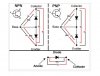
This is my goto for transistor diode testing, nice graphic from markthefixer, red/black indicate
meter probe orientation, 2 results expected, either open (OL) or 650mV or about
DiodeTest.JPG
 
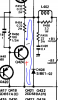
Incircuit transistor testing can be misleading, need to keep an eye out for alternate current paths, eg, wanting to test Q424c-e.
There is a lower resistance path marked in blue through D406 and R454, the MM will show 650mV when OL is expected.
EDIT: I had a look at the test results, some can be explained by alternate paths however the tests to collectors look odd, best to remove transistors/test out of circuit.

upload_2021-9-25_7-34-24.png
 
Last edited:
I usually check "in circuit" for a shorted transistor. If you have a direct short. I don't expect accurate readings, just to find a short circuit.

To check the protection, just measure resistance or continuity between the 2 connectors at the "protector". They look like single pole circuit breakers. If ok, you will have continuity between the contacts.

A 60 W bulb is also fine. I use a 56W bulb most of the time.
 
I usually check "in circuit" for a shorted transistor. If you have a direct short. I don't expect accurate readings, just to find a short circuit.
Yep, good point, I also "always" check in circuit. Helping the poster explain why unexpected test results.
 
Yep, good point, I also "always" check in circuit. Helping the poster explain why unexpected test results.

Yes, I usually check the pins without even knowing which one is the base, collector or emitter. If I hear a "beep" (short !!! ), I investigate further...
 
just measure resistance or continuity between the 2 connectors at the "protector".
Thank you. I tested the protectors, long beep so they seem fine.

Helping the poster explain why unexpected test results.
Much appreciated! charts also helps a lot to grasp what's being said.

Ok.. so I might have screwed something up...:(
Tried measuring the outputs in circuit with another DMM (a Fluke 27), receiver was disconnected from outlet and rested overnight.

All 4 of them made a short beep when measuring "Reverse Bias", so are all bad?
What's worse is I believe I saw a spark from Q424 when I moved one of the probes.. takes a toll on the confidence..
(Is this a certain sign that I destroyed the Output?)

I tried it again on on DBT and the bulb actually stays kind of dim after those initial 5-10 seconds, so is this an indicator that I didn't short something?
Measured the Bias on that channel as well and it was around 17mV.
 
Back
Top Bottom