• The move to the new server is done. There are some software and database maintenance updates in process. This has us passing the hat around to help out. We appreciate any donations. Seriously, even a dollar helps. The payment page may be found here - https://www.audiokarma.org/support.html

Old, cool, and interesting Stuff

In Romania there are some original hydroelectric power plants left original: Sinaia 1 (3 of the 4 groups and the equypment), Sadu 1 and Dobreşti.
Since you liked the undeground garage turntable, here is the other from Bucharest. Luxfer prisms above.

Untitled.jpg

In Romania cars with automatic gearbox where also called hidramate. Am cutie hidramată - I have hydromated gerabox. It was from the "Hydromatic" transmission.
 
"Around-the-clock airlift support in Venezuela:
The U.S. Department of War continues to provide vital support to earthquake relief efforts. United States Air Force, U.S. Marine Corps, U.S. Navy, and U.S. Army vertical-lift and rotary-wing aircraft are conducting airlift and transport flights to get life-saving assistance to the Venezuelan people.
At the direction of #SOUTHCOM, U.S. military forces are supporting U.S. Department of State-led U.S. government relief operations following the devastating earthquakes that struck the nation on June 24, 2026."
from US Southern Command facebook page

.relief.jpg
 
.dam.jpg

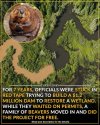
"In 2018, officials in the Brdy region of the Czech Republic, a protected landscape south of Prague, set out to fix a problem. Decades earlier, the military had dug drainage channels that dried out the local wetlands. To undo the damage, the government planned to build a series of small dams that would restore the wetland and protect a nearby river from acidic pollution, safeguarding rare species like the stone crayfish.

They secured the funding, roughly 30 million Czech crowns, about $1.2 million. And then the project ground to a halt.

For the next seven years, it went nowhere. The plan got tangled in permits, environmental approvals, and disputes over who actually owned the land. Agencies negotiated with the military and the river authority, paperwork shuffled back and forth, and the wetland stayed dry while everyone waited.

Then, one day, officials went out to the site and found the job already done.
A family of about eight beavers had moved into the exact spot where the dams were meant to go and built them, out of wood, mud, and stones, entirely on their own. And they had not just matched the plan. Experts who inspected the work said the beavers had chosen their locations perfectly, creating a thriving wetland with pools and canals that was twice the size of what the government had designed on paper.

The rodents had completed a $1.2 million project for free, and arguably done it better."
source; 'The Feedski' on Facebook
 
View attachment 3797676

"In 2018, officials in the Brdy region of the Czech Republic, a protected landscape south of Prague, set out to fix a problem. Decades earlier, the military had dug drainage channels that dried out the local wetlands. To undo the damage, the government planned to build a series of small dams that would restore the wetland and protect a nearby river from acidic pollution, safeguarding rare species like the stone crayfish.

They secured the funding, roughly 30 million Czech crowns, about $1.2 million. And then the project ground to a halt.

For the next seven years, it went nowhere. The plan got tangled in permits, environmental approvals, and disputes over who actually owned the land. Agencies negotiated with the military and the river authority, paperwork shuffled back and forth, and the wetland stayed dry while everyone waited.

Then, one day, officials went out to the site and found the job already done.
A family of about eight beavers had moved into the exact spot where the dams were meant to go and built them, out of wood, mud, and stones, entirely on their own. And they had not just matched the plan. Experts who inspected the work said the beavers had chosen their locations perfectly, creating a thriving wetland with pools and canals that was twice the size of what the government had designed on paper.

The rodents had completed a $1.2 million project for free, and arguably done it better."
source; 'The Feedski' on Facebook
Never underestimate the power of a beaver.
 
Spring loaded chick.

AVvXsEhdZPKtLIT8g5WGJWSxBqh4LLBbb_j4jXAUvsbblAxlS2pIVS7akrU_lGLGkmFBUCgkLgnvtDva_T73ZKCEojd0ObeUPXq3pe3UJ_SP2YbtSxyZKAPvrBOss6acpTIj5203JK7y4PCOm5e9zHSOmiAgSzRHeHQcr2oNF6ybS-B1_tN099GTubdllTbTq1w=w629-h354
Yea, fun vid, but clearly faked! Great thread overall though, thanks to all.
 
"FWD School Bus in Curry County New, Mexico had open windows, with heat in the spring and cold in the winter. Solid rubber tires, a primitive suspension and wooden seats, were still better than a horse drawn wagon with seats." found on Facebook 'Horseless Carriage Club of America'

.bus.jpg
 
The Four Wheel Drive Corpration figured large in WW1. They were a large supplier of fire apparatus for years, but you don't see much now...my city had three, as did our neighbor, they were beasts! Real "driver's" trucks. Pretty sure their big gig now is off road equipment, like for oil fields and such.

Four Wheel Drive - Wikipedia Four Wheel Drive - Wikipedia

Sorry, I guess as FWD they are defunct, however Seagrave Fire Apparatus, one of their brands, is still very present.

Seagrave Fire Apparatus - Wikipedia Seagrave Fire Apparatus - Wikipedia
 
The Four Wheel Drive Corpration figured large in WW1. They were a large supplier of fire apparatus for years, but you don't see much now...my city had three, as did our neighbor, they were beasts! Real "driver's" trucks. Pretty sure their big gig now is off road equipment, like for oil fields and such.
Looks like what was left of FWD was bought out by American LaFrance.

:idea:
 
Roughly 32 years ago I had a contract where I was designing tooling for Rockwell International in Oshkosh, WI. The plant made heavy duty off-road drivetrain equipment. I recall going through the various designs stacked in the files and found they ranged back to the mid to late 1910s. Many of those designs were for military trucks, such as axles and transmissions. It appeared the basic designs were used for many years, with the main difference being the materials used. There was some solid engineering involved with those designs.
 
Useless bit of trivia for the day.

As the days get shorter, I poked around just to see how fast the days are getting shorter for two different locations.

Here in San Diego
san-diego.JPG

And I just arbitrarily picked Bozeman, MT
bozeman.JPG

Crazy, eh?
 
Back
Top Bottom