

You are using an out of date browser. It may not display this or other websites correctly.
You should upgrade or use an alternative browser.
You should upgrade or use an alternative browser.
Passive subwoofer vs. Active subwoofer
- Thread starter SweetRolls
- Start date
I purchased a used XLS 1500 a couple of years ago for about $300. There's one on ebay going for $250. Do you recall the stated budget?A Parts Express subwoofer kit powered by a used Crown XLS 1500 amp which has a builtin low pass filter would be an optimal route for a passive sub.


I purchased a used XLS 1500 a couple of years ago for about $300. There's one on ebay going for $250. Do you recall the stated budget?
Did you read where someone stated that the OP will need a larger budget? And I paid $125 for mine bought locally.
Let's return to post #1:Did you read where someone stated that the OP will need a larger budget? And I paid $125 for mine bought locally.
"Hi, I have a budget of $100 and I'm wanting to add some bass to my PC setup."

AudioGMan
Well-Known Member
Very nice. That’s sort of what I did. A neighbor had a Dayton Audio SUB-1200 that he threw out because the cabinet was ruined when it got wet from a flood. The amplifier and 12” driver were fine. So I removed them and located the amp to my entertainment center where I feed the LFE signal to it from my receiver. Then I use a pair of 10” 8 ohm woofers in separate sealed cabinets(left and right) wired in parallel to the amp which puts out 120 watts rms into 4 ohms.This is a Parts Express kit sub. The plans called for the plate amp to be mounted within the sub box. I elected to make a simple frame for the plate amp so it could be used externally and placed on the rack with other gear with connection to the sub via speaker wire. That way the sub doesn't have to be near a power outlet and if the plate amp died I'd only have to replace it. The other advantage is that it's easier to connect and power two 8 ohm subs from a single plate amp as the power output is almost doubled.
View attachment 2085769

faber12
Addicted Member
Unless your passive subwoofer requires a proprietary connecting cable to its' amplifier then it is a passive subwoofer.
What is this business about it not being 'truly passive' because it has an outboard amplifier that does not also power the main speakers? Does that mean that all my speakers are 'kinda active' because they require an amplifier?
What is this business about it not being 'truly passive' because it has an outboard amplifier that does not also power the main speakers? Does that mean that all my speakers are 'kinda active' because they require an amplifier?

My oldest sub is now 30yrs old, amp still going strong, but it's a class A/B amp with a huge cast aluminum heat sink. The driver has required the surround replaced, but according to Arnie he used foam because all their testing showed it's SQ was superior in it's design.
My two Dayton Audio Sub 1200's from Parts Express are still going strong after 8yrs, only time will tell how much longer.
All of my other subs were passive, purchased as such or custom built around the drivers used.
My two Dayton Audio Sub 1200's from Parts Express are still going strong after 8yrs, only time will tell how much longer.
All of my other subs were passive, purchased as such or custom built around the drivers used.

SweetRolls
New Member
I gave up on powered subs many years ago because it’s just a matter of time before the built in amp craps out. I’ve had Klipsch, Polk Audio, M&K, and Velodyne. All have suffered failed amplifiers. Now I only use passive subs(2) and an outboard amplifier. No more problems. What do you plan on powering a passive sub with? Is that included in your $100 budget?
I plan on powering the passive sub with the receiver I use in my PC setup, a Kenwood KR-A5030. I could either hook it up to the B channel as a separate, or use the A channel and plug my speakers into the passive sub if the sub has that ability.
SweetRolls
New Member
how are you going to buy a passive sub and an amp when you only have $100 ?
Do you recommend having an amp? I was thinking that I would be fine just using the stereo receiver in my PC setup.
I plan on powering the passive sub with the receiver I use in my PC setup, a Kenwood KR-A5030.
The problem with passive subs set up this way is if not designed with your main speakers in mind how to balance the subs output with the speakers?
With an active sub, or passive connected to its own amp with gain controls the outputs can be balanced to work together.
Here's a picture of a system designed around a passive sub by the manufacturer.
Canton Plus S and "matching" Plus C passive sub
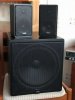
If not designed to work together it's going to be a crapshoot whether they will or not.
read my previous post, you'll most likely need an amp with gain controlsDo you recommend having an amp? I was thinking that I would be fine just using the stereo receiver in my PC setup.
SweetRolls
New Member
The problem with passive subs set up this way is if not designed with your main speakers in mind how to balance the subs output with the speakers?
With an active sub, or passive connected to its own amp with gain controls the outputs can be balanced to work together.
Here's a picture of a system designed around a passive sub by the manufacturer.
Canton Plus S and "matching" Plus C passive sub
View attachment 2085995
Ah, that is a good point. I have a pair of JVC full-range speakers coming in the mail that I plan to use in my PC setup. At this point, is it even possible for me to get a good subwoofer for under $100, or should I just save my money?

bigx5murf
Super Member
Forget simple crossovers. PE has an affordable device that gives you full LFE dsp functionality.
https://www.parts-express.com/dayton-audio-dsp-lf-low-frequency-dsp-controller--230-520
https://www.parts-express.com/dayton-audio-dsp-lf-low-frequency-dsp-controller--230-520

At this point, is it even possible for me to get a good subwoofer for under $100, or should I just save my money?
This might work okay.
https://www.parts-express.com/dayton-audio-sub-800-8-80-watt-powered-subwoofer--300-627
SweetRolls
New Member
I'll definitely look into that one, thanks.

Poultrygeist
Lunatic Member
yes, but that same sub could have it's own amp while the mains are run full range off another amp. Passive only means it's not active, as in no ability to adjust it's output or low pass setting included with the sub.
I've had both variations, passive I built myself, and passive purchased as a package unit with built in low/high pass like the Canton Plus C.
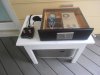
The Marcato ( under the table ) is an outdoor sub and I'm lucky to have one amp that I bring in and out.
Poultrygeist
Lunatic Member
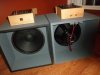
I guess we could vote to decide if these are active or passive. 
faber12
Addicted Member
Are the amplifier cabinets attached to the subwoofer cabinets or just sitting there?