• The move to the new server is done. There are some software and database maintenance updates in process. This has us passing the hat around to help out. We appreciate any donations. Seriously, even a dollar helps. The payment page may be found here - https://www.audiokarma.org/support.html

Pioneer RT-701 playing to fast

One thing that I forgot to mention is that before replacing the capacitors after it was powered on for a while it would run at normal speed. After replacing the caps, I left it on for a while and it did not go back to working at normal speed. I was very careful at replacing each cap one at a time, and checking the values each time. Does anyone know where I could check the uF values for each place on the board, I want to re-check and make sure i replaced each capacitor with the according values.
 
I found the service manual and the "Control assembly schematic" I'll try to read the schematic to see where each capacitor goes.
 
There should be an "X-Ray" schematic which shows the board layout and where each components goes with values next to it in tiny letters - from there you can double check all the values are right. I would say though that you've probably done a good job, but that it might be something else failing. Can you see the transistor part number on the large TO-3 style transistor on the metal plate at the top rear of the board heatsink? It's live when switched on so be careful - I've heard that if it is a particular type of transistor it can cause problems. It's a shot in the dark but it might help to diagnose.
 
There should be an "X-Ray" schematic which shows the board layout and where each components goes with values next to it in tiny letters - from there you can double check all the values are right. I would say though that you've probably done a good job, but that it might be something else failing. Can you see the transistor part number on the large TO-3 style transistor on the metal plate at the top rear of the board heatsink? It's live when switched on so be careful - I've heard that if it is a particular type of transistor it can cause problems. It's a shot in the dark but it might help to diagnose.
Thank you, this helped a lot.
 
So I finally had some time to spend on this issue today and ended up replacing Q903 -907, Q909, Q912 with similar transistors that I found on eBay; 10 for $3 so I figured I would replace all transistors with this part number. I finally put it all back to together and voila, the dam thing started playing at the correct speed from the start. I turned it on/off a couple of times and it kept the consistent speed. So, I think it's finally working correctly! :banana: I'll keep testing it but so far so it's looking good.

All of your guy's advice and help really helped me, so thank you all.
 
By the way I tested the removed transistors and per the multimeter they were working, not sure if the mv on them had drifted though.
 
Franco, Good job! Testing transistors on a multimeter is only a guide. It will find opens and shorts but if a transistor is "noisy" it will not see that. For example, on my RT-707 when in "source" position I had a hiss/noise on the right channel. Almost sounded like someone left the hose on outside. Turned out to be a 2SC1344 transistor. Replaced and all is well however when testing it, it tests fine on a multimeter.

Get some more tapes and enjoy!

Bob
 
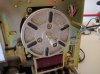
Now that I have fixed my speed problem, I'm trying now to restore some of the appearance of this machine. Does anyone know how to get rid of the green corrosion on the wheel? I've already tried a rust remover but this has not helped.
 

Attachments

  • IMG_20160621_085024.jpg
    IMG_20160621_085024.jpg
    79.2 KB · Views: 38
If that is anodized aluminum, stay away from products containing lye. If it's mold, try a q-tip of bleach or hydrogen preoxde. See if it scrubs off with mild abrasion, like with a fingernail or broken-off wood toothpick. Working your way up, perhaps a Dremel tool with a plastic "wire brush", or maybe a very light touch with the brass version. Stay away from carbon and stainless steel. Try the abrasion solutions somewhere inconspicuous first.

Chip
 
I have something like this on one of my RT-707's I think its the finish oxidising. Mine isn't as bad as yours but I found that cleaning it with a mild abrasive helped but the finish looks to be very thin... Stripping back to metal and respraying might be a good option....?
 
Franco, Good job! Testing transistors on a multimeter is only a guide. It will find opens and shorts but if a transistor is "noisy" it will not see that. For example, on my RT-707 when in "source" position I had a hiss/noise on the right channel. Almost sounded like someone left the hose on outside. Turned out to be a 2SC1344 transistor. Replaced and all is well however when testing it, it tests fine on a multimeter.

Get some more tapes and enjoy!

Bob
f

I have just replace my 2SC1344 transistors and a few others and the sonic difference is amazing
I also has bad hissing noise on one channel, both channels are now very quiet
 
I did the same and a big recap of the deck. After that, it really did come alive and I could see why people love this deck. It made a big difference to the meter response too. Now they're actually useful, not as sluggish as they used to be.
 
f

I have just replace my 2SC1344 transistors and a few others and the sonic difference is amazing
I also has bad hissing noise on one channel, both channels are now very quiet
Sure is a pattern for those 1344's.
 
Had the same problem [big time] with my 707. Two connectors and three screws. Remove old Servo board. Install new (old) servo board. Problem gone in 30 minutes.
 
Yes, still working great! Was worth the effort.
Hi, First time user of this forum. I have an RT-701 which hasn't been used in a number of years. I may have the same problem you had.....What I notice is that the capstan motor runs super fast, does not respond to the speed control button and the motor stays at this high speed when the machine is on stop. Is this the issue you had with your machine? Was replacing the capacitors and transistors ultimately the fix? Thank you....hope you are still on the forum as this thread is over a couple years old.
 
Back
Top Bottom