
• The move to the new server is done. There are some software and database maintenance updates in process. This has us passing the hat around to help out. We appreciate any donations. Seriously, even a dollar helps. The payment page may be found here - https://www.audiokarma.org/support.html

PIONEER SX-440 Output Transistor Replacement?

JB8

Well-Known Member
Hey all, I'll make this quick.

Spent some time trying to sift through a bunch of threads to find this info but came up empty, so I'm putting up my white flag!

What's a good replacement option for the 2SD226A?

I'm getting some distortion at the speakers (mainly right side) but not through headphones. Most all of the audio unit transistors have been replaced, some caps but most of the caps tested as "not too bad", PS not rebuilt, so I'll likely keep everything else the same. Sorry, I said I'd keep this short and there I go, rambling on, geez, JB....

Thanks in advance!
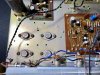
IMG_0356.jpg
 
Register to hide this ad
The MJE15030G is a capable replacement. The TO-220 package can replace a TO-66 directly by bending the leads appropriately and using only one mounting screw through the collector tab. Of course, it will need the matching insulator and screw bushing to isolate the collector properly.
 
Thank you, @Watthour , really appreciate the advice!

Your reply sent me down a fun rabbit hole around replacing TO-66 packages, great to learn about the process and that so many have been successful in making the swap.

Two questions for you. First, you mentioned needing the matching insulator and screw bushing to isolate the collector properly. Is this referring to a mica pad and/or thermal compound? Second, I noticed in a similar thread the collector lead had been cut back and not attached - is this an accurate way to install the part? Since this will be my first conversion I certainly want to get it right the first time!
 
On the retrofit TO-220 cases, the mounting tab is also the collector - Just like the metal case of the TO-66. The center collector lead can be cut back to prevent shorting to anything else.
 
Tell you what, @larryderouin , you're a living legend in these vintage Pioneer parts (said in a Dirty Harry no-sense cowboy-type delivery), it's a pleasure to have you contribute to this thread!

Seriously, you're the reason why so many have successfully revived their dead SX's, a fantastic resource for people like @mustang1102 and I. I've read many a thread with you guiding people through the black hole that repair can occasionally result in, only to have the thing come back to life and sing like a Jimmy Hendrix solo. You're much appreciated!

I'll get to work on this and share my results, thanks again!
 
+1 on that ^^, as well as the experience and knowledge of @Watthour, and all the other regulars that have given up their time and guided and helped so many of us !!
 
Totally agree, @Watthour is exceptional along with so many others who somehow remain patient as they're hand-holding us through troubleshooting steps, amazing! :music:
 
Thanks, but I'm a rank amateur compared to the likes of Watthour, Merlynski, and up to and including Echowars and Mark the Fixer. But show me someone who's been ripped up in a car accident or combat and I'm in my element.
 
  • Like
Reactions: JB8
I tried to contact Merlyn a week ago with no luck.:(
I also looked for him in some of the other audio hangouts, with no luck.
 
Quick update. Still have distortion across both channels, seems to be fairly balanced now between the two channels after replacing all the 870's and 871's as well as replacing most all caps on both the audio board and power supply. The main filter cap tests at ~1200 uF and the two 25V 1000uF caps on the underbelly seem to be within tolerance as well, so I'm assuming they're not likely the culprits. PS transistors replaced as well. All of the changes have seemingly made the unit stronger, but the garbling distortion is not cool.

While still considering the TO-220 conversion I pulled the four output transistors (2SD226A) to test out of chassis. Testing revealed no shorts or significant issues and I had fairly similar readings across B-E and B-C, all were in the .540-.580V DC range. Could these values be the issue (too low as a team) or are they likely still fine and I should start looking somewhere else for the source of distortion?
 
few ways to look at this depending on your tools .. first thing is narrowing it down to power amp . from what you say it most likely is that or power supply problem . you could monitor the voltages on the outputs cases whilst its idle and playing . .
if you could pot a sound clip of the distortion it might help understand a bit better .
 
  • Like
Reactions: JB8
Thanks, Pete, as long as we feel like those transistors aren't likely the issue I'll pop em back in and try to post a sound clip. Ahead of that, I'd say when listening to an FM station or music via phone plugged into AUX, the signal at low volume sounds fine, but as you start to crank it up even to 25-35% it sounds like the music starts to gargle and the overall output begins to plateau into a cacophony of sloppy distortion. Not a lot of white noise by any means, just crumpled sound fields.

Btw, I'd checked voltages at the cases before I pulled them, the two upper were at ~40 and the two lower were ~20 when at idle.

I'll try to reproduce it even though it's hideous. Thanks again, Pete, always great to get your guidance. I'll update soon!
 
Last edited:
Hey again, I reinstalled the output transistors and recorded a brief sound file but I have no way to host it and can't upload it to this post. Safe to say it sounds like the signal is being fed into a guitar amp with a fuzz pedal engaged... (BTW, took pictures before hand to make sure I correctly rewired the four transistors)

I'm baffled. All of the other transistors on the PS and Audio Board have been replaced, rechecked pinouts on all of them, replaced most all caps, remaining caps seem to be testing fine. The only things I haven't swapped out are the large filter caps and the diodes on the PS, but they seem to be fine when testing while installed. I'd been using some speaker connectors that came with the unit, so I bypassed them and jumpered directly to the speaker leads, still no change. I've used three sets of test speakers, all reacted the same, so safe to assume it's not the speakers. I sent both a 1K tone along with music through, both distorted at around the same rate.

I have a scope with one good channel, would love to get it fired up and start testing if that would be helpful. Let me know as time permits!

Also, right before posting this I decided to check the case voltages again and they were significantly off this time. When I checked them last they were as I mentioned, ~40 volts on the pair closest to the front of the unit (Q1/Q2), ~20 on the inner. Now I'm getting little to no case voltage (under 1V) on the two left channel transistors (Q3 & Q1) and the transistor closest to the power switch (Q1) is now reading .488 B-C and .250V B-E. Man, this is fun. I must confess, when I reinstalled Q1 I missed one of the plastic cups that surrounds the mounting screw, so perhaps I've now made things worse even after finding the insulator and reinstalling it after having powered the unit up without it.

I have a replacement 2SD226A on the way for the one in the corner. Good times!
 
Last edited:
i know its a bit late now but i should have suggested using the new transistors until its working ..i think that still applies though .
then check the fuse connections .. might be as simple as .
 
Thanks, Pete, I appreciate it! I think I may have found part of the issue - R6 had continuity across it, in-chassis, and when I went to pull it for further testing it basically fell apart in my hands, so I think it may have been faulty.

As I wait for the new transistor to arrive, does anyone have a favorite replacement for the four resistors (R6-9)? I'm keen on replacing all four so any assistance is much appreciated. I know Larry must have a favorite, his list of parts is incredibly accurate and complete!
 
Back
Top Bottom