• The move to the new server is done. There are some software and database maintenance updates in process. This has us passing the hat around to help out. We appreciate any donations. Seriously, even a dollar helps. The payment page may be found here - https://www.audiokarma.org/support.html

Power Conditioners - do you use them and do you have a recommendation?

Nice to see were all getting along. I can watch the THD on the AC mains start in the AM, around 5 AM @ 2.2% by 9 AM its 3.8%. The as I start each unit the THD go up approx. .2~.3%. Now we have a 4.5~4.8% on the mains. The total THD depends on not only what your power company has, you equipment also adds into the equation. For that mater it's everything running in your home and the folks around you on that line.
 
Again, it depends. I depends on the actual noise/distortion of the AC mains power and the design of the power supply.

Below is a simple example.

View attachment 1267872

This can apply to the power transformer of our vintage gear. Once the common mode noise, and note that it is common mode noise, makes it past the power transformer, it can or may modulate (change), for want of a better term, the audio signal. This may or may not be subjectively audible to the listener.


I am not sure that I follow your question. The basic component of our AC mains power will be 50HZ/60HZ.

Of course you can take a 1 GHz sine wave and add to it the first 2 odd harmonics and get the same waveform shape as doing the same thing with a 50HZ/60HZ sine wave.


For those that say the internal parts of the power supply are more than adequate, see the picture below, and yes it is somewhat of an exaggeration, just used for the sake of clarity.

View attachment 1267893
Okay for the sake of example, lets say that the beginning of a powerful musical note happens at the exact time as the dip (the red circles) in the AC mains waveform. What do you think will happen?. The power supply will be starved for voltage. Or what do you think will happen if the power supply is repeatedly, periodically starved for voltage. This may not do nice things to the audio output.

Again, my example is somewhat of an exaggeration for the sake of clarity. But even a smaller amount of distortion may result in a change in what is called the load step response of the power supply. Depending on its severity, it may or may not make a subjective difference in the sound quality.

Again, see my post regarding common mode noise. Not all power supplies are created equal when it comes to dealing with common mode noise.

To be clear, I am not saying that outboard AC mains power conditioning is always needed for everyone and that there will always be a subjective change in the sound quality.

And since all things Internet forum are not always clear. I am not saying the noise and interferences are not there. I know they are. I have just never measured any there needs to be any concearn over. IME the PS in most AK members gear are more than capable of handling most of these issues, am I wrong? Could be, don’t care if I am right or wrong. My mention of chicken little was making a point, both ends of the spectrum are always debated on every post in here. The truth is typically in the middle more than likely.
 
I am not sure that I follow your question. The basic component of our AC mains power will be 50HZ/60HZ.
Harmonic distortion of a wave can be modelled as the sum of harmonics of the fundamental waveform. For illustration, in post #53 I distorted a sine wave by adding harmonic components, which was based on post #41 in which I stated -- well, postulated, really -- in response to a post that mentioned the typical harmonic distortion levels of household supplies, that lower frequency harmonic components are likely to represent less of a filtering challenge for a conventional power supply than high frequency harmonic components. Indeed, if the harmonic content is sufficiently high frequency and energy, I'd expect it to be able -- in the absence of appropriate shielding -- to bypass the power supply and possibly be radiated as RFI.

No?
 
Last edited:
And since all things Internet forum are not always clear. I am not saying the noise and interferences are not there. I know they are. I have just never measured any there needs to be any concearn over. IME the PS in most AK members gear are more than capable of handling most of these issues, am I wrong? Could be, don’t care if I am right or wrong. My mention of chicken little was making a point, both ends of the spectrum are always debated on every post in here. The truth is typically in the middle more than likely.
Let me ask a personal favor GC, when you want to make an argument, please don't use me as a sounding board to present your juxtaposition of extremes, when in fact I have not presented any type of extremes. In fact my only recommendation was to minimally use an effective Type 3 SPD. There is no "middle" to the fact that even you recognize and acknowledge, "I am not saying the noise and interference's are not there."
 
Let me ask a personal favor GC, when you want to make an argument, please don't use me as a sounding board to present your juxtaposition of extremes, when in fact I have not presented any type of extremes. In fact my only recommendation was to minimally use an effective Type 3 SPD. There is no "middle" to the fact that even you recognize and acknowledge, "I am not saying the noise and interference's are not there."

I am sorry if I offended! Not the intent!! I lumped together all the “got to do it” support on to your posts.
:beerchug:
 
I may not have understood one of your questions clearly. To be clear your examples of a harmonically distorted wave forms do include the fundamental frequency and any harmonics. With the correct filter, each frequency can be recovered separately.

Distortion of a wave can be modeled as the sum of harmonics of the fundamental waveform.

It is not limited to only that and this can be important to the topic at hand. The waveform can be distorted by energy that is not harmonically (that is numerically related) to the fundamental. If were are talking about AC mains waveform anomalies, they will likely include both fundamentally related unwanted energy and non-fundamentally related energy. I understand that this is kind of like splitting frog's hair.

Indeed, if the harmonic content is sufficiently high frequency and energy, I'd expect it to be able -- in the absence of appropriate shielding -- to bypass the power supply and possibly be radiated as RFI.

If it sufficiently high, it would start to come suspiciously close to a square wave and that may not be a good thing. This is a fairly deep rabbit hole with a lot of variables. Some power supplies may have a more difficult time with unwanted higher frequency energy.

This is one of the reasons given for using small value bypass capacitors across the main filter capacitors. There are those that say that not only will this improve noise rejection, it will also improve the load step response of the power supply, but is a topic for a different discussion.

Nice to see were all getting along. I can watch the THD on the AC mains start in the AM, around 5 AM @ 2.2% by 9 AM its 3.8%. The as I start each unit the THD go up approx. .2~.3%. Now we have a 4.5~4.8% on the mains. The total THD depends on not only what your power company has, you equipment also adds into the equation. For that mater it's everything running in your home and the folks around you on that line.

Just out of curiosity, are you looking at just THD, that is distortion that is harmonically related to the fundamental or are you including unwanted noise/energy that is not harmonically related to the fundamental, which would be THD+Noise.

In the RF world we look at both distortion and noise. This is called the SINAD measurement. It stands for Signal+Noise+Distortion divided by Noise+Distortion, expressed in dB. This allows us to take into account not only distortion such as might be caused by a mis-adjusted FM detector, but also noise that might be caused by a mis-adjustment of the RF/IF chain or a defect there in.
 
Nice to see were all getting along. I can watch the THD on the AC mains start in the AM, around 5 AM @ 2.2% by 9 AM its 3.8%. The as I start each unit the THD go up approx. .2~.3%. Now we have a 4.5~4.8% on the mains. The total THD depends on not only what your power company has, you equipment also adds into the equation. For that mater it's everything running in your home and the folks around you on that line.
with all due respect.....unless you are listening to 60hz tones and care which are distorted or not - WGAS?

You have these rectifier things and capacitor things and regulator things that completely and utterly negate that - you tube advertisments to the contrary be damned.

in reality, we really dont care about the frequency of the power input and in modern cases we dont care about the voltage either - its just that in the older stuff, if the transformer did a 2:1 reduction on the mains for the rail voltages before the regulators, 1/2 of 120 might be under the limits of the diodes and 1/2 of 240 might not be.

and if its RFI/EMI - well you dont need a power cord to transmit that. just take the metal off a marantz and see what I mean for yourself...
 
I have a Panamax unit primarily because it gives me a single switch to power my system on and off. Surge protection is an added benefit. I make no claims of the need or usefulness of line conditioning in my situation, but it came with the package.
 
I have a Panamax unit primarily because it gives me a single switch to power my system on and off. Surge protection is an added benefit. I make no claims of the need or usefulness of line conditioning in my situation, but it came with the package.[/QUOTE

me too
 
I use two Tripp lites with 6 & 8 outlets. They fill-up quickly with all sorts of accessories.
Still, I unplug for thunderstorms, if practical. As I do washer, dryer and TV's.
 
Last edited:
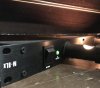
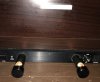
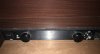
I use a Furman M8-LX 15 amp power conditioner. Does help especially with digital audio transmissions. I would have skips and pops when I would plug or unplug heaters or lamps. No more since installing this little gem I pick up at local thrift store for $5.

76B5EC87-0F9B-44BD-89FF-B6A17519D0A7.jpeg7C6D73B9-9E80-4836-B813-00501A6E5F4A.jpegC00A50C5-3C8B-4C8B-8FB0-A10124236F72.jpegB555AA1D-4427-4563-9885-A70CDBC5BFD0.jpeg
 
Last edited:
I'm gonna pick up a cheap Furman just for piece of mind. I live in a house that's over 100 years old, AND still has a bit of knob and tube wiring that needs to be replaced when time and funds permit.
 
View attachment 1342347 View attachment 1342339

Unfortunately I wasn’t able to install mine above my stereo. The next best place was underneath my stereo rack upside down so the lights shine upward with decent results.
You also may be keeping the power cords away from your gear.

Off topic: I had a strange (interferance?) issue between that Furman and a SMSL model Sanskrit 6th dac. The dac was sitting directly on top of Furman and near wallwarts, power cords plugged in. If I touched the dac while in use, got static noise through speakers and music stopped. Turning dac off and back on, it works.To solve, I moved dac away from Furman and no issue when touched.
 
Last edited:
You also may be keeping the power cords away from your gear.

Off topic: I had a strange (interferance?) issue between that Furman and a SMSL model Sanskrit 6th dac. The dac was sitting directly on top of Furman and near wallwarts, power cords plugged in. If I touched the dac while in use, got static noise through speakers and music stopped. Turning dac off and back on, it works.To solve, I moved dac away from Furman and no issue when touched.

Have you ever opened up the power conditioner? I’m just curious if it’s actually a decent power conditioner or just a power distribution block with a surge protector?
 
Have you ever opened up the power conditioner? I’m just curious if it’s actually a decent power conditioner or just a power distribution block with a surge protector?
No I have not. Power conditioning is a mystery to me. I also have Triplites on main setup. They say condioners.
I downloaded pdf on the Furman Merit series conditioners at Furman site. They discribe what it does. They use word conditioning.
A friend has a Mcintosh integrated with matching Conditioner, as large as the amp. So conditioner term is thrown about easily.
 
I use Furman SS-6B surge protectors on all my systems, and my tv/sound bar/blu ray setup. They're way more heavy duty than cheap power strips, and supposedly filter RF and EMI interference. That's about as far as I'm going to go towards 'power conditioning '.
 
The sound quality in my system is way better in evening+nighttime than daytime..
Has been like that in every house I have lived.
Both power mains and air everywhere is filled with noise,
and any audiophile would be wise to sort out that potensiale issue before venturing into high-end equipment.
 
Back
Top Bottom