Well if that really is your point, why not just say something like, "Yes, often noise present in the electrical supply can have negative audible effects in a large number of consumer hi-fi audio components, and a power conditioner may help considerably in these circumstances."
Instead, when somebody claims that power conditioning helps in their system (or is looking for advice about trying one), your response, at least to me, is more along the lines of: "If you think a power conditioner is helping, then either, A) you are imagining it (psycho-acoustic effect), or B) the 'questionable design' of your 'high-end equipment' is to blame, because any competently-designed piece of gear does not require external power conditioning." Apologies for putting words in your mouth, but that is my interpretation of your stance.
Now getting back to a Linn Classik (K) CLEARLY benefiting from a power conditioner. Again, this piece is certainly not what I consider "high-end", but I do believe it is competently designed and assembled.
If not, there would be literally hundreds of thousands of pieces of gear around the planet that likely are also not "competently designed", that would nonetheless benefit from external power conditioning.
I think it better to relate personal experience on the issue and give productive advice, rather than deride the design quality of others' gear.
My intent isn't to deride gear, but to encourage consumers to press manufacturers not to let standards slip. Per my post #81:
It's questionable design of "high-end equipment" if it can't filter out line and environmental noise. Technically, that's straightforward enough that it shouldn't need external filtering. If it does, there are questions you should be asking the manufacturer...
Here's an example of what I'm talking about:
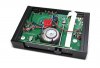
There is
no internal shielding or filtering. The power leads run freely around the interior, so it's very likely that external shielding and filtering -- i.e., power conditioning -- would help.
Compare that to this:
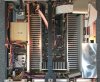
Note the copper barrier between the power supply components on the left and the audio components in the middle, and the shielding on the tuner and control components on the right. The power lead is short and confined to a small region in the upper left and goes nowhere near the audio circuitry. This unit is well-shielded, and likely would not benefit from external power conditioning.
These two pieces of gear are
very roughly at the same level(-ish) though the latter is an home theatre amp; the former stereo. I imagine some
might consider the former -- a Rega Elex R -- to be more "high end" than the latter, a Yamaha RXV-1.
Why is that?
Notably, the Rega is consumer-grade construction. Aside from the use of a toroidal transformer and extension on the volume control, it's essentially the same internal construction standards I can find in any £30 DVD player.
As consumers -- and
this is my point -- we
should be demanding better for our money. We
should complain if we see high-end (or consumer!) standards slip to the point that the manufacturer is selling low-end construction under a high-end badge.
Which means we shouldn't
have to add a power conditioner, when it would be relatively inexpensive for the manufacturer to put all the power supply components (except for perhaps the transformer) in a grounded box. That's already standard (and inexpensive) construction for personal computers, servers, and many laptops, so it's not something new. Of course, they use switching power supplies which
need shielding to not emit broadband noise, but as the Yamaha (above) shows, it's possible to achieve the good shielding with a linear power supply.
Note that you don't get better results from shielding and filtering the internal power supply
and adding an external power conditioner unless the internal shielding and filtering are inadequate. If the internal shielding and filtering are adequate -- and there's no reason they shouldn't be in
every piece of reasonably-priced
consumer gear, let alone high end gear -- then external power conditioning won't improve the results.
Indeed, it won't be needed at all.



 ,
, 


