• The move to the new server is done. There are some software and database maintenance updates in process. This has us passing the hat around to help out. We appreciate any donations. Seriously, even a dollar helps. The payment page may be found here - https://www.audiokarma.org/support.html

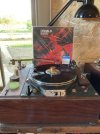
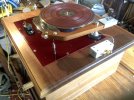
Prepping a Russco turntable..


No actual progress on my plinth yet - but I did make up a wooden armboard for it today. Needs another coat of finish and then it’ll closely match the tonearm. No idea yet if it’ll sound any better (or different) than the original, which is cast aluminum. In case you’re wondering why it has a seam, it’s ‘cause I cut it from some reclaimed hardwood that was part of an old drawer..
Armboards are pretty easy to make so I’ll probably do another one that’s a constrained layer affair.

View attachment 2671663 View attachment 2671666
I'm wondering how you ran the wires; did you drill another hole in the armboard to get them inside to meet the Monster rca cable? Looks like a small hole under the mounting base would work, and it would be hidden........

Steve T
 
I'm wondering how you ran the wires; did you drill another hole in the armboard to get them inside to meet the Monster rca cable? Looks like a small hole under the mounting base would work, and it would be hidden........

Steve T
Duane’s plinth has an exit hole in the rear for the tonearm cable,(post 75)
 
I'm wondering how you ran the wires; did you drill another hole in the armboard to get them inside to meet the Monster rca cable? Looks like a small hole under the mounting base would work, and it would be hidden........

Steve T

From memory - I used small, round file to cut a notch next to the bearing pillar.
The tonearm wires and shield are run inside a piece of soft, flexible silicone tubing (nitro fuel) and it pops up through the base for a strain relief.
 
From memory - I used small, round file to cut a notch next to the bearing pillar.
The tonearm wires and shield are run inside a piece of soft, flexible silicone tubing (nitro fuel) and it pops up through the base for a strain relief.
Thanks man. I can't wait to get this arm up and running, in my "wanna be a DJ" Russco....

Steve T
 
I saw that, but I'm talking about up top; the small tonearm wires before the plinth....
The base for that particular arm has a hole for the tonearm wires…..if the arm has external wires and there’s no hole in the base, I’ve always ran the wires to an RCA pod or mount.

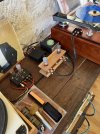
Couple of home made examples and one Cardas solution :

the one behind the wood banana arm is just plexiglass& wood

The bright metal one gets mounted under the edge

The Cardas black box is excellent, just a bit more costly ;)
4ACD61EF-39BC-493C-8204-077B7B777348.jpeg8537D187-47B6-44AF-9289-365AFD251EBA.jpegA5BADF14-A749-4913-A766-06D96F411ACD.jpeg
 
A little update on my Russco.. The idler wheel I made from a hockey puck worked but it was noisy. I had a feeling the puck rubber would probably be too hard, and - it probably is. Out of curiosity and also for fun, I made an idler arm out of hardwood, then tried it with my hockey puck wheel.. Still noisy and possibly even noisier than the original Russco idler arm.
Then came Abe’s Delrin idler wheel to the rescue! It arrived in the mail today so I had to try it out, first on my hardwood arm.. I can’t hear it!! The rubber is much softer than the hockey puck.. Now all I hear is a slight hum from the big, Bodine motor and a little ringing from the still bare, mat-less platter. Not too sure about the WOW numbers here, taken from a screen shot of my RPM/WOW app, but the speeds are looking close enough for me and this old Russco seems pretty quiet.
Surprisingly quiet for being on my Arrowhead, cardboard test box!

View attachment 2663095

Now I need to start thinking about a nice plinth for this.. and maybe a couple wooden armboards.. :)
Hi all!
MisterDK, do you still have the idler shaft measurements?
I'm missing this part to restore my Russco.
My friend can make this part, but I don't have a broken tension shaft to get the dimensions.
Thanks!
 
Hi all!
MisterDK, do you still have the idler shaft measurements?
I'm missing this part to restore my Russco.
My friend can make this part, but I don't have a broken tension shaft to get the dimensions.
Thanks!
They’re 3/8” on the O.D but I don’t remember exact length. You can measure your original one; right?
I think I’ll replace the wooden one I made. Seems that it’s too light in weight and may be transferring some noise, instead of damping, as I’d hoped for. Haven’t had a look at mine lately but I also suspect that the hollow studs I used when making my idler arm may have been too soft - and have possibly worn.. They should have been at least been case hardened..

If your friend is going to make one up, maybe he’ll do a couple or more. If they look good, I may buy one.
Still haven’t bought one from Serge in Ukraine but his are made from heavier brass and may help to dampen some sound.

Duane
 
I don't have the original idler shaft. If someone can measure it, I can prepare a file in Fusion 360 and publish it here.
 
I don't have the original idler shaft. If someone can measure it, I can prepare a file in Fusion 360 and publish it here.

Yup; unless yours is one of the later Russco tables finished in gray/black hammertone paint, those arms were made of pot metal and cracked - and probably got tossed out. The later ones were apparently made of steel. Need to find my original (cracked) one and get a measurement; won’t be today though…
 
Hello All, I am restoring a Cuemaster and have found many useful tips in this thread such as using teflon tape to
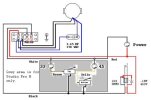
keep my expensive bearing oil from leaking out onto the bottom of my plinth. I had considered doing that myself but thought that the issue was due to some negligence on my part. A new idler wheel is on its way from Serge in Ukraine and I'm working on a mounting plate for a recently acquired Micro-Trak 303. Someone broke the base of the MT 303 that I repaired with a judicious application of JB Weld and someone else buggered the drilling of the hole in the deck, hence the need for a plate to cover the hole and allow for the mounting of the tone arm without drilling the three holes that the MT 303 requires. I was hoping that someone might have a schematic to confirm the values on the run cap and the other capacitor(s) and resistors. I found one for the Studio Pro but there's a small chance that they are different. My TT is from the '80s so the schematic would need to be from that era. I might be pushing my luck but a manual would be helpful as well. Thanks in advance. Jason
 
Jason, there is a little Russco info in the vinylengine library. You need to be signed up there to view/download it. If you have trouble, I’ll see if I can help.

Duane
 
They are a great Radio Station TT where the bass is rolled severely below 40 or 50 HZ. They accelerate quickly and their Wow and flutter are reasonable. But their rumble level is horrid. We used them in the AM station with no problems. But we had to go with the professional Technics for the FM Station in order to get the rumble to disappear. Plus unless you were sharp getting them to run on speed which is very important for a station where everything is timed down to the last second could be a real challenge. Especially as the drive puck changes diameter and texture over time. You new it was time to change the drive puck when the speed started slowing even when cleaning the puck daily. One of my first jobs at the radio station besides listening to some DJ's continuously complain. DJ's had to change the stylus them selves when accidents occurred or the sound became marginal. Fortunately most all DJ's had excellent hearing. They all cleaned each record before and after each use. When we broadcast top 40 CW hits for the weekends they had to have multiple copies of each disc because with the high tracking pressures each disc needed time to recover before being played again. When a record might get played 10 times in a day it needed time to return to normal before being played again. There fore multiple copies. The hardest part of a DJ's job was cataloging when each LP, add, announcement and news cast was made in addition to selection which LP was to be played next under normal times. Request broadcasts might have two people working together. to find the requested album promptly and played when promised.
 
Last edited:
Jason, there is a little Russco info in the vinylengine library. You need to be signed up there to view/download it. If you have trouble, I’ll see if I can help.

Duane
Thanks Duane. Vinyl engine has capped it's membership so no more access from what I gather. If you have any "pull" there I would be forever in your debt. Regards, Jason
 
They are a great Radio Station TT where the bass is rolled severely below 40 or 50 HZ. They accelerate quickly and their Wow and flutter are reasonable. But their rumble level is horrid. We used them in the AM station with no problems. But we had to go with the professional Technics for the FM Station in order to get the rumble to disappear. Plus unless you were sharp getting them to run on speed which is very important for a station where everything is timed down to the last second could be a real challenge. Especially as the drive puck changes diameter and texture over time. You new it was time to change the drive puck when the speed started slowing even when cleaning the puck daily. One of my first jobs at the radio station besides listening to some DJ's continuously complain. DJ's had to change the stylus them selves when accidents occurred or the sound became marginal. Fortunately most all DJ's had excellent hearing. They all cleaned each record before and after each use. When we broadcast top 40 CW hits for the weekends they had to have multiple copies of each disc because with the high tracking pressures each disc needed time to recover before being played again. When a record might get played 10 times in a day it needed time to return to normal before being played again. There fore multiple copies. The hardest part of a DJ's job was cataloging when each LP, add, announcement and news cast was made in addition to selection which LP was to be played next under normal times. Request broadcasts might have two people working together. to find the requested album promptly and played when promised.
Well, that shoots to hell my perception of a DJ's job as one of comparative leisure. As you describe it, it seems pretty damn stressful! As for the Russco, this one popped up on FB marketplace for a price that I could afford and like so many other projects that I've started, exposes my naivete with regard to the complexity of most restorations. I have a soft spot for old British drivers, field coil drivers and other "antiquities". My regular TT is a Pioneer PL41. Hope to do a side by side comparison of these two when the Russco is finished. Thanks for the info.
 
Back
Top Bottom