

You are using an out of date browser. It may not display this or other websites correctly.
You should upgrade or use an alternative browser.
You should upgrade or use an alternative browser.
Question about nailed and glued butt joints
- Thread starter tomlinmgt
- Start date
Register to hide this ad

Marantz Fan
Active Member
Clamp to hold in position if you can then drive nails while the glue is wet.


bob06
Addicted Member
^^^
I'll get there. Woodworking rookie here gettin his feet wet. This isn't for scratch built cabinets...I'm modifying existing cabs. Learning to use my table saw and router...gaining confidence, making mistakes and all that stuff.
It won't be perfect without mistakes.


Clamp to hold in position if you can then drive nails while the glue is wet.
This is what I would do.
Screws would be stronger though. Harder to hide than a finishing nail, but much stronger.

GuyK
Addicted Member
It depends upon what my results are intended to be, and the materials used. With a properly assembled glue joint, with either mdf or solid wood, mechanical fasteners are not required at all structurally, and I'll only use them if clamping is going to be difficult. If I have to glue a butt joint in a less than optimum fashion, for instance the frames I knocked together for attenuation panels, where one member is end grain, or when working with plywood - especially edges of plywood, I'll clamp things long enough to hold parts in place while I fasten with screws, nail, pneumatic staples...and then remove the clamps. And with edges of plywood I usually use a glue block of some sort.

tomlinmgt
Lunatic Member
This is what I would do.
Screws would be stronger though. Harder to hide than a finishing nail, but much stronger.
On a woodworking forum I was checking out there were several who prefer nail/glue over screw/glue when working with MDF. For some it was because of veneering, others felt a screw compromised the integrity of the MDF in the immediate proximity of the screw.

restorer-john
Addicted Member
On a woodworking forum I was checking out there were several who prefer nail/glue over screw/glue when working with MDF. For some it was because of veneering, others felt a screw compromised the integrity of the MDF in the immediate proximity of the screw.
So they have heated discussions about screw types, best types of adhesives, my saw is better than yours etc, just like we have heated discussions about high res and vinyl vs digital? Do their threads all end in bacon?

The RTA furntiture manufacturer I worked for for never nailed into MDF- everything was CNC machined for screws, dowels, cams, connector rods etc. All butt joints were cam/dowel locked and they were strong. Nailing always splits the MDF in time.
Last edited:


sKiZo
Hates received: 92644 43.20°N 85.50°W
Sounds painful ... wonder if your proctologist would charge extra to haul out the can opener to get a peek inside? 
Oh. None of the above.
Invest in a pocket hole jig kit. Very strong - glue optional.

Great for dry fitting too. Also allows you to adjust the fit after the fact as the wood dries and settles in. From a recent project ...
Oh. None of the above.
Invest in a pocket hole jig kit. Very strong - glue optional.
Great for dry fitting too. Also allows you to adjust the fit after the fact as the wood dries and settles in. From a recent project ...
Last edited:


Binkman
Lunatic Member
The Op's 'title' alone is worth a bump.
I think the first answer is good enough.. light tack nails for thicker material or sewing pins for thin stuff. Tacking problem corners or forming a curve till the glue sets. Finding fine nails or long brad tips is another story. but cork board tacks could do as well.
I think the first answer is good enough.. light tack nails for thicker material or sewing pins for thin stuff. Tacking problem corners or forming a curve till the glue sets. Finding fine nails or long brad tips is another story. but cork board tacks could do as well.
sKiZo
Hates received: 92644 43.20°N 85.50°W
Why not? Veneer should be applied after the base wood has been joined? Contact cement, then razor the joints with a straight edge for fit.
Don't suppose you'd be able to do any adjustments like I mentioned earlier after the veneer is applied. In that case, I'd want to let the wood dry naturally over time so it's stable before doing any machining.
Here's an example of face framing ... I'm thinking that's more like what you're intending to do? The frame is butt jointed and pocket screwed, then that is pocket screwed to the box. Allows some slop factor in assembly. This pic shows a dry fit that pointed out a wandering line along the dry wall. Easily solved with quick scribe and one last trip to the saw ...
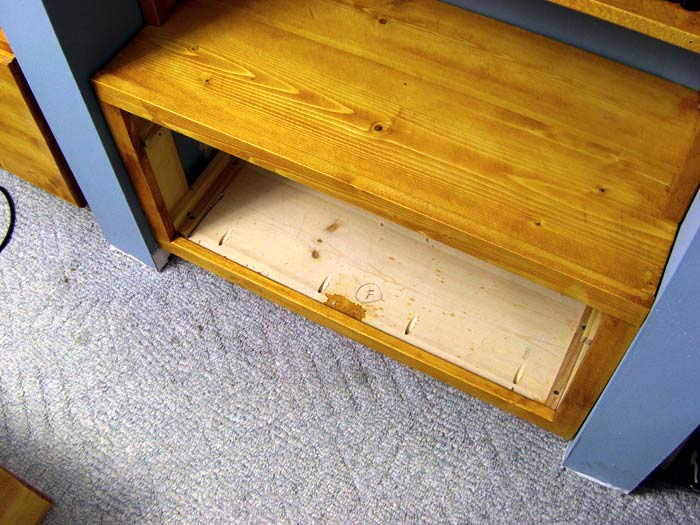
Main thing when doing pocket joinery is to make sure the pieces are clamped right 'n tight prior to drilling the pocket so everything lines up nice. Long as the pieces are square, the screw will draw the joint up exactly as clamped.
Don't suppose you'd be able to do any adjustments like I mentioned earlier after the veneer is applied. In that case, I'd want to let the wood dry naturally over time so it's stable before doing any machining.
Here's an example of face framing ... I'm thinking that's more like what you're intending to do? The frame is butt jointed and pocket screwed, then that is pocket screwed to the box. Allows some slop factor in assembly. This pic shows a dry fit that pointed out a wandering line along the dry wall. Easily solved with quick scribe and one last trip to the saw ...
Main thing when doing pocket joinery is to make sure the pieces are clamped right 'n tight prior to drilling the pocket so everything lines up nice. Long as the pieces are square, the screw will draw the joint up exactly as clamped.
sKiZo
Hates received: 92644 43.20°N 85.50°W
others felt a screw compromised the integrity of the MDF in the immediate proximity of the screw.
Not an issue if you pre-drill the holes using the appropriate sized bit ...

westend
Audiopile
If you stay with woodworking long enough you'll probably get away from MDF as much as possible. Even with the best dust collection, the dust is horrendous.
That said, Titebond III and clamps will eliminate the need for fasteners for most projects. I've glued up 3' panels without fasteners and the bond is still intact. When assembling some projects, a pin or brad nailer is helpful with speed of construction.
That said, Titebond III and clamps will eliminate the need for fasteners for most projects. I've glued up 3' panels without fasteners and the bond is still intact. When assembling some projects, a pin or brad nailer is helpful with speed of construction.
Similar threads

- Replies
- 18
- Views
- 3K


- Replies
- 9
- Views
- 963
