• Please note that Audiokarma will be offline briefly for updates early on Monday morning, September 28th.

Question about nailed and glued butt joints

A poorly aligned joint or a gap will show through your veneer like a sore butt joint.

Use a good wood filler if your cabinet joints don't line up as evenly as you intended. Feather it in so that there is a smooth transition between panels or edges. This also works to sharpen up your corners - rounded corners are a bitch to veneer.
 
If you stay with woodworking long enough you'll probably get away from MDF as much as possible. Even with the best dust collection, the dust is horrendous.

That said, Titebond III and clamps will eliminate the need for fasteners for most projects. I've glued up 3' panels without fasteners and the bond is still intact. When assembling some projects, a pin or brad nailer is helpful with speed of construction.

+1 on the dust. It is like blowing talcum powder over your entire workshop. When I do use it (and it it great for some purposes) I use carpenters glue and an 18 gauge brad nailer. Of course, some of you will say 18 gauge is too small for speakers and I would get better sound if I used 12 or 14 gauge.
 
Ah...the dust. Yes, didn't take me long to develop a strong aversion to that stuff.

I have a 16g nail gun, so I think I'll glue the joints and clamp, pop in a few 1.5" or 2" tack nails per joint then put a few glue blocks in each joint. I do like the pocket joints, but seems like overkill for what I'm doing. After this project I'll get proficient with making proper rabbet joints before I move on to my next cabinet build. Thanks for the input, guys.

Oh, and I have a nearly full bottle of Gorilla wood glue on the shelf. Titebond has been mentioned in the thread...I can't find any bad info on the Gorilla product and will go ahead and use what I have but for future reference is there something that makes Titebond the preferred wood glue over the other brands?
 
I'm a cabinet-maker and wood-worker, who knows many other cabinet-makers and wood-workers. We all use the Titebond products. None of us use Gorilla glue. I tried it once or twice and had problems, especially with any excess around joints. I'll occasionally use a cyanoacrylic glue along with an accelerator if I need to patch a mistake, but the Titebond does everything well.
As to butt joints in MDF, it's a poor method mechanically. Your idea of glue blocks on the inside will improve it tremendously. All of my cabinet carcasses are assembled with pocket screws (Kreg jig) and Titebond II or III, and remain square and sturdy while filled with LOTS of heavy dishes and such and hanging on walls.
My main use of MDF these days is as a substrate for vacuum veneering for door panels, at which it excels. But as others have mentioned, the dust is prevalent and difficult to contain. You'll be happy the day you move on to a quality plywood.
 
It depends upon what my results are intended to be, and the materials used. With a properly assembled glue joint, with either mdf or solid wood, mechanical fasteners are not required at all structurally, and I'll only use them if clamping is going to be difficult. If I have to glue a butt joint in a less than optimum fashion, for instance the frames I knocked together for attenuation panels, where one member is end grain, or when working with plywood - especially edges of plywood, I'll clamp things long enough to hold parts in place while I fasten with screws, nail, pneumatic staples...and then remove the clamps. And with edges of plywood I usually use a glue block of some sort.

Totally agree, especially with the glues we have today; TightBond, Guerrilla, etc.... If I'm building a wooden chassis bottom, after it's all squared, clamped, glued, and dry, I will take scraps and make little wedges to glue and clamp in the corners for added strength. The wood will break before the joint will come apart. If I use a biscuit it will show, and be there for looks only, made from a darker wood. That said, I would never subject a dry glue joint to the shock of driving a nail in after the glue has set, the nail would be driven with the glue wet so it could act as a clamp while the glue dries.
 
Not a fan of Gorilla products. The glue is a "all purpose" formulation that's not quite as good as it gets for most any application. Their super duty tapes are pure shite that fail quickly in heat, won't bond in cold, leaves a gooey mess when removed, and I've had entire rolls go south when the glue debonds from the cloth backing. Hard to like a tape that won't even stick to itself, ok ...

Another vote for TiteBond II ... the ultimate yellow glue here. Only caution is it will degrade if frozen, so don't leave it in an unheated shop.

And ya, MDF can be a PITA to work around, but it's sonically passive and nice for speaker projects. My McIntosh XR16's are made out of 1½" thick bonded panels and have stood the test of time.

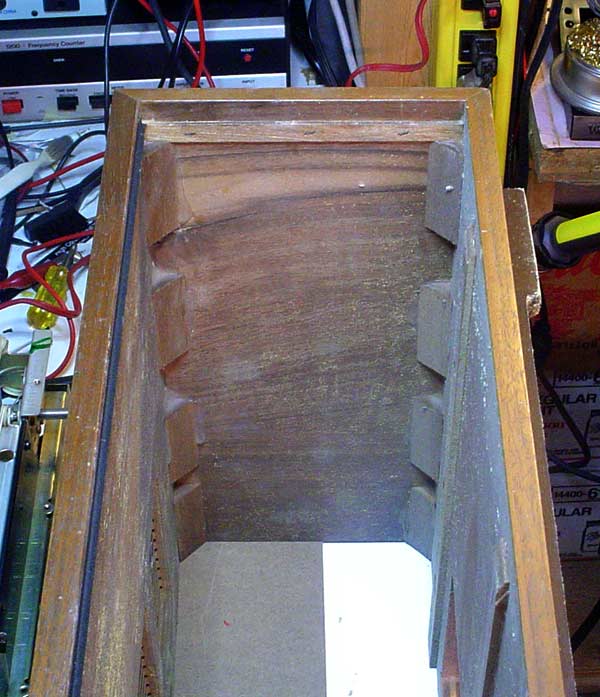
If I'm building a wooden chassis bottom, after it's all squared, clamped, glued, and dry, I will take scraps and make little wedges to glue and clamp in the corners for added strength.

Yup ... corner blocking is an excellent addition to any project if you've got the clearance. Here's the case of a Sansui QR4500 ... they weren't fooling around on this one ...

case-blocking.jpg


If I use a biscuit it will show, and be there for looks only, made from a darker wood.

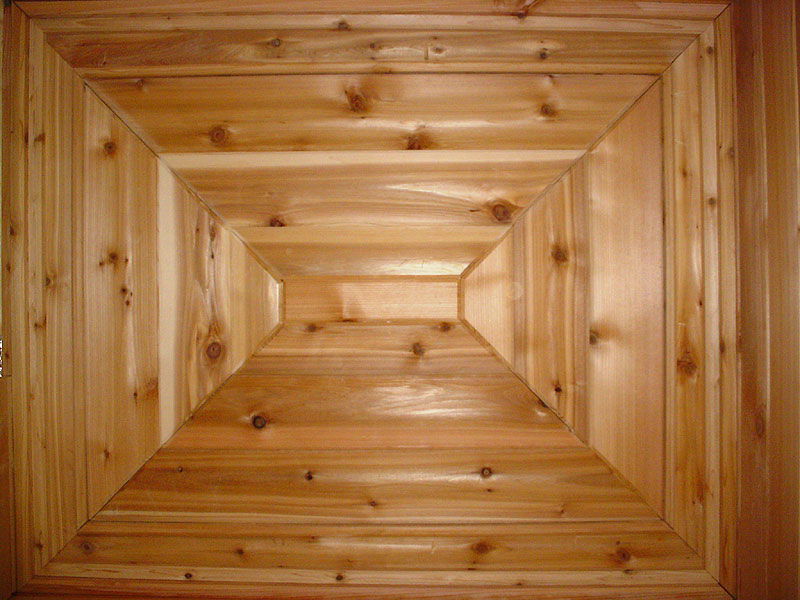
Biscuits make for a strong joint, but I reserve those for edge joining boards. Guess how many went into this ceiling panel for my sauna? I don't even know myself ... let's just say ... a lot!

SaunaCeilingInstalled.jpg
 
Last edited:
nails and screws don't add any strength to the join unless it is bent or pulled apart. If you are building something that is static, just glue it. As a test, glue two pieces of wood together then bust them apart. The break is in the wood not the glue.....glue is tough stuff.
 
The wood will break before the joint will come apart.
nails and screws don't add any strength to the join unless it is bent or pulled apart. If you are building something that is static, just glue it. As a test, glue two pieces of wood together then bust them apart. The break is in the wood not the glue.....glue is tough stuff.
Yes the wood breaks first every time with a good wood glue, but if it's only one layer of ply veneer in a butt joint that has to break, which you see all the time in DIY speaker stuff...
 
I see what you are saying. The glue is attached to only the top layer of the plywood. So with plywood a mitered joint would be better.
 
Never tried gluing a rabbit ... I usually just go for the buckshot ... <G>

Real woodworkers do it with dovetails! ;-}

dovetail_99930726_md.jpg


Real masochists do those with a chisel and saw. <G>

Got me a nice little jig that takes the work right out of that.
 
Yes the wood breaks first every time with a good wood glue, but if it's only one layer of ply veneer in a butt joint that has to break, which you see all the time in DIY speaker stuff...

I believe these butt joints fail because of the the edges of the plywood do not glue well. It's not often because the plys delaminate.
 
I see what you are saying. The glue is attached to only the top layer of the plywood. So with plywood a mitered joint would be better.

Yes, but not quite for the reason you think. The miters expose more of the flat grain of the plys, the face of it, and lessens the amount of edge grain. Plywood faces glue very well, edges don't.
 
...

Real woodworkers do it with dovetails! ;-}

dovetail_99930726_md.jpg


Real masochists do those with a chisel and saw. <G>

Got me a nice little jig that takes the work right out of that.

None of those jigs allow the variation in spacing or pitch that cutting by hand allows. This in turn forces one to build components to sizes that accommodate using the jig, rather than what may be the most æsthetically pleasing or useful. I use one regularly, don't get me wrong, but when I want to go all out on a piece it does not get used. I am assuredly not a masochist; fine furniture requires handwork. There is simply no getting around this.
 
Best to have a thin layer of glue over entire contact area of mating surfaces or a bead that spreads when mating surfaces are clamped together?
 
Whatever you have to do to ensure a uniform film is applied. Either method can work. Just using a bead has the advantage of being less prone to applying too much at the cost of being a bit more likely to give a glue-starved joint. Applying a film to both surfaces pretty much eliminates a starved joint, at the cost of being quite a bit more prone to over-application. Gotta choose your own poison and use what works for you.

Cleanup of squeeze-out is the biggest reason I prefer to use PVAs like Tite-Bond instead of polyurethanes like Gorilla Glue. The latter makes a foam that is terribly messy (REALLY messy, it seems to get on everything), and requires paint thinner to clean up when wet. The former uses a damp rag, and if caught at the right time, the little bead peels off like a bandaid.
 
Best to have a thin layer of glue over entire contact area of mating surfaces or a bead that spreads when mating surfaces are clamped together?


When working with MDF I have used both methods, and though never have had any issues. I usually go for the bead, usually I just press the two pieces together then separate them for a few seconds, and then I press them back together and clamp. Works well on MDF.

For plywood, I usually seal the edge(s) with wood glue and I let it dry. Afterwards I re-apply wood glue on the edge that will mate against the face of the other panel and join/clamp. No issues so far.


Sent from my iPhone using Tapatalk
 
I still can't help butt pucker up every time I read the thread title ...

(shudder!)
 
I believe these butt joints fail because of the the edges of the plywood do not glue well. It's not often because the plys delaminate.
Well, I don't have any beliefs concerning the matter, but every ply butt joint I've seen fail, seriously every single one, whether by accident or under my stomping foot, has left the joint intact on the end grain (so to speak) side with a ragged layer of delaminated ply from the other panel's face hanging on. It's true a face-to-face joint is going to glue better that the edges do, but it doesn't matter unless you have enough surface area being glued to make delamination a non-issue.
The miters expose more of the flat grain of the plys, the face of it, and lessens the amount of edge grain.
...bizarre claim. :scratch2:
 
Well, I don't have any beliefs concerning the matter, but every ply butt joint I've seen fail, seriously every single one, whether by accident or under my stomping foot, has left the joint intact on the end grain (so to speak) side with a ragged layer of delaminated ply from the other panel's face hanging on. It's true a face-to-face joint is going to glue better that the edges do, but it doesn't matter unless you have enough surface area being glued to make delamination a non-issue.

...bizarre claim. :scratch2:

Different experiences, obviously. I have never seen plywood de-laminate except when exposed to the weather or when an edge has been penetrated with a point fastener like a nail or screw. My claim is not especially bizarre. Cut yourself a miter in a piece of plywood and compare that to a plywood edge. Better yet, make it exaggerated, as if you were going to scarf two pieces together, and examine that.
 
Back
Top Bottom