

You are using an out of date browser. It may not display this or other websites correctly.
You should upgrade or use an alternative browser.
You should upgrade or use an alternative browser.
RCA SP-10 Restoration
- Thread starter elpulpo88
- Start date

Amorphous1
New Member
awesome man your system looks very cool
love the "nonabsolute sound audiophile" term, glad to see some coverage of the old school systems.
My friend was drooling over your sp-10s, its why I started to research them.
love the "nonabsolute sound audiophile" term, glad to see some coverage of the old school systems.
My friend was drooling over your sp-10s, its why I started to research them.

kstlfido
Member
I just finished a resto on a pair of SP-10's. Really impressed with their sonics! Vocals, in particular. Very in-the-room! Customer pleased. Thanks for the info thread; didn't realize how special these amps really are.
One had been partially restored using CE cans. I prefer to use high reliability, high-ripple current rated stuff; Nichicon UCY, United Chemicon KXJ or similar. As the OP did, I kept the original cans in place, bypassing underneath. Added CL-90 inrush current limiters and increased the dual 390Ω's to a single 250Ω. Getting 340v on the plates, so pretty much close to spec, voltage-wise. Each makes 12.5w before clipping.
Very clean resto, elpulpo88!
These and the Sherwood S-5000 are my faves for musicality. Wish I could have kept them! Piqued my interest in trying this circuit with it's plate to screen feedback for a future build.
One had been partially restored using CE cans. I prefer to use high reliability, high-ripple current rated stuff; Nichicon UCY, United Chemicon KXJ or similar. As the OP did, I kept the original cans in place, bypassing underneath. Added CL-90 inrush current limiters and increased the dual 390Ω's to a single 250Ω. Getting 340v on the plates, so pretty much close to spec, voltage-wise. Each makes 12.5w before clipping.
Very clean resto, elpulpo88!
These and the Sherwood S-5000 are my faves for musicality. Wish I could have kept them! Piqued my interest in trying this circuit with it's plate to screen feedback for a future build.
Attachments

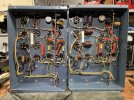
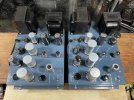
Hi,
I know this thread is a little old, but I've decide to build a stereo version of the RCA SP10. My speakers aren't all that efficient, so I will need some more power, maybe 30 watts.
Do you think the 12AU7/6AU6 front end could drive larger tubes such as a 6L6GC or maybe even a sweep tube like a 6HJ5?
If the design can accept a sweep tube, could someone please recommend one could work well as an output?
Lastly, are their good substitutes for the 6AU6 in 9-pin or octal?
Thank you all
I know this thread is a little old, but I've decide to build a stereo version of the RCA SP10. My speakers aren't all that efficient, so I will need some more power, maybe 30 watts.
Do you think the 12AU7/6AU6 front end could drive larger tubes such as a 6L6GC or maybe even a sweep tube like a 6HJ5?
If the design can accept a sweep tube, could someone please recommend one could work well as an output?
Lastly, are their good substitutes for the 6AU6 in 9-pin or octal?
Thank you all

The output transformers will be your first and most important component to choose once you decide on the output tubes and power rating. Since it is outside the feedback loop you want the best you can afford or find, IMO. I'm planning on building an SP-10 this winter. I have some PC boards from another AK'er and have done some power supply sims and have a top plate layout worked. Not sure which OPT's to use yet but I have several choices in the 7.5k to 10k range.

OPT mentions covered. Not having a long global loop it should be a whole lot less cranky about tuning than a Williamson amp in terms of making it stable.
If you're after octal pentodes to dump the 6AU6, a 6AC7 or a 6SJ7 ought to do it. I think they exist in both metal and glass depending on your visual preferences. Dump the 12AU7 for a 6SN7 while you're at it. Its more linear, or use a 6CG7 if you want to keep it 9 pin.
If you're after octal pentodes to dump the 6AU6, a 6AC7 or a 6SJ7 ought to do it. I think they exist in both metal and glass depending on your visual preferences. Dump the 12AU7 for a 6SN7 while you're at it. Its more linear, or use a 6CG7 if you want to keep it 9 pin.

I love the 6SJ7 or 6SC7 if you have the chassis space.
Thank you both for your reply and suggestion for octals. I'm a fan of the 6SN7. It's what I plant to use.
I have three sets of push pull transformers that are rated around 35 watts. They are 8K, 5.2K and 6.6K.
I was hoping for a cheap sweep tube and some more power. I have a few old 6L6. All the common types are so expensive now.
I have three sets of push pull transformers that are rated around 35 watts. They are 8K, 5.2K and 6.6K.
I was hoping for a cheap sweep tube and some more power. I have a few old 6L6. All the common types are so expensive now.
807 tubes tend to not be overly dumb money. If you want cheap though, 1625 is a 12 volt 807 with a different base. Can either run a transformer with two 6v windings, run in series for the outputs and the front end off just one of them or use a 12sn7 and a 12sj7 and run the whole thing off the 12v supply.

SP-20 is the same circuit but with PPP outputs for 20W, why not build that?

PakProtector
AK member
SP-20 is the same circuit but with PPP outputs for 20W, why not build that?
I have been working up a design for a little stereo amp. The idea of an expanded SP10/20 is not without consideration. Couple of basic ground rules: Class A, single pair finals, and an improvement if possible on the drive circuit( fraction of a mA to drive a power tube is a bit of a reach, even with evidence supporting brilliant results ).
Sooo...KT66 finals, and a 6k6 OPT. Likely running 6EJ7 drivers, and a 6CG7 arranged as LTP for the front end. Substantial thought required to bring the 6EJ7 stage up to 8-10 mA idle current, as the entire resistor set( cathode bias resistors, grid voltage divider and the FB resistors ) will need adjusted.
So I argue against myself just as I might if somebody else posted. Starts with a 10W amp is difficult to tell apart from a 20-25W amp. It is barely louder, and for speakers a Pair of EV 8"-ers like the Wolverine in a smallish flat baffle aided by a small subwoofer would absolutely ROCK. The EL84 amp I am also contemplating is a straight 2-stage amp. Pentode input and U-L rigged finals with Sherwood S5000 output iron. Much smaller...

The amps all have potential to be brilliant. Building at this stage is about stretching and trying some new-to-me stuff. Even after getting blown away by the SP20's I heard, I remain convinced there is room for subtle improvement. See Heyboer for a pair of S265Q outputs. 10k a-a with no limits to a pair of 6V6's on low frequency performance. And no worry about them being too big; they worked brilliantly on a 1619 amp that made *MAYBE 8W...10W at the outside...LOL
First step would build it as originally designed. Then live with it. Then start in on the modifications. With the big Peerless clone OPT, that bit won't be a limit. A first improvement would be a solid choke input power supply. As big a swinging choke as you can carry, and pile on capacitance until ripple is Looooooowwwwwww. Then worry about tweaking the driver/FB circuit...IMO and YMMV and all that stuff...LOL
I would take the SP10/20 performance as a lesson on the ease with which pentodes can be driven. That screen grid leaves a vanishingly low input capacitance for the 6V6 finals. The 6AU6 stage can drive it most adequately on less than a mA of plate current. Holy macaroni! Have to remember that whilst contemplating circuit level mayhem.
Douglas

maxhifi
Addicted Member
Starts with a 10W amp is difficult to tell apart from a 20-25W amp
In theory, yes, it only looks like a few measly dB. But in practice, I've had speakers that gave satisfying results with a 30W EL34 amp, and very underwhelming results with a 15W EL84 push pull amp. Similarly, a solid 100W is subjectively way more powerful than 50W. I get that it's logarithmic and 3dB isn't such a difference. And if you're not into Magnepans and inefficient stand mount speakers maybe it just doesn't matter, but my two cents is a push pull 6V6 amp will be way less versatile regarding speakers choice than the KT66 version would be, because that 25W is just at the cusp of being useful, whereas 10W is going to distort on peaks.

PakProtector
AK member
Maybe it's the added headroom, not necessarily the volume?
The other side of that power v perceived volume coin is of course, how often the amp has to clip. Even a little. Music is a peaky beast, some much more than others. Get an amplifier slightly bent out of shape by requiring more power than it can deliver and it is going to get noticeable fast. What comes to mind is a fairly typical complaint: 'amp does fine on ___ music, but seems 'congested' on ___ sorts.
Ultimately, tube amps with output Iron are going to be limited in power output. The bigger the iron, the harder and harder it gets to beat all the parasitic's effects. Leakage L and shunt capacitance do nothing good for the sonics. IME this limit is on the order of 60 Watts. So bi- or tri- amplify with an active crossover. A high frequency amplifier does not need to focus so heavily on low freq performance( large primary L ). Within reason...
The amp topology( global loop NFB or not ) will also play into OPT requirements. Soooo...experiment. It is not at all difficult to remove a passive cross over from a speaker, and drive it with multiple amplifiers...
It can work pretty well indeed.Apologies for presenting a simplified argument...LOL
Douglas
maxhifi
Addicted Member
IME this limit is on the order of 60 Watts.
I think there's good sounding tube amps up to and above 150W, but they're rare, expensive, excessively heavy, and impractical for most people most of the time. I think audio research for example do a good job with their larger output transformers, but many others don't.
Anyway all I was saying is I like your KT66 idea. Actually I bet this design could also be scaled to drive 6550s, which could also make a very cool amplifier. The earlier mention of using sweep tubes is also an interesting idea, because since the outputs are used in pentode mode, the low G2 voltage limit of sweep tubes doesn't really affect their use in this amplifier. It might actually be an ideal location for sweep tubes, although I don't think the good ones are as available as they were in the past.
north of 100 watts you're either into big boy tubes or parallel human size tubes. It all gets heavy and expensive.
Something about parallel tubes has never really appealed to me either. Seems like it would be fussier about matching and all to justify the bother, especially when we're talking little tubes. PPP 6V6 is basically a 6L6GB in terms of capability and a pair of 6L6GB are cheaper than a quad of 6V6.
Something about parallel tubes has never really appealed to me either. Seems like it would be fussier about matching and all to justify the bother, especially when we're talking little tubes. PPP 6V6 is basically a 6L6GB in terms of capability and a pair of 6L6GB are cheaper than a quad of 6V6.