• The move to the new server is done. There are some software and database maintenance updates in process. This has us passing the hat around to help out. We appreciate any donations. Seriously, even a dollar helps. The payment page may be found here - https://www.audiokarma.org/support.html

Recapping and restoring a Harman Kardon 330C

Greetings All! I know this is an older thread, but I'm hoping someone is listening... I have a 300c that is functioning, but has tons of noise/distortion and crackling, probably related to the 'known noisy transistor' problem. I'm going to use this unit as my first attempt at a recap/updgrade as my winter project. I've never attempted anything this big myself, so I'm just gearing up and ordering the parts list from Mouser.

Here's my question: I'm encountering multiple parts that are listed as 'Long lead time' etc. on the Mouser site, when I see them, Mouser offers alternatives. How do I know if the suggested alternatives will work for me, or is there another source I should pivot to for those? Any advice is appreciated. Thanks
 
I'm encountering multiple parts that are listed as 'Long lead time' etc. on the Mouser site, when I see them, Mouser offers alternatives. How do I know if the suggested alternatives will work for me, or is there another source I should pivot to for those?

Mouser and DigiKey and Arrow are, for me, the "big, first go-to" sources for these parts. If they don't have them, then it is time to start a thread asking specifically "where can I get a substitute for X?"

That being said, the very-specific part Mouser numbers like those in my HK330C-BOM-list will definitely change over time, for various reasons, so you should expect some of them to never be exact-match-found even on a big site like Mouser or DigiKey.

If you post the ones that you aren't finding, we can help you through the process of finding alternatives that are available.

For example:

  • For diodes like 625-UF4003-E3, you could search for just UF4003 instead as the rest of that part number are one specific manufacturer (there are several who make the same thing) and a sub-model number (E3) which doesn't matter much.
  • For electroltyic caps like 647-UKL1V101MPDANATD, you could search for the core values 100uF 10V (or higher), radial leads, lead spacing of 2.5mm or 5mm, instead, and just hope there are some in the Nichicon UKL (low leakage) family. If not, just about any cap will work, just not as well (for audio) as the UKL family.
  • For transistors like 512-KSC1845FTA, you may find discontinued or long lead times because that particular part number is in short supply. In that case, you could search for the core model number, KSC1845, instead and find readily-available, slightly-different-numbered ones.
 
Also, make sure to clean all switches and pots thoroughly before attempting to track down / solve noise issues. Could save you a lot of time and should be done anyway- even before a recap as it's much easier and faster to do.

I recommend removing the cover, then spraying the inside tracks and contact points of the pots and switches with plastic-safe electrical contact cleaner, followed by a light coating of DeOxit D100L in the small, needle applicator size while working all the controls thoroughly. Or, Faderlude for all the pots that have that nice, smooth tactile feeling when you turn them. D100L may 'thin out' that nice resistive feel on some of the dials (to some extent) but usually isn't much of an issue.

Let us know what caps you can't find and what sections of the board they're in. It will be easy to find alternatives.
 
Thanks guys, and thanks for your patience as I learn to navigate better on AK...

FYI, for general into, I'm a huge HK fan, I run a 730 twin as my daily driver and love it. (it was recapped and upgraded by Benny Amina and Modular Electronics here in Atlanta)

these guys were out of stock, or no longer avail on either Mouser or Digi-Key:

Power Supply
Q1 512-BD1396STU (confirming, this one is an updated corrrection to the originally listed 512- 1N5243BTPR?)
Q601 512-KSA1220AYS

Main Amp
R433, R434 71-CPF2-F-22

EQ amp
C109, C110 647-UKL1C102KHD


I'm not savvy enough to know how to find replacements that will work, any advice would be great.

*also, related... I'm not planning on working on the AM/FM board, I only use Phono and Aux, should I considering any unintended consequences of that decision?

Thanks -Sean
 
Last edited:
these guys were out of stock, or no longer avail on either Mouser or Digi-Key:

Power Supply
Q1 512-BD1396STU (confirming, this one is an updated corrrection to the originally listed 512- 1N5243BTPR?)
Q601 512-KSA1220AYS

Main Amp
R433, R434 71-CPF2-F-22

EQ amp
C109, C110 647-UKL1C102KHD

Updated 02/2025

Q1
Q1 was originally 2sd414 used as a voltage regulator... so nearly any will do... assuming it fits in that spot right (package TO-126) and has the correct pinout. When I look up 2sd414 at alltransistors.com, clear out the unnecessary specs (HFE, Ft, Cc, R1, R2) that don't apply to use as a voltage regulator, I get a long list of potential substitutes. When I look up the important specs on Mouser (through hole, NPN, TO-126, >=16V, >=1A, ECB, in stock) I get a bunch... and several of them are the BD139n series... all the same, just better at amplifying. So, you could use:

  • BD139-10
  • BD139-16
  • BD135-10
  • BD175-16
  • KSD882
  • KSD794
  • MJE15034G dlucy's preference
  • MJE180
  • FJE5304

Q601
Q601 could be replaced by (just be careful matching original pinout to new replacement's pinout):

  • BC556
  • BC638
  • BC640
  • BD138
  • BD140
  • KSA1013
  • KSA1015 dlucy's preference
  • KSA1142
  • KSA1281
  • KSA1381
  • KSA708
R433, R434
R433, R434 are just 22 ohm 2 watt resistors, so nearly anything big and beefy would do. You could use something other than the Vishay CPF series (Vishay PRO would be good) or go up in wattage and stay in the CPF series:

  • PR02000202209JR500
  • PR02000202209JA100
  • PR03000202209JAC00
  • PR02FS0202209KR500
  • CPF322R000FKE14 my preference
  • CPF222R000FKE14 my preference

C109, C110
C109, C110 on the EQ amp just need to be 100uF or higher, 16V or higher (but higher you go, the bigger the cap is physically), and preferably low ESR (like the Nichicon UPW series). When I search for these specs on Mouser, I find most lower values are no longer carried, but the 220uF have several that are in stock:

  • UPW1C221MPD
  • UPW1C221MPD1TA
  • UPW1C221MPD1TD
 
Last edited:
Ok... bit of a problem. I replaced the caps on the main power board, and now I've lost the right channel completely. I don't have great gear to test, but here's what I can diagnose easily.
-When powered up I read juice in all the caps
-When powered down, only one of the C3, C4 caps holds charge.
This board is not labeled so I'm having trouble identifying what's what. I'm pretty sure I got the caps in correctly, is it possible one of the big boys is bad 'out of the box'? Not sure where to start with further diagnosis. The only other board I worked on was the EQ amp (the little guy on the side)

Any ideas?
 
Ok... bit of a problem. I replaced the caps on the main power board, and now I've lost the right channel completely. I don't have great gear to test, but here's what I can diagnose easily.
-When powered up I read juice in all the caps
-When powered down, only one of the C3, C4 caps holds charge.
This board is not labeled so I'm having trouble identifying what's what. I'm pretty sure I got the caps in correctly, is it possible one of the big boys is bad 'out of the box'? Not sure where to start with further diagnosis.

It is possible, but unlikely, that a cap you bought directly from Mouser, Digikey, Arrow, etc. is dead or bad on arrival. Possible, but unlikely.

More likely would be: you installed something not exactly right, some wire is unattached or solder joint cold or not fully formed, an adjacent component was jostled and loose now, or a wire leading somewhere that was marginally or stressed is no longer connected fully.

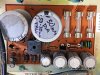
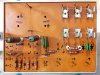
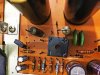
Here are some photos to help diagnose:

DL-POWER-SUPPLY-board.jpg IMG_4623.JPG IMG_4637.JPG IMG_4645.JPG
 
Thanks dlucy, now I'm leaning towards a bad solder as the culprit... The underside of this board has the heaviest solder I've encountered and it was a challenge to unsolder, re-solder in general. Any tips on working with these huge solder tracks? My joints currently, at least on the big Caps are a blobby mess.
 
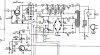
Don’t know if anyone is still watching this thread, but in the process of restoring a Harman Kardon 330c I’ve run into a few problems. I can’t get the -36.6V on the collector of Q601. Thanks for all of the info in this thread.
 
Don’t know if anyone is still watching this thread, but in the process of restoring a Harman Kardon 330c I’ve run into a few problems. I can’t get the -36.6V on the collector of Q601. Thanks for all of the info in this thread.

Q601 is "supplied" from LP413 and LP414 via LP11, right? At LP413 and LP414 on the main amp board, what are you getting?

Are C405 and C406 OK?

Are D401 and D402 working properly?

Are you getting the full voltage at LP403 and LP409?
 
BTW I started a thread, Harman Kardon 330C Q601 pnp, if anyone wants to read it. I’m new at posting here and don’t know all the rules about “hijacking” a thread.
 
hello.. what replacements to use in hk300c instead:

2sc1345:
2sc1344:
2sa777:
2sc1509:
2sd476A:

Thank you in advance
Some recommend ksc1815yta for 2sc1344/2sc1345, but they only have a gain of about 240 if you’re lucky. I went with BC550cta for those. They have a minimum gain of 420. But the pinout is Collector-Base-Emitter. You have to put some very thin heat shrink tubing or silicone tubing on the collector and base pins and bend them around so they go B-C-E. You don’t have to bend them much because of the triangular shaped hole patterns on the boards. I did not change 2sa777 or 2sc1509 as mine were working and these transistors are not prone to go noisy, as far as I know. I’m curious as to why you would want to change the main outputs. Are their voltages way out of spec? Do you have an oscilloscope and a way to input a signal into the unit? I think you can use a smartphone or a computer if you don’t have a function generator.
 
thank you for the hint.. I was mainly referring to the two you mentioned.. I will not change the rest.. I asked just out of curiosity and what.. and sorry for the spelling.. my English is poor
 
I understand you fine Tomek. They say English is one of the hardest languages to learn because it’s so irregular. It doesn’t have nearly as many rules as other languages. Good luck with your transistors.
 
Back
Top Bottom