• The move to the new server is done. There are some software and database maintenance updates in process. This has us passing the hat around to help out. We appreciate any donations. Seriously, even a dollar helps. The payment page may be found here - https://www.audiokarma.org/support.html

Recapping and restoring a Harman Kardon 330C

@dlucy, I did some sweep on it yesterday. Amplifier is dandy, it does what it is supposed to do. Pretty flat response at mid point and then expected movements when bass and treble are adjusted. So, I guess I will have to give it another listen and look elsewhere. This this is doing around 24W but I suppose at 20 it is super clean. I do not have many audio testers, just a function generator and Oscope :). Did some simulation of the tone control board, trying to make the power one working now...
 
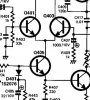
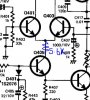
Oh, a question for all of you reading this. I noticed main amp schematic to be different than actual realization of the board at least at one place. Emitter of Q401 and Q403 are connected with Collector of Q405 directly on schematic but on board there is a resistor between two connected emitters and Q405 collector? I think the value of that resistor is 5.6K, can someone confirm please??

Below is what schematic has:

Schematic.JPG

This is what I found on board:

On board.JPG
 
This this is doing around 24W but I suppose at 20 it is super clean.

Oh. Yeah, the 330 is going to start clipping between 20 and 23 watts, depending on which output transistors you have (and how much you've replaced or modified), so you _should_ expect distortion above 20 watts.

The signal generator and the oscilloscope are great tools for watching the output, adjusting until you have symmetric clipping _just_ as it starts to clip, and then knowing exactly how loud you can crank it up before audible distortion appears.
 
Oh, a question for all of you reading this. I noticed main amp schematic to be different than actual realization of the board at least at one place. Emitter of Q401 and Q403 are connected with Collector of Q405 directly on schematic but on board there is a resistor between two connected emitters and Q405 collector? I think the value of that resistor is 5.6K, can someone confirm please??

Below is what schematic has:

View attachment 1349579

This is what I found on board:

View attachment 1349578

Is this mod done to both channels? Or just one?

The 330A and 330B have several board variations across the different manufacturers and across the years they were made. Ive never noticed a deviation from the right schematic for a board and the actual board itself, but I don't think assembly mods would be unusual. Unless this is not a factory mod, then it is really interesting and worth additional scrutiny.
 
It is on both channels. And I did take it to clipping and backed off so it was in linear region, calculated power was around 24 Watts, no way to tell what was the harmonic level at the point as it is close to saturation. I might put it on spectrum analyzer some day. Once I have my simulation working for main amp, I can play with variations.
 
This is beautiful. I have a HK330b that I am looking for a case for. Do you sell the cases you make?

Thanks very much. I was making and selling them when I had a woodshop. I got separated and moved into much smaller digs, so no woodshop right now. Also means all my big speakers are languishing right now in a storage bin. :(
 
Thanks very much. I was making and selling them when I had a woodshop. I got separated and moved into much smaller digs, so no woodshop right now. Also means all my big speakers are languishing right now in a storage bin. :(
Ahh. Sorry to hear that. My hunt continues then. All the best to you.
 
Getting my Mouser order ready for my H/K 330c right now. A few of the parts were out of stock but I think I found suitable replacements. The only one that's questionable is the 512-KSA1220AYS replacement transistor on the power board. I'm having a hard time finding another transistor to substitute it. Any ideas?
 
Is anyone else confused by the left/right speaker fuses? It's printed '2A2AG', however it seems they only fit 3AG...
 
Hello guys! I need a little help, i got Harman Kardon 330c as a gift from my friend, after the first power on i notised that all lamps are dead (the sound is there and sound good enough).... after that i opened receiver and saw a non-original transformer, all fuses on rectifier board is OK. Voltages in points (according to service manual) +B1=29.5 -B1=-29.5 +B3=15.3 -B3=-15 B4=18.8 (bigger on 6 volts). Voltage on the secondary windings of the transformer is +21.4 -21.4 and winding that feeds the lamps and FM\AM Tuner board is 15V (I think it's a bit much).

Who can measure the voltages on the windings of the original transformer (they are not given in the service manual for transformer), please measure and write the voltage values, then if necessary I will rewind the winding that feeds the lamps and tuner boards.
Thanks in advance and sorry for my english, i am from Ukraine.

GofPpHzy7LApwzWrhSX3I-vpF_nvRonkOfZUy9IfsRhdvj4N1GCRjzcg53tRL3I1BK-_74MBygwjltp65biavbcSqyDoL0VF2iWmvVTkc1lUdORKZAcBVm8KnTOMhyWCtSOp6bq1P7Sal5DZMrTndd-pRDEHH-YvMHtbGTfeVnHoqz_-Be3J8Mx-yu9FEHoqeRCxB1k-t1CDcS-W8_q8Pp7iURhZi8w71iXSaVZClcI4XyuyKMuxz8y8sp93Z_rCiAUpep_2UxrD_2rbkFWLqaIIdQe0hlxYMTfKHTCMRRQdVyThtRgOqe8Ltj9XkhpyKgzqlAiPk5y8BWzrefKdTP9Ukv7azkr7Nz4EScv1mtXGuoTmOURGW8Mt9V7PxvGPRo574H_a61gpsOV2QgvsyF2g6okuOm06W60ocwzV7_IyPs7c-OgUVm-bjoJKZZkPaOfoGOZDX34zd-2mflHQpSaxKvdeDQTp-TIQJqiVIlhzCcZ_fmCjKmjFDMN7gKevvOU4uot35dEsV4I1x-eCcw_Vz0vbrkYuPNN7bafqwZXzzW25YmgUsVeG8884WWIj21WIJ0F48GvDceFKOCrzOPjDiIe6YDh602KUkwTaJexcea8OjzZHViTrIQu2cmyQxxiDVX7vrZ8t1Bv3Bpr5hdBHeWSuM3fAOGSJU92c-kvpOLa-y_pJ20Y=w1560-h734-no
 
Last edited:
The key to getting long leads on WIMA MKP, MKS, FKP or FKS series caps is to order the cut tape or reel packaging. If you don't order this way, you'll get short 2mm to 5mm leads which make matching the original holes in the PCB difficult.

An example of bulk or ammo pack versus cut tape or reel:

View attachment 1266225

Aaaand, here you are again. I type in a beginner question and you have the answer.

Long leads/cut tape. I default to bulk for easier picking and now I know that's the wrong answer.

Again, thank you!
 
Aaaand, here you are again. I type in a beginner question and you have the answer.

Long leads/cut tape. I default to bulk for easier picking and now I know that's the wrong answer.

Again, thank you!

Every single one of my answers started off as beginner experience... which turned into some kind learning experience for me... and then into shared learned experience here. ;)
 
I wouldn't say there's anything wrong with buying bulk caps vs. cut tape or reel packaging. Price is generally about the same. Bulk caps aren't useless unless the lead spacing on your pcb differs greatly from the lead spacing on your replacement caps or the cap is located in an extremely awkward or inaccesible part of the board where you really have to "reach" for the holes or even bend those long leads to make them "wrap-around" nearby components that obstruct pcb holes.

Thankfully, this doesn't happen all too often when using a good, thin needlenose pliers with adequate reach to install them. Also, bulk caps take up less storage space and are cleaner to install because you don't have to deal with removing the sticky tape residue off the leads with a razor blade before inserting them through (often times) very small pcb holes which barely fit the lead diameter. Also, sometimes the added lead length of cut tape caps can be a liability and have to be snipped off anyway just to make them seat all the down when dealing with occasional space contraints or other obstructions underneath a pcb.

However, there is one other advantage to cut tape besides their additional lead length. You can test each for capacitance just One time (if you're interested in putting together matched pairs) by simply testing and then writing each cap's corresponding uf value directly on the paper in front of it. This way you can see all the actual, measured cap values at a glance, which is nice, and both easier and quicker when putting together matched pairs of capacitors for different projects- preventing you from ever having to check capacitance twice on any future, replacement cap to obtain matched, stereo L/R pairs on all the work you do.

I will say it's more satisfying and easier tightening longer leads prior to soldering. Also, if you plan on any future DIY projects or point-to-point wiring, you'll appreciate the longer leads to help compensate for the inevitable component spacing/ bridging issues you'll encounter.
 
Last edited:
I wouldn't say there's anything wrong with buying bulk caps vs. cut tape or reel packaging. Price is generally about the same. Bulk caps aren't useless unless the lead spacing on your pcb differs greatly from the lead spacing on your replacement caps or the cap is located in an extremely awkward or inaccesible part of the board where you really have to "reach" for the holes or even bend those long leads to make them "wrap-around" nearby components that obstruct pcb holes.

I agree with you 100% on there being nothing wrong with buying in bulk, loose, ammo packs, etc.

When I'm buying parts, I normally buy more than I need for just one project and at least enough to cover a mistake from me. When I have a need for a 680K resistor and I have none, I look to see how affordable qty 100 would be... and most times buy that much so I have parts on hand for the next project. This buy-for-more-than-one-project approach, however, means I will be buying to fit more than one application, one PCB location and layout. I've found having 100 Panasonic 2.2 uF 250 V caps with 15mm lead spacing and short leads ends up being more of a pain than 100 of the same part with long leads that can be bent, stretched, added to as needed for many different applications.

But that's all my oddball, OCD nature. Knocking down the qty 1 price of $0.49 to $0.11 at qty 100 appeals to me, buying with long leads to fit easiest in many applications appeals to me, and ending up with a big shoe box of clear plastic Mouser baggies with lots of ready-to-go and no-extra-shipping-or-wait-time-needed appeals to me. But it's all just one way o doing things.

However, there is one other advantage to cut tape besides their additional lead length. You can test each for capacitance just One time (if you're interested in putting together matched pairs) by simply testing and then writing each cap's corresponding uf value directly on the paper in front of it. This way you can see all the actual, measured cap values at a glance, which is nice, and both easier and quicker when putting together matched pairs of capacitors for different projects- preventing you from ever having to check capacitance twice on any future, replacement cap to obtain matched, stereo L/R pairs on all the work you do.

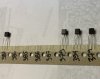
And THERE is some seriously good advice! I end up writing the hfe (gain) of transistors directly on the cut tape / reel paper as I'm looking for matching values. The Atlas Peak DC or cheap component tester makes it quickly to find the value and writing it down on the tape then selecting the best match out of several dozen... leaves me with pre-measured, labeled transistors for next time.

HFE of transistors marked directly on cut tape.jpg
 
I wouldn't say there's anything wrong with buying bulk caps vs. cut tape or reel packaging. Price is generally about the same. Bulk caps aren't useless unless the lead spacing on your pcb differs greatly from the lead spacing on your replacement caps or the cap is located in an extremely awkward or inaccesible part of the board where you really have to "reach" for the holes or even bend those long leads to make them "wrap-around" nearby components that obstruct pcb holes.

Thankfully, this doesn't happen all too often when using a good, thin needlenose pliers with adequate reach to install them. Also, bulk caps take up less storage space and are cleaner to install because you don't have to deal with removing the sticky tape residue off the leads with a razor blade before inserting them through (often times) very small pcb holes which barely fit the lead diameter. Also, sometimes the added lead length of cut tape caps can be a liability and have to be snipped off anyway just to make them seat all the down when dealing with occasional space contraints or other obstructions underneath a pcb.

However, there is one other advantage to cut tape besides their additional lead length. You can test each for capacitance just One time (if you're interested in putting together matched pairs) by simply testing and then writing each cap's corresponding uf value directly on the paper in front of it. This way you can see all the actual, measured cap values at a glance, which is nice, and both easier and quicker when putting together matched pairs of capacitors for different projects- preventing you from ever having to check capacitance twice on any future, replacement cap to obtain matched, stereo L/R pairs on all the work you do.

I will say it's more satisfying and easier tightening longer leads prior to soldering. Also, if you plan on any future DIY projects or point-to-point wiring, you'll appreciate the longer leads to help compensate for the inevitable component spacing/ bridging issues you'll encounter.
When full length leads aren't necessary (which is most of the time), I simply cut the leads at the tape to eliminate the goo infested portion. Though there have been many times I needed the full length. Touching the goo with your hot iron and "presto", it wipes right off. The same with transistors, plus matching is easy writing the value(s) on the tape and handling them by the tape for consistent temperature.
 
I agree with you 100% on there being nothing wrong with buying in bulk, loose, ammo packs, etc.

When I'm buying parts, I normally buy more than I need for just one project and at least enough to cover a mistake from me. When I have a need for a 680K resistor and I have none, I look to see how affordable qty 100 would be... and most times buy that much so I have parts on hand for the next project. This buy-for-more-than-one-project approach, however, means I will be buying to fit more than one application, one PCB location and layout. I've found having 100 Panasonic 2.2 uF 250 V caps with 15mm lead spacing and short leads ends up being more of a pain than 100 of the same part with long leads that can be bent, stretched, added to as needed for many different applications.

But that's all my oddball, OCD nature. Knocking down the qty 1 price of $0.49 to $0.11 at qty 100 appeals to me, buying with long leads to fit easiest in many applications appeals to me, and ending up with a big shoe box of clear plastic Mouser baggies with lots of ready-to-go and no-extra-shipping-or-wait-time-needed appeals to me. But it's all just one way o doing things.


And THERE is some seriously good advice! I end up writing the hfe (gain) of transistors directly on the cut tape / reel paper as I'm looking for matching values. The Atlas Peak DC or cheap component tester makes it quickly to find the value and writing it down on the tape then selecting the best match out of several dozen... leaves me with pre-measured, labeled transistors for next time.

View attachment 1828029

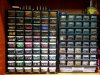
Just do them *all* at once so there are no temperature variations between "batches", and use the tape as a handle. I buy them by the 100 (minimum) and cut them in strips of 10. Then grab some coffee and test away. 10 per fit in my drawers perfectly too.
 
I agree with you 100% on there being nothing wrong with buying in bulk, loose, ammo packs, etc.

When I'm buying parts, I normally buy more than I need for just one project and at least enough to cover a mistake from me. When I have a need for a 680K resistor and I have none, I look to see how affordable qty 100 would be... and most times buy that much so I have parts on hand for the next project. This buy-for-more-than-one-project approach, however, means I will be buying to fit more than one application, one PCB location and layout. I've found having 100 Panasonic 2.2 uF 250 V caps with 15mm lead spacing and short leads ends up being more of a pain than 100 of the same part with long leads that can be bent, stretched, added to as needed for many different applications.

But that's all my oddball, OCD nature. Knocking down the qty 1 price of $0.49 to $0.11 at qty 100 appeals to me, buying with long leads to fit easiest in many applications appeals to me, and ending up with a big shoe box of clear plastic Mouser baggies with lots of ready-to-go and no-extra-shipping-or-wait-time-needed appeals to me. But it's all just one way o doing things.


And THERE is some seriously good advice! I end up writing the hfe (gain) of transistors directly on the cut tape / reel paper as I'm looking for matching values. The Atlas Peak DC or cheap component tester makes it quickly to find the value and writing it down on the tape then selecting the best match out of several dozen... leaves me with pre-measured, labeled transistors for next time.

View attachment 1828029

Just do them *all* at once so there are no temperature variations between "batches", and use the tape as a handle. I buy them by the 100 (minimum) and cut them in strips of 10. Then grab some coffee and test away. 10 per fit in my drawers perfectly too.

Making another Mouser list I think I'm going to graduate from the "10 club" to the "100 club", I'll have to revisit my storage method but I'll save a bundle and have them when I need them.
 
Back
Top Bottom