• The move to the new server is done. There are some software and database maintenance updates in process. This has us passing the hat around to help out. We appreciate any donations. Seriously, even a dollar helps. The payment page may be found here - https://www.audiokarma.org/support.html

Recapping AR-4X

Go figure. :scratch2:
It's kinda like replacing the fan belt. Next thing you know you're rebuilding the alternator 'cause the bearings are shot.

It's still about the fan belt. :p:

**********

Tweeters ordered per your recommendation.... :thmbsp:

 
It's still about the fan belt.... :p:

Wait, AR-4x has a fan belt? That changes everything! You've got to check the timing to make sure you're not causing interference. That may be where the 2kHz dip is coming from. If the fan blades are ~3" long then you're probably getting a cancelling reflection from the acoustic impedance change at the end of the blade.

For those who think "pshaw!" to speakers with fans, check out the Thigpen radiator here:http://www.soundimage.dk/Different-col/LinearMotor.htm

:D

Ray
 
Black curve in first pic is what happens when the pot is removed entirely, a bad idea.
attachment.php


attachment.php


ar4x_oa.gif


Zilch, if I'm reading your first graph above correctly, I'd say the black curve is the preferred solution.

When you look at all of these graphs, it looks like at 10KHz we are down 4 db with no pot and much worse with a pot at any setting. Then when you look at the last graph, it seems that if we can get as much out of the tweeter as we can (ie no attentuation except for freqency band pass), our only problem would be the need for a slight boost in the bass to achieve a flat response. Since most bass controls center around 100Hz, we should easily be able to achieve a modest boost to bring the bass in balance with the tweeter.

Now, I admit that I'm ignoring the response above 10KHz, but that's intentional. Most of us can't hear it anyway and our dogs certainly don't care. Then for those who can, there is very little music there anyway.


Regards,
Jerry
 
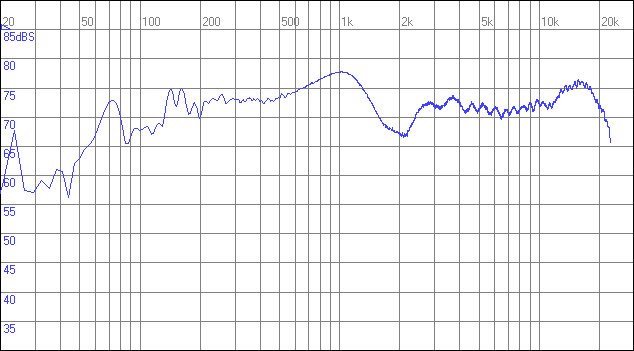
Here's a redo using windowed MLS with more clarity, this time using tweeter #2, as that's in the box right now. You can see that by removing the pot entirely, you're providing 1.7 dB of effective differential boost at 1 kHz (and more just below there,) when the purpose of the filter is apparently to knock that down in the factory voicing.

The reason this occurs is, without the 15 Ohms resistance of the potentiometer across the driver, the impedance "seen" by the filter is higher, and the effect of the capacitor begins at a lower frequency; thus, it's not as effective at 1 kHz.

At what frequency is the effect of the capacitor first evident in the black curve (no resistor) versus the red one (15 Ohms)?

attachment.php


Are we picking nits here? Well, maybe, but there's no denying the voice is being altered; the increased tweeter output does not uniformly extend across the full HF bandwidth, as many have supposed, and the differential action's all below 5 kHz....
 

Attachments

  • Tweet #2 Attenuation.jpg
    Tweet #2 Attenuation.jpg
    60.1 KB · Views: 513
Now, I admit that I'm ignoring the response above 10KHz, but that's intentional. Most of us can't hear it anyway and our dogs certainly don't care. Then for those who can, there is very little music there anyway.
That's just wrong, Jerry.

There's major content up there in virtually all music, and chances are you and most others CAN hear it. It's clearly visible on an RTA monitoring the playback. Every hit on the cymbals, for example, displays a burst of HF out to 20 kHz.

Kick a 24 dB/octave 10 kHz lowpass filter in and out on any system that has good HF, and it'll be immediately apparent that all of the tizz and air goes missing.... :yes:
 
Well, Zilch, I have a set of Koss Pro 4 Plus headphones, signal generator and a scope. I know for a fact that I cannot hear any pure sine wave beyond 11KHz.

Zilch, have you tested your hearing?? Most males over 40 start losing hf hearing and hf sensitivity continues to decline as we age.

Nevertheless, I can still hear cymbals. I listen to jazz trios all of the time, so the fundamental frequencies of the cymbals must be way below 11KHz. What you see on scopes are the harmonics.

Regards,
Jerry
 
Are we picking nits here? Well, maybe, but there's no denying the voice is being altered; the increased tweeter output does not extend across the full HF bandwidth, as many have supposed, and the action's all below 5 kHz....

Yep, probably are nit picking! It's a little hard to believe, however, that the 15 ohm resistor dissipates zero power at 10Khz and that's what your curve says!

I mean, is it possible that no current flows through the 15 ohm resistor at 10Khz?? Theoretically shouldn't approx 10% flow through the resistor and 90% through the tweeter?

Regards,
Jerry
 
Todd, that sounds about average!

The hf loss gradually increases with age and eventually we start experencing lf loss as well.

The good news is even in our 90's we'll still be able to hear our wives talk/nag!

Alas, there is no justice!

Regards,
Jerry
 
Well, Zilch, I have a set of Koss Pro 4 Plus headphones, signal generator and a scope. I know for a fact that I cannot hear any pure sine wave beyond 11KHz.
I've had this discussion in other forums. I can't hear sine waves up there myself, either, and haven't heard a TV whistle in 20 years, but I seem to perceive high frequencies in music or pink noise well enough to get the balance correct by ear. The proponents of ultra uber-tweeters argue that there are other means at work which allow us to "hear" out to 40 kHz and beyond. Of course, there's also a major industry trend unfolding which relies upon that concept for sales and income. :yes:

Yep, probably are nit picking! It's a little hard to believe, however, that the 15 ohm resistor dissipates zero power at 10Khz and that's what your curve says!
By my calcs, it's more like 20% of the power is going into the resistor, actually, no?

BUT, I just re-verified, using the tweeter, 20 uF capacitor, and a 15-Ohm resistor, so I'm gonna punt, say "inductive reactance," and pass the baton to Ray to explain why that is.... :p:

Ooops, just figured it out. It's dB shown, of course, 10 log power ratio, and the difference is less than 1 dB. We all knew that, right? If HALF the power was going into the resistor, the tweeter output would only drop 3.01 dB. :cool:

[No need to wake Ray up.... :boring: ]

What it is, the differential without the resistor, here shown at 2 dB/Div, 0.2 dB above 10 kHz, and 2.1 dB at 1 kHz. I'm suggesting it matters with respect to AR4x voicing:
 

Attachments

  • Tweet #2 Attenuation Exp.jpg
    Tweet #2 Attenuation Exp.jpg
    63.7 KB · Views: 29
While I do not understand the science of these measurements, it seems obvious to me that it a 15 ohm rheostat is an integral part of the crossover netwrok, removing it is going to change the nature of the speaker. With the AR's we have both history and art from some of the most influential men in the audio world of all time. I don't think we should argue with what they created.

While not everyone will want to spend $25 each for 15016 ohm replacements, I do recall a creative approach using the readily available 8 ohm L-Pads and incorporating an additional resistor to bring the total close to the original 15 ohms. Removing the rheostat and/or biamping/EQ'ing to compensate far removes us from the original beauty of these magical speakers.

AR's of this vintage have very simple yet very well thought out (maybe elegant) crossovers. I don't think we should question the design that generated such overwhelmingly positive reviews and earned over 30% of the audio market - just think almost 1 in every 3 speakers sold back then was AR. Changing then compensating for those changes is an interesting experiment but it's not going to allow you to enjoy these pieces of history for what they are - fantastic speakers :yes: :banana: :tresbon:
 
One more thought on this. While all the above seems to focus on db changes, isn't the real problem in removing the pot the fact that it will increase the crossover freq thereby creating a hole in the spectrum?

I recall Dr. Audio pointing out that going from 15 ohms to 8 ohms doubles the crossover freq. Let's say crossover is designed at 1500. halving the resistance raises it to 3000!

Not sure what the effective change in ohms seen through the pot is from min to max but I don't think it's 0-15 ohms. So whatever the effective ohm reading would be at max position compared to 0 ohms taking the pot out will enable calculating effect on the crossover point.

So you could end up with a louder tweeter but loose a chunk of frequency range going to that tweeter.

Maybe folks here who know a lot more about this than me can chime in.
 
Zilch, would you mind explaining in more detail what changes you made to crossover the tweeter and early woofer higher (to take care of the 2000hz funny business)?

Nevertheless, I can still hear cymbals. I listen to jazz trios all of the time, so the fundamental frequencies of the cymbals must be way below 11KHz. What you see on scopes are the harmonics.
Yes, and harmonics are what enable you to distinguish between an oboe and a clarinet. Timbre is in harmonics.
 
I did manage to make a big ol' hole in the response in the third image of this post:

http://audiokarma.org/forums/showthread.php?p=1375204#post1375204

As you suggest, the interaction among the components is complex, and while the changes I made to the crossover in that specific instance to "improve" one generation of AR4xs may actually have accomplished that (I thought so,) it changed them in a fundamental way. I also showed that it would not work well with other generations of AR4xs.

So, both philosophically and practically, I believe I've demonstrated throughout this simple exploration and exposition that, if the objective is to restore the original product performance, there's merit in looking to methods involving minimal intervention. There are measureable differences which occur with any other approach, and these should be rigorously evaluated when considering alternatives.

Certainly there are compromises in the original design, and they may not be consistent with contemporary standards and/or performance objectives in some ways, BUT, used as intended, stock vintage AR4xs stand up quite well from a frequency response standpoint, once restored:

attachment.php


Does that mean they cannot be "improved?" Well, no -- new tweeters are on order per Ray's suggestion; we'll see how that goes here soon.... :thmbsp:
 

Attachments

  • What Zilch Knows.jpg
    What Zilch Knows.jpg
    49.7 KB · Views: 381
Thanks Zilch. I'm starting to get the jist of these curves. That hole is very evident.

I have a pair of older 2AX's. When I went through them using 8ohm L-Pads I was not happy with the sound. Felt like I was missing something in the midrange. I went back in and used cleaned up pair of originals and viola sound was more right.

I think this problem is worse in older 2AX's than later as crossover for mid and tweeter are already significantly higher in the old model. So it makes the change in crossover freq much more apparent.
 
Zilch, would you mind explaining in more detail what changes you made to crossover the tweeter and early woofer higher (to take care of the 2000hz funny business).
No problem, but bear in mind this is just me diddling around to illustrate stuff, and not a recommended anything:

These early cross-hatch woofers (from 1966, apparently) play up into that range, though AR didn't use them there, at least not in Duff's pair, which have a full blown two-pole lowpass filter an octave lower. I let them do that by using the #4 inductor (~1 mH, my pair) in series with the woofer as a single-pole lowpass. The curves show the result.

For the tweeters, I looked in the Parts Express crossover design charts at 12 dB/octave highpass, 3 kHz for starters. It says 0.3 mH, 9.4 uF. I had 10 uF and tried that. You can see it's higher than what I was thinking would be optimum, but it worked well enough to tell me it'd be worth refining if I wanted to go that way. I could probably tweak it better, but the goal of dumping (well, significantly attenuating) the notch and everything below it was achieved. It may take third-order or a series notch filter to do that more effectively. :yes:

I then swapped in the later woofers, which simply don't play that high; the result was poor to terrible, so this would not be suitable for use as a generic upgrade. It's clear it'd not be easy to mate them with the standard tweeter response in that region, and I suspect it's cone mass allowing them to play lower in the bass, which may at the same time be incompatible with producing quality response at the higher end. That's why I say there's much more to do working out such an option; it's redesigning the speakers, really, and not the objective. I'd switch to newer JBL woofers for that, most likely, as I did in my earlier work with AR4xs, and use a more thorough and analytical design procedure.

Still, that's kind of how it happens here, ultimately, an interative process the hard way: design, measure, tweak, measure, listen, measure, tweak, measure, listen, 'til I deem it "Done." Well, temporarily done, at least; everything's works in progress.... :p:
 
BUT, I just re-verified, using the tweeter, 20 uF capacitor, and a 15-Ohm resistor, so I'm gonna punt, say "inductive reactance," and pass the baton to Ray to explain why that is.... :p:

Ooops, just figured it out. It's dB shown, of course, 10 log power ratio, and the difference is less than 1 dB. We all knew that, right? If HALF the power was going into the resistor, the tweeter output would only drop 3.01 dB. :cool:

[No need to wake Ray up.... :boring: ]

Wake up??? I'm still trying to figure out what sport we're playing where you punt and then pass the baton!

Good explanation, btw!

I'm really enjoying this thread. Oh, and I was originally tipped about that TB tweeter by the CEO of Parasound. I took his word for it and when I played with it, it sounded pretty good so I'm just passing along the info. Don't know that he ever used it in production but he seemed to like it and he's got a pretty good ear. ;)

Ray
 
One more thought on this. While all the above seems to focus on db changes, isn't the real problem in removing the pot the fact that it will increase the crossover freq thereby creating a hole in the spectrum?

db changes are what this discussion is all about, sharky. Any hole would show up as a reduction is db at some frequencies.

There is no "hole" caused by removing a pot. Further, you have it backwards. When you remove a pot you raise the net resistance and this decreases the xover frequency.

Nevertheless, the differences are pretty slight. As Zilch said we are dealing in the range of 1 db and less. Please bear in mind that for most folks 1 db is on the borderline of whether they can detect any difference.


Regards,
Jerry
 
Certainly there are compromises in the original design, and they may not be consistent with contemporary standards and/or performance objectives in some ways, BUT, used as intended, stock vintage AR4xs stand up quite well from a frequency response standpoint, once restored:

Does that mean they cannot be "improved?"
Zilch, I applaud your work! :banana:

Even the designers of the AR-4 made clear they were not perfect:

attachment.php


At the time the AR-4's were popular the roll off in hf's was not a serious problem, because back then the record companies enhanced hf's on records to compensate for the poor sound reproduction equipment available in the mass market.

Today with digital playback, those deficienices become more apparent and that's why many folks seek modern tweeters for these vintage units. For three reasons I recommend by-passing those pots:

1. the extra 1 db at the high end helps as were moving in the right direction
2. often the pots are full of corrosion and that can make the situation much, much worse
3. even if you clean out the corrosion, those pots will immediately start corroding again (heat, current + dissimilar metals in contact)

So prior to investing in a new tweeter, I'd strongly recommend that folks try the 4's with the pot by-passed and see whether they find the result satisfactory. If not, then the quest for new tweeters should begin.

In closing, Zilch, I think your approach is consistent with resorting the AR "sound" while not getting bogged down with rigid adherence to the original design. Good job! :thmbsp:

Regards,
Jerry
 
Thank you, Jerry. :thmbsp:

It looks like the only point on which we might disagree is I'd put a 15-Ohm resistance in there in place of the pot. Those who want to retain adjustable attenuation should consider installing the resistor stack and switch I have proposed and tested in this thread, which also retains everything electrically original.

For the record, the four AR4x pots I have here measure 15.3, 15.4, 15.3, and 16.4 Ohms, respectively. Thus, stacks totalling anywhere between 15 and 15.5 Ohms would be consistent with the original design, from my experience. I'm considering the 16.4 an anomaly, but note that the potentiometer resistance is variously stated as either 15 or 16 Ohms elsewhere. Yes, a 16-Ohm resistor or stack would likely work just fine, too.... :yes:
 
Back
Top Bottom