• The move to the new server is done. There are some software and database maintenance updates in process. This has us passing the hat around to help out. We appreciate any donations. Seriously, even a dollar helps. The payment page may be found here - https://www.audiokarma.org/support.html

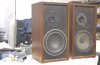
Recapping AR-4X

There is no "hole" caused by removing a pot. Further, you have it backwards. When you remove a pot you raise the net resistance and this decreases the xover frequency.

Regards,
Jerry

This doesn't make sense to me. How can removing the pot increae resistance? The pot is 15 OHM's no? Removing it would be 0 OHM's wouldn't it?

Here's a piece of previous discussion of 15 OHM Pots vs. 8 OHM LPads:

Quote:
Originally Posted by Upnorth
I've used the Parts Express 16 ohm l-pads with good results on the AR2ax speakers. Although on my AR5's I used the original 15 ohm pots recovered from earlier projects. I know some people don't like fixing the originals as some are well worn out. If you ask there are a ton of originals out there that are restoreable which I think are a much better fit. Just my 2 cents.


Aha, I knew someone would chime in that they found a good replacement! Yes, 16 ohms is close enough to 15 as to make no noticeable difference.
Fotno, the way the equations for crossover frequency work out, if you halve the impedance of the load (in this case the lpad is the load) then the crossover frequency doubles. It is inversely proportional.
Frequency= 1 / (2 x 3.14159 x Capacitance x Impedance). When you divide 1 by a number, if you lower that number you divide by; the result is a higher number. 1/2 is greater than 1/4.
__________________
Warren
 
This doesn't make sense to me. How can removing the pot increae resistance? The pot is 15 OHM's no? Removing it would be 0 OHM's wouldn't it?
Well, no, 0 Ohms would be a short; removing it gives infinite resistance.

It's because the pot is in parallel with the tweeter.

Consider the two options for "bypassing" the pot illustrated in the schematics often posted here:

1) Disconnect the tweeter from the pot and remove the pot from the circuit, reconnecting the tweeter after the pot has been removed (electrically, if not physically, as well.) The highpass filter works directly into just the impedance of the tweeter, 4 Ohms, nominal, versus,

2) Disconnect the tweeter from the wiper and connect it to the maximum resistance (15 Ohms) terminal, leaving that resistance in place, or substitute an equal resistance for the pot. The filter then works into a parallel combination of the 15 Ohms and the tweeter impedance, 15||4 = 3.16 Ohms.

Thus, removing the pot from the circuit entirely and not installing an equivalent substitute resistance raises the impedance from 3.16 to 4 Ohms, an increase of 26.7%, and the filter operating point shifts downward in frequency proportionately.

As shown in the measurements, however, the highpass filter is not the primary determinant of the crossover point; the tweeter's own inherent response rolloff is the major controlling factor there, and the filter is mostly operating to provide compensation, i.e., to "shape" the tweeter response.

The primary consequence of changing the impedance by removing the pot entirely and not replacing it with an equivalent resistance is to alter the contour of that compensation, resulting in a differential "peaking" of the response at 1 kHz by ~1.7 dB.

Now, we can all debate whether or not that difference is significant with respect to the "voice" of AR4x, but there's no denying it is altered, and more importantly, the consequence of removing the resistance is not the uniform 1 dB of increased output across the high frequency spectrum previously supposed....

There's more going on here than simple attenuation, and I suspect some of the altered voicing reported by those who have tried the "remove from circuit" approach may be due to these factors. If you're going to remove the pot, put a fixed 16 Ohms [alt. 15 Ohms] in its place to restore the original impedance and highpass filter operating point at minimum attenuation.

http://audiokarma.org/forums/showthread.php?p=1308946#post1308946
 
Just for the record, as the pot value reported on ARs varies a bit:

I have measured (or received measurements of) 28 original rheostats over the last two years. 15.7 ohms is where the majority measure. Variances of +.4 ohms, -.3 ohms on just a few so far.
 
Thanks, Ozzie, that's exactly the sort of info we need! :thmbsp:

PM me your mailing address, and I'll send you these four, and everyone else should do the same.

You'll become the definitive global authority once you get like 100 of them and do the statistical analysis.... :banana:

Note: The formula in Shacky's post #61, above, computes the HF filter frequency to be 2.227 kHz using these values. That's certainly consistent with what my measurements of the acoustic performance show.... :yes:
 
Zilch,

Thanks for the education. So what's the HF filter frequency bypassing the pot?
Taking it out and not installing a substitute resistance?

10^3/ 2 * pi * 4.625 * 20 = 1.721 kHz

4.625 Ohms is the average impedance of the two tweeters I have here.

The calculation would be more precise if I measured the actual impedance(s) at the filter frequency....
 
Zilch, according to AR, the AR-4x crosses at 1200 Hz, which would put your calculations in the correct neighborhood.

When people use modern media (CD's, MP3's, FM, satellite radio, etc) with these speakers any attenuation in the tweeter would be undesirable. Indeed, your charts show that fairly well.

Some still feel the speakers are too "laid back", and my suggestion to remove the pot entirely is just a way to see whether the extra 1 or 2 db is enough. Enought, that is, before seeking a modern tweeter.

For the average listener, I think just by-passing the pot wiper is a very cost effective solution and should yield acceptable results.

Regards,
Jerry
 
I certainly agree that there's not much in the way of high frequency headroom in AR4x. The tweeter with no attenuation is only barely able to balance with the woofer for flat response, which is why bypassing the pot is workable as a modification.

Again, just to be clear, the HF highpass filter plays little role in establishing the crossover point. As Ray observed at #21, it's the tweeter's inherent rolloff which is primarily "in charge" in the crossover region:

http://audiokarma.org/forums/showthread.php?p=1371866#post1371866

See the next post there for the illustrations of how that works.

The situation for the woofer is similar. Except for the earliest version with the two-pole lowpass filter, AR4x in large part relies upon the response characteristics of the drivers themselves for crossover; the network filters function primarily to shape their responses outside the crossover region to provide the AR4x's "Voice."

Calculate the frequency of the lowpass filter on the woofers. The actual result is measured here:

http://audiokarma.org/forums/showthread.php?p=1375719#post1375719

Rolloff rules AR4x.... :yes:
 
There's a lot of edumacational stuff in this thread. I wonder if we should apply for stickyhood with this one?

Ray
 
There's a lot of edumacational stuff in this thread. I wonder if we should apply for stickyhood with this one?
I'm working on two more phases to this, Ray -- tweeter upgrade and woofer swap. Once those are complete, I can put together a reference on AR4x according to Zilch, if AK would like. I think we need another AK forum for reference info, though; there's already too many stickies, in my view, and I don't know how to turn them off. :dunno:

The tweeters are on order per your recommendation, and for now, I'm playing the originals with a different woofer (for the past day, actually,) at a higher crossover frequency, which I first tried earlier in this thread with good results. I'll leave it to local members hearing them for the A/B listening performance evaluation.... :thmbsp:
 

Attachments

  • Woofer Swap.jpg
    Woofer Swap.jpg
    31.3 KB · Views: 588
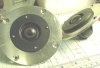
Tang Band (TB-Speakers) 28-847SD shielded neodymium 1-1/8" fabric dome tweeters (PE #264-822, $24.59 ea.) get custom 1/8" aluminum mounting flanges, 4.5" OD x 2.0" ID. Detailed with 3/8" x 1/8" closed-cell foam gasket tape on the rear of the stock plastic (glass-filled nylon, it says,) flanges to maintain AR4x's closed-box seal, they mount with #4-40 stainless hardware.

Countersunk to accept flathead screws securing them to the cabinets, they'll ultimately get foam anti-diffraction rings if measurements indicate those are warranted. If not, they'll just be anodized or painted to look pretty. Performance data pending.... :thmbsp:

Hmmm. PE's CLIO curves are now gone, and they're linking to the SE version TB-Speakers factory spec. May have been the SA version previously shown, perhaps, as that's what used to ship with this PE part number. Specifications subject to change without notice, apparently. No problem; we'll do it right here on AK.... :p:
 

Attachments

  • Tang Band.jpg
    Tang Band.jpg
    34.5 KB · Views: 323
O.K., here we go then:

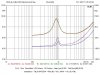
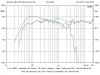
1) Impedance of TB vs. AR tweeters. Resonant frequencies indicated by the cursors. TB is indeed lower.

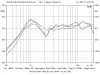
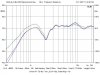
2) Frequency response of the raw drivers mounted in the cabinets, no filters. ARs remeasured; compare to results earlier in this thread. Looks as if TB replicated the AR tweeter using modern materials. Yes, they're well matched and sound appreciably better. Voltage sensitivity is virtually identical to the originals.

3) Here with 20 uF highpass filter. Is there diffraction going on here? Yup, look what happens at 9 kHz when I "dress" the tweeter in a foam ring.

4) What it is. JBL L100/4311 owners, if the foam rings on your tweeters are not in place, fix 'em. It matters.... :yes:
 

Attachments

  • TB & AR Impedances.jpg
    TB & AR Impedances.jpg
    58.2 KB · Views: 104
  • TB & AR Raw Drivers.jpg
    TB & AR Raw Drivers.jpg
    53.4 KB · Views: 125
  • FR TB #2.jpg
    FR TB #2.jpg
    50.2 KB · Views: 190
  • TB with Foam Ring.jpg
    TB with Foam Ring.jpg
    25.9 KB · Views: 195
1) Mid-Genre AR4x with TB tweeters "dropped in," stock crossover, but with an 8-Ohm L-Pad replacing the potentiometer. If you're going to the expense of new tweeters, upgrade to standard technology attenuation.

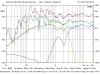
Does this work? Yes, despite the significant difference in tweeter impedance. There's a peak at 1 kHz, and a notch at 2 kHz, but we're still within +/- 3 dB here. The TB tweeters sound much better down around 1 kHz than the AR originals, and they're cleaner on up from there. There's less beaming at high frequencies, as well.

2) Early cross-hatch woofers play higher, as we discovered earlier in this thread, so I tried a Butterworth two-pole crossover approach to bury the notch at 2 kHz. That worked, but I could do a bit better with Linkwitz-Riley, shown. In both cases, I ended up closer to 3 kHz than I would have liked, but this is the fourth attempt, and it always goes there. I may try third-order or a notch filter later, if interest persists, to eliminate the 2 kHz TB notch entirely (it's the 1.2 kHz peak that's gotta go, actually). Yes, this sounds fine, too, but the cross-hatch woofers do not have as full bass extension as the later versions.

3) So, swap in JBL 116H woofer instead, to get the better bass along with full midrange response. No further crossover mods required. There's nothing left of AR4x but the boxes and logos at this point, alas, and the boxes would be next to go, replaced by mirror-imaged pre-builts from Parts Express, probably.... :dunno:
 

Attachments

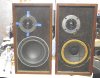
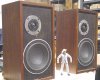
  • Tang Band Pair.jpg
    Tang Band Pair.jpg
    32.3 KB · Views: 177
  • TB Early X-Hatch.jpg
    TB Early X-Hatch.jpg
    71.7 KB · Views: 68
  • TB Mid-Gen System.jpg
    TB Mid-Gen System.jpg
    64.4 KB · Views: 70
Hey Z, are you splicing near/far field measurements or just using 1m for the whole range?

Ray
 
Hi, Ray.

I'm just using 1M full range, unwindowed, for this, as the low end is knda irrelevant. The nearfield LF response of the AR woofers is posted earlier in this thread. The action above 1 kHz is windowed MLS, e.g., the drivers and the network summing (cyan) in the second graph immediately above.

I'll do a gated sinusoidal fullrange and nearfiled on the JBL woofer right now, and we'll see how that looks.... :thmbsp:

Edit: Let me first say I very much like the TB tweeters. Thank you for the suggestion, Ray. I'm sure there are other options crossed above 2 kHz, though, as you mentioned earlier.

Here's the sinusoidals, showing classic closed-box response. The nearfield is -30 dB, so you can stitch as desired. Looks like with boundary reinforcement, these babies gonna play to 20 Hz.

If I could get rid of the notch, I'd be +/- 1.5 dB.

Just needs a bump at the top of the LF. :p:

[It's 1.5 mH & 10 uF right now.... ]

Midnight Update: O.K., the notch is gone (Cyan). Spice knows how to do stuff like raise the Q of a lowpass (0.85 mH & 13.5 uF). It's quality listening now, but not the ultimate solution, is all.... ;)
 

Attachments

  • TB & 116H Sin2.jpg
    TB & 116H Sin2.jpg
    56.7 KB · Views: 78
Midnight Update: O.K., the notch is gone (Cyan). Spice knows how to do stuff like raise the Q of a lowpass (0.85 mH & 13.5 uF). It's quality listening now, but not the ultimate solution, is all.... ;)

That's a pretty sweet looking curve! I might pull the Q on the LPF down a little as I like to have the 1kHz band a little below the curve average to keep vocals from getting "in your face" but that's totally a personal preference.

I'm assuming the "ultimate solution" would include some part of the 4x? This thread has been a great adventure with a destination that I wouldn't have imagined from the OP.

Ray
 
This thread has been a great adventure with a destination that I wouldn't have imagined from the OP.
Thanks, Ray. OP and I have recently had this discussion, actually. It looks like his next project may be a set of mini-monitors.

I see all of vintage restore and upgrade as a progression, i.e., an ongoing experience over time. In another thread here is a high school student with a pair of marginally operative AR4x and limited means:

http://audiokarma.org/forums/showthread.php?t=129441

"Shall I bypass the pots?" Yes, of course. There's several options, and some of them cost nothing.

"How about recapping?" I can tell you, none of the originals I have here measure to original spec. Do it.

"New tweeters sound better?" Yup, and Ray has suggested a modern replacement that works well, when you get some free cash.

"Anything else?" Just look at the pics and decide for yourself whether the original woofers are in the same league as the cast-frame 116H I used here. That one cost me $6.95* on eBay, plus shipping and a refoam. You'll learn how to build simple crossovers, too.

http://audiokarma.org/forums/attachment.php?attachmentid=63600&d=1191259542

http://audiokarma.org/forums/attachment.php?attachmentid=64120&d=1191812764

"Yeah, but they're not AR4xs anymore!" So what? You paid $15 for them at the thrift store, remember...? :music:

*Price of the pair, actually. One of them had a slipped magnet. I'm working on fixing that.... :thmbsp:
 
Vintage Grilles

Was reading this little "History of Hi-Fi" essay from another forum yesterday, in which the author asserts that vintage grilles weren't all that acoustically transparent:

http://www.nutshellhifi.com/library/tinyhistory1.html

O.K., so let's find out. I have a pair of original AR4x grilles, and a pair that recently had new cloth installed by Duffinator.

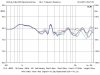
See below. Yeah, stuff certainly happens, and it's not random. The scale is expanded (5 dB/division,) but it's enough to swamp my efforts at honing the HF response.

It may be the grille frames or the cloth, actually, so I'll investigate a bit more. In any case, "ICK!"

Edit: The frame's part of it, but not the majority (second graph). It has a cross brace just under the tweeter which could both diffract and reflect.

Looks like the "Linen" cloth reflects back onto the baffle and tweeter, which, in combination with the frame, sets up a regular pattern of interference. :dunno:
 

Attachments

  • Grilles.jpg
    Grilles.jpg
    50.9 KB · Views: 52
  • Grille Frame.jpg
    Grille Frame.jpg
    45.6 KB · Views: 37
I tried third order; that worked. I tried a notch filter; that worked.

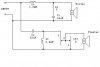
But I settled on a simple topology commonly employed by JBL: first order LP with tuned Zobel and second order optimized-"Q" HP. That got me within +/- 2.5 dB, nearly as close as I achieved with any of the other more complex approaches.

They're mighty good; good enough I'm moving them to edgeless PE stock cabs with mirror imaging. (Auditions by arrangement in the interim. :p:)

Duff's AR4x cabs will then experience a more radical upgrade.... :yes:
 

Attachments

  • TB 116H Pair.jpg
    TB 116H Pair.jpg
    28.8 KB · Views: 105
  • TB & 116H Sin3.jpg
    TB & 116H Sin3.jpg
    55.4 KB · Views: 73
  • TB 116H Schematic.jpg
    TB 116H Schematic.jpg
    11.9 KB · Views: 91
Vintage Grilles - less wank

Was reading this little "History of Hi-Fi" essay from another forum yesterday, in which the author asserts that vintage grilles weren't all that acoustically transparent:

http://www.nutshellhifi.com/library/tinyhistory1.html

O.K., so let's find out. I have a pair of original AR4x grilles, and a pair that recently had new cloth installed by Duffinator.

See below. Yeah, stuff certainly happens, and it's not random. The scale is expanded (5 dB/division,) but it's enough to swamp my efforts at honing the HF response.

It may be the grille frames or the cloth, actually, so I'll investigate a bit more. In any case, "ICK!"

Edit: The frame's part of it, but not the majority (second graph). It has a cross brace just under the tweeter which could both diffract and reflect.

Looks like the "Linen" cloth reflects back onto the baffle and tweeter, which, in combination with the frame, sets up a regular pattern of interference. :dunno:

About a year ago I undertook a brief study on grill cloth. Coincidentally, the study involved the use of an AR4x speaker. At the time my objective was to find a suitable replacement for vintage AR cloth. With an original AR3a sample in hand, I spent considerable time scouring fabric and craft stores for suitable substitutes. The bottom line is I found that % open area (defined by thread count & size) and fuzziness of the threads had the most effect on the high end of the audio spectrum. At the same time, I was able to identify a few good candidates which I have sold to a number of satisfied customers. The study is summarized in a 6 page .pdf file with closeup photos of fabrics included. Unfortunately, the 1.6 MB file size was rejected for uploading.
Anyone interested in a copy can send me a private message requesting one and I'll glady oblige. :yes:
 
Back
Top Bottom