• The move to the new server is done. There are some software and database maintenance updates in process. This has us passing the hat around to help out. We appreciate any donations. Seriously, even a dollar helps. The payment page may be found here - https://www.audiokarma.org/support.html

Recapping AR-4X

Thank you for those suggestions, Zilch.

This was the original thread that I started for the aforementioned ADC 303a and photos of them: http://www.audiokarma.org/forums/showthread.php?t=177003

But, I think this is the year to break into the 303a's. I just want to do plenty of research beforehand so I appreciate your input. I see what you mean about limited sources of sealed box replacement woofers. Thanks again!

Brian
 
I have a quick question about the original color options of these, since many on this thread have seen a lot of them.

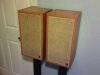
Almost all the AR-4x's on ebay or AK are a dark brown or cherry wood finish, but I have a pair that are a very light wood color. Have any seen similar looking ones like these?
 

Attachments

  • 1203092313.jpg
    1203092313.jpg
    47.6 KB · Views: 51
Birch?

They look nice. Sets them apart.

Thanks, I thought about doing a different finish on them, but I think I'll restore the original. You can't really tell from the picture, but they are pretty worn, so they need some attention. The only problem is the birch doesn't really match the rest of my room.:scratch2:
 
Think twice about refinishing them. They were available unfinished for a bit less, and are rare, selling for double the price of the common walnut ones on eBay.... :yes:
 
I have a quick question about the original color options of these, since many on this thread have seen a lot of them.

Almost all the AR-4x's on ebay or AK are a dark brown or cherry wood finish, but I have a pair that are a very light wood color. Have any seen similar looking ones like these?

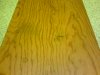
Finish options during the classic years included walnut (both varnished and oiled), cherry, birch, mahogany and unfinished ponderosa pine (the bigger models 2-3 were also available in teak and blonde korina). Since darker woods like walnut and mahogany can fade and lighter woods like cherry, birch and pine can go yellow or orange over the years, the color by itself isn't really enough to determine what the wood is. Can you take a shot from the sides that shows the grain pattern better?
 
Thanks, I thought about doing a different finish on them, but I think I'll restore the original. You can't really tell from the picture, but they are pretty worn, so they need some attention. The only problem is the birch doesn't really match the rest of my room.:scratch2:

They may change if you lightly sand. I find a palm sander is just the right tool. Use ~ 200 then 400 removing dust in between - vacuum and tacky cloth. Then finish of your choice. I like Howard's Restor-A-Finish as it's one coat quick and easy. And it comes out nice. They may make it in birch if not something similar.

Of course they are your speakers and if you like them it's best to have them the color you want. If they are a rare color maybe sell them and get something else to your liking.

Once the AR big hits you you'll be swimming in AR's like me :D
 
More pics

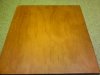
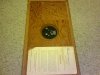
You can see the imperfections a bit, some scrapes and cracks. The thought crossed my mind to peddle these on ebay, but I think I'm going to hang on to them for now.

I'm going to try to restore the original finish and color as best I can, and get some new grill cloth for them too, I don't care for the originals.

Speaking of ebay, it's ridiculous how much these go for on there, considering how many are found at thrift or garage sales, including this pair.
 

Attachments

  • 1230092330.jpg
    1230092330.jpg
    85.3 KB · Views: 35
  • 1230092330a.jpg
    1230092330a.jpg
    74.2 KB · Views: 29
  • 1230092332.jpg
    1230092332.jpg
    90.3 KB · Views: 31
I would sand them clean and NOT refinish them.

You will be stunned by what "very rare near-mint" unfinished AR4x bring.... :tongue:
 
I'm going to try to restore the original finish and color as best I can, and get some new grill cloth for them too, I don't care for the originals.

This is ponderosa pine. These were originally delivered unfinished, and it appears that some previous owner put a clear finish on them that has significantly yellowed. If you want to restore an "original" look to them, sand them to remove the existing finish and then rub on a thin coat of a hard paste wax. Do not apply any finish.
 
Alright, will do. I'm beginning to like the idea that they don't match anything else, as they will stand apart from the rest my things.:yes:
 
Wasn't the unfinished pine option provided for those who intended to paint the speakers? It used to be very popular to paint speakers to match a bookshelf or to blend into a wall from which they were hung.
 
Yes, unfinished was a low-cost option for speakers that would be painted or inserted into consoles. Most probably were painted by their original owners, which is why they're fairly rare in their unfinished state.
 
Upon further inspection, there's evidence of a very amateur finish job; runs, pools, etc. From what you mentioned gkimeng, it seems like to me that only original, untouched pine versions would bring the big bucks. Mine can be restored, but they would probably not be worth the same as an all original near mint pair.
 
I don't know if unfinished pine 4's have the same cache that the larger models seem to have in this form. The attraction has always escaped me. I can see someone who preferred a blonde finish wanting one in birch or korina, but the pine doesn't seem to me to be suited for anything other than the purpose it was originally intended for.
 
Nice thread resurrection! Looking forward to hearing that square waveguide mounted within the cabinet.
Here's the end result for now:

attachment.php

Details:

http://www.audiokarma.org/forums/showthread.php?p=3316259#post3316259
 
Well, no, unless I'm reading the schematics wrong, it's a wirewound potentiometer used as a variable resistance divider. A rheostat is not a divider. A potentiometer can be wired as a rheostat, but I don't believe that's the case in AR4x. See the pics below: rheostat, left, potentiometer, right.

[Of note: Wikipedia doesn't QUITE agree with me on this distinction, taking a somewhat broader view that rheostats are merely high-power potentiometers, but also duly noting that rheostats "are usually used as variable resistors rather than variable potential dividers." http://en.wikipedia.org/wiki/Rheostat Two terminals, it's a rheostat, and three it's a pot, according to Zilch. ;) ]

Neither is it constant impedance. We look at the schematic and see the 16 Ohms connected from the capacitor to common, and say that it's constant, but once you connect a tweeter to the wiper, the impedance seen by the capacitor, even assuming that of the tweeter itself is constant, varies according to the wiper position.

Consider the extremes: at maximum attenuation, with the wiper at zero resistance, the capacitor "sees" 16 Ohms to common. However, at minimum attenuation, the tweeter is in parallel with the 16 Ohms, and thus the capacitor sees a lower impedance. If it's an 8-Ohm (nominal) tweeter, that's 16||8 = 5.33 ohms, and the filter highpass frequency increases proportionately.

Now, remove the 16 Ohms in parallel with the tweeter, the impedance goes to 8 Ohms, and the filter frequency drops. Without doing the calcs, just looking at the filter charts in the PE catalog, taking the AR pot out of the circuit drops the highpass frequency from ~1.5 kHz to 1 kHz, a bad idea, I'd say.

There's more going on here than simple attenuation, and I suspect some of the altered voicing reported by those who have tried the "remove from circuit" approach may be due to these factors. If you're going to remove the pot, put a fixed 16 Ohms in its place to restore the original impedance and highpass filter operating point at minimum attenuation.

My conclusion that the pot (or perhaps RoyC's suggested approximation thereof) is a better solution than a straight L-Pad is based upon the observation that, given a fixed LOWpass frequency for the woofer, to maintain a constant voicing of the system, it would be appropriate for the highpass frequency to rise with increasing drive. Without being aware of it, we actually vary the acoustic crossover point whenever we change the balance of the drivers using common crossover topologies. See Fig. 7 here:

http://sound.westhost.com/bi-amp2.htm

I appreciate that y'all have been through this AR4x pot thing ad infinitum previously; I'm merely revisiting that work and putting forth a rationale favoring one particular approach over the others commonly advocated here.... :yes:

Edit: Wikipedia corrected its information ~12/07 in conformity with my position as stated above. In discussions there, the prior version was dubbed "Ignorant." It now references IEEE standard definitions:

http://en.wikipedia.org/wiki/Potentiometer

This may be rudimentary but here're measurements I took a while back of the original pots, Mem Cor 15 OHm NOS, and the 8 OHM L-PAD:

I was just playing around with the Mem Cors (only have 2 Ohmites but 6 MemCors), originals, and some 8 Ohm L-Pads I had previously purchased for 2AX project but didn't like the sound. If I measure DMM across tabs 1 and 2, then B to 1 and get following:

Originals
1-2 constant 15.5 Ohm throughout renge
B-1 15.6 to 0.3

Mem Cors
1-2 constant 15.6 Ohm thoughout range
B-1 15.3 to 0.2

L-Pads
1-2 (infinity all the way) Just off full 40.7 to 8.4
B-1 (infinity all the way) just off full 40.2 to 0.2
 
I just picked up a pair of these AR4x in oiled walnut, in pretty fair shape, and even the pots seem to be in fair shape. The papers are even complete on the backs, serial numbers on the back.

What I would like to know is if anyone has sorted out when (by serial number) they went to the foam surrounds?

The second thing is these appear to have the grills glued on. Are these difficult to get off intact?

I have a tool I made that should allow me to get them off (2" wide rigid metal "hook" that allows me to get behind the grill edge.), but am uncomfortable about how much pressure these can take before they tear or are otherwise damaged. :dunno:
 
Back
Top Bottom