• The move to the new server is done. There are some software and database maintenance updates in process. This has us passing the hat around to help out. We appreciate any donations. Seriously, even a dollar helps. The payment page may be found here - https://www.audiokarma.org/support.html

Rek-O-Kut Rondine Jr. L-37 Restoration Begins.

Skipping/Getting stuck

So this weekend I gave the ROK 120 arm a little TLC. I flushed the bearings with lighter fluid followed by denatured alcohol, then Radio Shack electronics lube (in the little clear pen bottle).

But it still gets stuck from time-to-time. i think it's the result of small scratches on some of my LPs b/c it does not do it on 70% of them. But on about 3 out of 10 sides, it will get stuck, jumping back a groove each rotation; playing the same half a musical measure over and over again.

Is this something that old arms and carts are prone to? Sensitive to tracking damaged LPs, or do you think i need to tear the whole arm down and clean and rebuild it (I'm a little scared to do this)
 
That is something that any arm will do if the bearings are binding even the slightest bit.
 
That is something that any arm will do if the bearings are binding even the slightest bit.
That's what i was afraid of. I guess i need to start figuring out how to tear it down. Am i correct in assuming I should use a light oil on the (ball) bearings? I was tempted to use 30 weight motor oil.
 
That's what i was afraid of. I guess i need to start figuring out how to tear it down. Am i correct in assuming I should use a light oil on the (ball) bearings? I was tempted to use 30 weight motor oil.

Lightest weight oil you can find. You have a small piece of debris in there, or a burr. I bet if you zero float the arm and use a thin strip of paper to push the arm across its span, it will bind at times.
 
Lightest weight oil you can find. You have a small piece of debris in there, or a burr. I bet if you zero float the arm and use a thin strip of paper to push the arm across its span, it will bind at times.
I'll try that. I wish I had better access to the bearings to flush them some more w/o disassembling it. As it is I can only turn it upside down (which exposes the bottom race) and pour whatever fluid over that race. It does run out the top (now upside down). It seems three flushes w/lighter fluid yesterday didn't help.

If I have time later tonight, I'll start looking further into it.
 
Ok, here's what I found. The bearing assembly is an integrated shaft that simply slides into the base and locks with one set screw. You can move this up and down to adjust the VTA. (I knew this already)

attachment.php


attachment.php


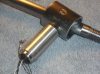
So this shaft, as far as I can tell, is a sealed unit that is pressed onto the gimbal. There's no apparent way to either remove the shaft assembly from the gimbal, nor take the shaft assembly apart (so I can clean or replace the ball bearings). I assume this whole unit was pressed together in the factory? If anyone knows otherwise, please tell me.
attachment.php


So here is the exposed bearing race i was able to run solvent (lighter fluid) then oil through. Although there is no access to the top of this bearing shaft, I did see that what I poured into this open race, eventually ran out the other end.


attachment.php


I found that when the bearings were cleaned and dry, there were a lot of sticking points in the rotation. As though the races that the balls roll in are pitted or damaged.

I first re-lubed it with sewing machine oil, but after it sat a day, it didn't seem to retain enough oil to keep it smooth. So I re-lubed it with some ND 30 weight motor oil. This seems to work better, but there are still subtle divot spots where the bearing assembly wants to come to rest.

I'm still fiddling with it. Now that I understand the thing a little better, I can work with it if it continues to hang up by simply rotating the bearing shaft in the base to try and get the arm's range of travel in a smooth zone.

Wish me luck.
 

Attachments

  • 102_Arm bearing and base.jpg
    102_Arm bearing and base.jpg
    76.2 KB · Views: 343
  • 106_Arm bearing Shaft.jpg
    106_Arm bearing Shaft.jpg
    71.8 KB · Views: 339
  • 104_Arm bearing lower.jpg
    104_Arm bearing lower.jpg
    52.3 KB · Views: 341
  • 102_Arm bearing and base 2.JPG
    102_Arm bearing and base 2.JPG
    94.9 KB · Views: 340
Last edited:
Hi Brett,

Just catching up on this fascinating thread, what a great project.

I feel compelled to comment on a few things, since I also have the Denon 103 playing with an idler drive (a Garrard 401, and yes, you will want to go there eventually, sorry to say).

I can understand your initial disappointment to hearing the Denon with a less than ideal setup. The house sound of the Denon carts are much more forward in the midrange, and the Shure carts are very laid back by comparison. The 103 does settle down after a break-in period, so this will help even things out.

As for having a 3D soundstage with it, I think you will get there eventually, once you've tamed your vibration and tonearm issues. Seems like you are well on the way there, since it definitely is a matter of all the incremental refinements adding up. In my setup, I have the 103 mounted to a 12" wooden tonearm, and the Garrard is in a stacked ply plinth, not unlike yours, then into a Project tubebox pre, another tubed preamp, Dynaco ST70 amp, and then homebrew open baffle speakers and a powered subwoofer. Each link in the chain has been tweaked to work with each other component, so there is probably a lot of sympathetic compensation going on.

Anyway, the more you can quiet things down, the more you'll get somewhere with the Denon. It has terrific low level inner resolution, which you won't really hear if there is rumble. I had one of these night-and-day experiences when I had the Denon mounted to my Thorens 135, after doing a motor rebuild and refreshed the rubber mounts. All of a sudden the music was released into space that wasn't there before.

On that note, the motor grommets are definitely worth paying attention to, just as much as the idler wheels. The Thorens 124 and 135 have an upgrade possibility, which the 124 got in its MkII version, which is basically an extension rod and second set of grommets, which suspend the motor further away. I don't think this would be possible on the Rek since the drive system is different, but you could improve upon the grommet itself. There is a tweak for Thorens motor mounts which is to use a white silicone grommet in place of the black rubber. The white silicone is much softer and thus absorbs more vibration. Given the Rek's drive system, this might offer some help. The Garrard 301/401 has its own method of motor isolation, which is to hang the motor from a set of springs. These motors are huge, and I'm guessing the Rek's motor is even larger, by the looks of it, but it doesn't have the benefit of the extra isolation engineered into either the Thorens or the Garrard. The Thorens has a smaller motor, and it also has a belt driving the idler, so it is decoupled.

Another thought: The Lenco drive uses a very thin idler wheel, like a knife edge, and it mounts vertically rather than horizontally like the others do. This gives it a very small point of contact against the platter compared to the fat tires of the horizontal idlers. I wonder if anyone has experimented with the profiles of their idler tires? It would be interesting to see what happened if one changed the wheel shape into something pointy, so that there was less contact surface, which should theoretically transfer less vibration to the platter edge. Hmm...

And here's yet another thought: The Garrard 301/401 motor creates less vibration if we feed it less voltage, and common American house voltage tends to be higher than it was in the days these tables were designed. I've measured my house current to average about 127v, whereas the vintage gear should optimally run on 110v. I'm starting to experiment with using a variac to bring the voltage down to 110v, and it definately makes a difference in taming motor noise, as well as making the tube gear happier (cooler). Loricraft, the Garrard standard-bearers, make a power supply for 301/401 units which basically does this, but happens to cost $4000. A decent Variac will set you back maybe $100. If you already have one, I suggest hooking it up to the Rek and bring the AC voltage down a bit, and see if it doesn't tame things somewhat. Just note that you lose torque as you lose voltage, so you won't want to go below 100v, probably.

Just my 2 cents, with interest...

Looking great!

Sean
 
Checking in.

I realized that using the spindle clamp made more motor noise come through the cartridge, but less into the room. Running it with no clamp makes the player louder in the room, but quieter in the speakers. I still have not had the idlers rebuilt though.

I'm starting to get frustrated with this Rek-O-Kut arm; its pivot bearings are damaged and it's hard to find a spot where it will track a whole LP side without getting stuck. I took it apart again this week and cleaned and re-lubed it; trying different lubes. Right now, I have it full of Permatex 81950 Ultra Slick Engine Assembly Lube which gave it the best finger-turning feel.

FWIW, I cleaned, lubed, cleaned, and re-lubed it to try different types of lube. Along the way, I've used sewing machine oil, Radio Shack lube pen oil, ND30-weight motor oil, White Lightning Self-Cleaning Wax Bicycle Chain Lubricant, and now the Permatex.

The bicycle chain wax and the Permatex were the only ones that got it to approach "smooth". I've played about 5 sides since putting it back together and think i may have it dialed in. We'll see how well the lube stays up in there though.

Hi Brett,

Just catching up on this fascinating thread, what a great project.

I feel compelled to comment on a few things, since I also have the Denon 103 playing with an idler drive (a Garrard 401, and yes, you will want to go there eventually, sorry to say).
Yes, I feel its just a matter of time before I have a 401, 301, or Thorens 124. :yes:
I can understand your initial disappointment to hearing the Denon with a less than ideal setup. The house sound of the Denon carts are much more forward in the midrange, and the Shure carts are very laid back by comparison. The 103 does settle down after a break-in period, so this will help even things out.
As for having a 3D soundstage with it, I think you will get there eventually, (…) the more you can quiet things down, the more you'll get somewhere with the Denon. It has terrific low level inner resolution, which you won't really hear if there is rumble.
I do think the Denon is changing; I’m pretty sure it’s not just me getting used to it. It has settled back a bit, but still has an awfully long way to go before I’d think it was a good performer relative to its cost. And I’m not sure how much of a project I want to make out of specific to getting good performance out of the Denon (aside from my efforts to get the ‘table on the whole running well). In considering the time and effort it might take to get the Denon to behave, I might just decide to jump ship and find a cartridge that doesn’t demand I work so hard for its happiness.
On that note, the motor grommets are definitely worth paying attention to, just as much as the idler wheels.
I replaced the grommets a while back. I’m in them for $56, so I don’t see myself replacing them with something else. However, I still have not had the wheel rebuilt. I finally dropped one in the mail to Ed Crockett yesterday (keeping the other to run the ‘table in the meantime)
And here's yet another thought: The Garrard 301/401 motor creates less vibration if we feed it less voltage, (…) I'm starting to experiment with using a variac to bring the voltage down to 110v, and it definitely makes a difference in taming motor noise, (…) A decent Variac will set you back maybe $100. If you already have one, I suggest hooking it up to the Rek and bring the AC voltage down a bit, and see if it doesn't tame things somewhat. Just note that you lose torque as you lose voltage, so you won't want to go below 100v, probably.

Just my 2 cents, with interest...

Looking great!

Sean
I don’t have a Variac...but now that I know what one is and that I could use one, I think I feel one approaching. I had never thought about the affect of voltage on motor noise, thanks. (My house runs a pretty steady 119 volts BTW)

4.7k
 
Last edited:
Checking in

I expect to get my rebuilt idler back from Ed Crockett any day now. This will be the last piece of the rebuild as far as replacing all the rubber.

I continue to wrestle with the Rek-O-Kut arm. Its vertical shaft bearings are pitted and just when I think I have them rotated to an agreeable spot, a week later, it starts hanging up again. I know the innards are a dynamic system, I was just hoping I could set it and forget it. Guess not.

Since snapping the cantilever off the Denon 103 last week, I've tried a couple others carts I have on hand on the ROK arm.

First, a Red Ed Elliptical---nope. All the highs were choked off under the mass.
Now I have the Sure M91ED back on it, with 2 gram stylus. Still sounds a bit muffled (relatively speaking).

Next I will try the Sure M78 cart with 3 gram stylus. I've always found this cart body to be terrifically underwhelming though. (dull highs and very poor channel separation --and no, I don't still have the mono jumpers on it:) ). Maybe under this massive arm, it's reveal something thus far hidden.

Not sure I'm going to be satisfied with any of the carts I have on hand. I'm thinking of trying a low compliance Stanton maybe??:scratch2:
 
Well, the newly restored rubber wheel from Ed Crockett sure has calmed down the noise floor! It used t be that you could hear the 'table running (without music) when you walked into the room. --no more! It's brought it down to an acceptable level while playing records. The motor noise through the speakers is now down there with the swoosh of the vinyl.

I've also bought and am enjoying a Stanton 500II with 3.5 gram tracking elliptical stylus. I have to say I'm enjoying this lowly Stanton as much as I enjoyed the Denon DL-103; more actually when i figure it was 10% the price of the Denon.

I keep thinking I need new pictures in order to post updates. I don't have any new pictures of the 'table, so I've attached a couple random favorites.
 
Last edited:
Interesting how big of a difference it made. Was there any appreciable slippage at startup that the new idler corrected?
 
Interesting how big of a difference it made. Was there any appreciable slippage at startup that the new idler corrected?
Yes, it really brought it into this century.

The old idler did not have any traction problems, but the new one does grip better with lighter pressure which helps make it quieter. Now that i think about it; it seems to have improve bass "weight". Could this be related?

I started drawing up plans for a new plinth over the weekend. My local lumber seller has 60" by 60" by 3/4 sheets of Baltic ply for $50. This will give me enough for the new plinth at half the cost I've seen elsewhere.

I custom-made a set of 2 cut-out templates that will allow me to leave as much support and mass under the deck as possible. There's two b/c the top-most layer needs to have a bigger opening than the lower layers to accommodate the hardware on the underside of the mounting plate. I'm also planning on drilling a tight-fitting hole in the base plinth for the main bearing to set in.

I also want to make the 'table match the dimentions of my other gear. Right now it's a 50 pound coffee-table sized behemoth. The new one will be able to join the main set-up and I can do away with the 50 foot cables.
If the templates work well, I'll make them available as PDFs. But that'll be a while from now.
 
Last edited:
Update.

I'm sticking with the Rek-O-Kut arm and putting the Pioneer arm in storage.

So I've been going back and forth between a Stanton 500 MKii and a Shure SC35C. I have LP and 78 stylii for both.

I started a thread asking how concerned I should be running a heavy arm with a high tracking force.

Also, I've boxed up the Musical Fidelity V-LPS (1st gen.) and tucked it away in favor of the equally good sounding (in this application at least) but more adjustable Art DJ II.

So far, I much prefer the Stanton to the Shure, but I need to give the Shure more time to break in. The Stanton certainly opened up after several hours of play. Compared to the Stanton, the Shure sounds dull and lifeless with poor channel separation. It somehow manages to make music less compelling. But as I said, I need to give it more time. That's just hard to do b/c i like the Stanton so much.

On a related note, I'm somewhat motivated to get the Shure established as the main cartridge b/c I believe a 0.7 mil spherical tracking at 4.5 grams might just be less potentially damaging to my LPs than the Stanton's 0.4 X 0.7 mil elliptical tracking at 3.5 grams.

I still have not built the new plinth.
 
Wow. Exactly the turntable my parents had. I was 4 or 5 yrs old when I started using this turntable. Listenting to Pix and an Exhibition, Straviinsky, Beethoven and Debussy lying on the floor. Mono speaker mounted in a corner of the ceiling with a Harmon Kardon Tube mono amp and separate tuner. Boy does this bring back memories.
 
Here's a high-res variable bit rate (VBR) MP3 thirty second sample of how quiet I've got it now. (I still wish it were quieter, but whattagonnado?). It's the very end and very beginning of two tracks.

It's the L-37 with ROK 120 arm mounted with a Stanton 500 mkii running through a ART DJii phono amp with the rumble filter switched on.

http://dl.dropbox.com/u/16387095/Ornette ROK Stanton ART sample.mp3

This is a Dropbox file and will either stream in your browser or will open your default media player. Which is to say it does not direct you to a third party web page where you'd have to download and save it.
 
nate, by "anchoring" you mean they're creating an enclosed space below, so the bottom end of the thing is anchored in a bottom plate? or are they using a strip of wood/material with a hole drilled in it? or? any link to a thread at lenco heaven?

I've seen it done both ways, but I can't find a photo of the most elegant solution that comes to mind, a cross-brace bar with an integral clamp that was affixed to the bottom-side of the plinth.

EDIT: Found a couple examples from our own mfrench, builder extraordinaire!
http://www.lencoheaven.net/forum/index.php?topic=1087.msg47422#msg47422

IMG_1127.jpg

I highly recommend this tweak in building up an idler TT plinth.

Brett,
That REK has a thin top plate, and a bearing support system would go a long way in firming up the top plate. I've done two of them on two plinth builds now, and really like the results.
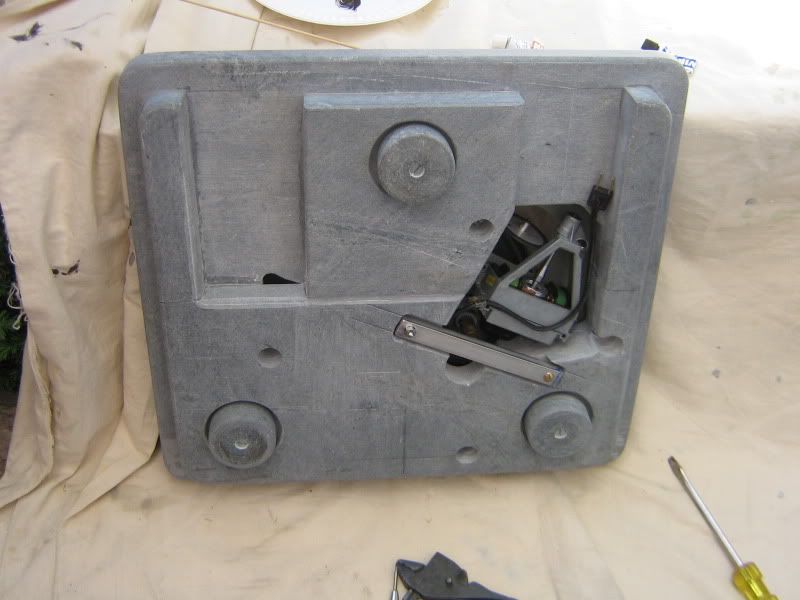
On my Presto T18 build, posted in Nates linked thread at LencoHeaven, I utilize an aluminum ring around the bearing housing. This ring pulls the bearing housing and top plate down onto the face of the plinth, which adds major rigidity, and kills any top plate flex. I also used a secondary layer of support, the aluminum cross bar, which is intended to support the base of the bearing housing cap. I used a gasket between the cap and housing to seal the lube into the housing. I didn't want the gasket to allow any flexibility to be introduced, so the al. cross bar pushes up against the bearing cap, adding rigidity to that end of the bearing housing.

On the deck that has the included image, above; That is a Bogen-Presto B51 that I converted from a light platter deck, to a dual platter deck. This took the platter load from maybe 4lbs to 17lbs. The original top plate was not designed to handle this load. So to support the upgraded bearing and platter load, I routed in a channel into the soapstone that accepts an aluminum cross bar that supports the bearing load. I could probably stand on the platter now, without introducing any top plate flex.
Ultimately, the reason behind these cross bars was two fold:
1) To eliminate top plate flex.
2) To dampen out vibrations and noise from the bearing into the plinth, rather than causing the platter to take it all in. It is a major mode to eliminate drivetrain noise.


Nate,
I was reading this thread, and when I came on that image, i did a head scratch, as it looked so familiar. Duh! It was mine.

Interesting how big of a difference it made. Was there any appreciable slippage at startup that the new idler corrected?

Yes, it really brought it into this century.

The old idler did not have any traction problems, but the new one does grip better with lighter pressure which helps make it quieter. Now that i think about it; it seems to have improve bass "weight". Could this be related?

I started drawing up plans for a new plinth over the weekend. My local lumber seller has 60" by 60" by 3/4 sheets of Baltic ply for $50. This will give me enough for the new plinth at half the cost I've seen elsewhere.

I custom-made a set of 2 cut-out templates that will allow me to leave as much support and mass under the deck as possible. There's two b/c the top-most layer needs to have a bigger opening than the lower layers to accommodate the hardware on the underside of the mounting plate. I'm also planning on drilling a tight-fitting hole in the base plinth for the main bearing to set in.

I also want to make the 'table match the dimentions of my other gear. Right now it's a 50 pound coffee-table sized behemoth. The new one will be able to join the main set-up and I can do away with the 50 foot cables.
If the templates work well, I'll make them available as PDFs. But that'll be a while from now.

Well done on getting the wheel retread. Too many people depend on the sanding the wheel theory as some sort of a rehabilitive fix for a 40 to 60 year old rubber idler wheel. New rubber makes a huge difference, as you found out; same goes for the new motor mounts.
Ed Crockett is a good guy, and good choice. I've had three wheels OH'd by Ed. I also like Terry's Rubber Rollers - both great resources.

congrats on your efforts to this point!
Now that you've honed your skills with wood - try some stone!

 
Thanks Nate and Mfrench. The wheels are already turning on how to incorporate a main bearing brace in my Baltic Birch plinth build.

I've also been thinking of way to possibly brace the motor to sink vibration off of it while still allowing it to slide back and forth in its normal operation. I wonder if I could incorporate sliding plinth layer onto the motor mounting plate; one that would have a low enough friction to slide, but still offer enough compression to couple. Sort of like a big internal wooden slide-bolt.

:scratch2:
 
Back
Top Bottom