• The move to the new server is done. There are some software and database maintenance updates in process. This has us passing the hat around to help out. We appreciate any donations. Seriously, even a dollar helps. The payment page may be found here - https://www.audiokarma.org/support.html

Roll call, SME series 1 3009, 3012 arm's

totem

Addicted Member
After reading another roll call thread it got me to wondering, although the numbers were not huge
for the early production Series 1 round yoke SME arms 3009 and 3012, I would imagine
some AK members have 1 or perhaps more, knowing the collections that are hidden away.

So if your inclined lets hear and if you have a picture all the better.

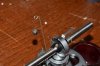
Bellow the first Sony DD, TTS-2250 sold as a drive, motor only with an SME 3012 Series 1 arm
W/ Shure V15 III.


tts2250sme3012028.jpg
 
Last edited:
Register to hide this ad
While waiting for other owners, a historical fact,

1 - This series had no anti-skate when brought to the market, as was common along with other
brands Ortofon etc.
A short time later SME designed a user installed anti-skate accessory that could be bought at your dealer
as mounted on this example but hard to see.
 
You mean that fishing line with the sinker on it? Nice that they saved that design to use on later version of the arm.

On those later arms they shoved a rod into the back of the yoke and put some notched rings on it to hold the fishing line at different anti-skate values. How did this arm accommodate the line?
 
Last edited:
After reading another roll call thread it got me to wondering, although the numbers were not huge
for the early production Series 1 round yoke SME arms 3009 and 3012, I would imagine
some AK members have 1 or perhaps more, knowing the collections that are hidden away.

So if your inclined lets hear and if you have a picture all the better.

Bellow the first Sony DD, TTS-2250 sold as a drive, motor only with an SME 3012 Series 1 arm
W/ Shure V15 III.


View attachment 865821
Beautiful Totem, I always wanted one of those first generation SMEs. Particularly due to the fact that when I see them they usually have that genius pivoting headshell mount that allows use with pretty much any cartridge/headshell style (ESL, EMT, SME, Ortofon mono, etc.) Does yours have that?
 
. Particularly due to the fact that when I see them they usually have that genius pivoting headshell mount that allows use with pretty much any cartridge/headshell style (ESL, EMT, SME, Ortofon mono, etc.) Does yours have that?

Yes that's another one of the difference'e between the series 1 SME's, the rotating cartridge collar, an end of an era when standardization within
the Audio world was still settling out, at least headshell pin orientation.

If you wondered how one goes about changing from diamond pattern to square pin orientation, you simply insert the headshell
and rotate to the desired pattern.
There was a thread recently where Kent and I brought the subject up, seems a fact that is relatively unknown.
 
  • Like
Reactions: WAH
Very, very cool, quite a useful feature even in today's world, you can pretty much run any style of head on it. I only really was aware of it from looking closely at pictures of those early series 1 arms...
 
I see the Roll call line is a little sparse owner wise, on the net there are several sites quoting the numbers produced and the one that's
quoted is 500, now was that the 3012 or 3009 or quantities for both?

There were other differences between the first series and the later versions in both materials
and dimensions including the baseplate thickness, the knife edge bearing size and the tube material.

I have some original series 1 literature somewhere but need to copy it to post.
 
Last edited:
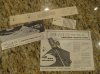
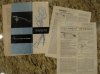
While rummaging through my files I found the original owners manual, template cutout, SME sales brochure
and some period test reviews, the original owner was an engineer who kept and filed everything away.

Interestingly the arm was bought from a dealer in Vancouver and over all these years has not travelled far.

They show a date of 1958/59 and most have already been posted on VE in their excellent archival section, other than
the colour SME sales brochure which I will send in to them.


IMG_3115_Fotor.jpg

IMG_3119_Fotor.jpg
 
Just a follow up to the lack of anti-skating on the series 1, 3009/3012 arms mentioned in an early published
review shown above, the reviewer was very positive over all but commented on not having skating compensation.
But you could "tilt" the table slightly and get the same results.

The winds of change were blowing, O how far we have come!
 
Still looking for other owners who can add any user or historical information regarding
the early series 1 SME arm's.

One fact not noted so far relating to the rotating arm collar, is that when in the "EMT" or diamond orientation
it allows for connection of the classic 2 pin horizontal Mono cartridges of the day.

Regarding information found on net there are many conflicting and simply wrong statements {materials of construction, spec's}
even down to images so take what you read with that in mind. This no doubt is due to the numbers produced and era.
 
Last edited:
I recently came into possession of a very early 3012 Series 1 (no serial number, just 'Made in England' on the bottom of the base plate). It is, however, in a bit of rough shape. The previous owner liked to modify things, and among his questionable acts was to fill the tonearm extension with solder, somehow lose the balance weight (there's a smaller balance weight with a big honkin' hole drilled in the side...also filled with solder), and rewire using way-too-heavy gauge wire (and ditch the

I've ordered new Cardas 33/4 wiring, new coupling rubber for the tonearm extension, new bedplate grommets, and a replacement rider weight spring / plunger combo (spring is there, but the previous owner lost the plunger and replaced with a dogtag chain ball). Not sure what I'm going to do about the balance weight, but I might just have to live with what I've got (if it is sufficiently heavy) and try to find a replacement over time (maybe AudioSilente?).

A few questions I have, which I have been unable to glean from Vinyl Engine or any other site I've found:
  • How is the earth wire attached to arm tube? The original slotted knife bearing screws are too short to put a ring terminal + nut on the inside of the arm as with Series 2 arms and the non-original wiring doesn't provide any clues.
  • Did the Series 1 have a plug for the brass spigot that holds the tonearm extension to the back of the arm tube as with the Series 2, or did it simply use the coupling rubber and glue to hold everything together? Given the size of the screws mentioned above, a plug seems unlikely unless press fit.
  • Does anyone know if/where a bumper for the underside of the arm tube (above the arm lift) and/or an appropriately-sized grommet for the wiring hole in the arm tube can be sourced? As with the balance weight, I've had little luck with finding a replacement.
Thanks in advance.

-Derek
 
Just a quick reply for now, I can get back with photos when I get back home after work this evening.

I've been restoring what I assume is a late 3012 Series 1; it has a modern bearing housing and anti-skate kit, but the "loose" headshell mount and the old type of isolator between the main arm tube and the back stub.

The ground wire on mine is soldered to an angled metal clip, pressed into place at the headshell end of the arm tube. This means it has five wires along the arm tube. Not the most secure ground connection, but this is what was on offer.

The rubber isolator is the tricky part; those have been unavailable for years. I've been told from one serious restoration shop there are plenty of these arms lying around, impossible to get in shape due lack of proper isolators.

That part has a traditional design with a quirk: A rubber grommet, with a long screw from the back. But the rubber has an inner brass tube enforcing, which makes it tricky to replace: a plain rubber part will not behave as the original, and the turned teflon parts that have sometimes been sold obviously won't do that isolation thing the arms were designed for.

So, of course I've copied the old wonky isolator of "my" arm, and hope to finally give a couple of my prototypes a good listen in the next weeks. The default option will probably be a silicone grommet with the brass insert. The dimensions are the same as the originals, apart from the brass tube having a 0.5 mm thinner wall (1 mm larger inner diameter), since I couldn't source anything with the exact dimensions. This shouldn't have affect the sonics. Using silicone instead of the original rubber will be a bit different, but I won't be able to tell if it would be better or worse than the original, since I obviously don't have any pristine original part to compare with. What I'll be trying out is the best final outer dimension of the rubber - I've made three of them in about 0.07 mm steps. Of course I don't know if the o.d. of my original part is affected by age or hardening.

While I'm at it, I'll also make one version in polyurethane rubber, a bit harder than the silicone (and what I assume the original was when new). The idea behind that is to give a possibility to experiment with a stiffer isolation in the arm, which I suspect could be interesting at least with some cartridges.

If all goes as planned - as it seldom does in my life - I should have the parts ready to ship by this spring.

 
Last edited:
Just a quick reply for now, I can get back with photos when I get back home after work this evening.

I've been restoring what I assume is a late 3012 Series 1; it has a modern bearing housing and anti-skate kit, but the "loose" headshell mount and the old type of isolator between the main arm tube and the back stub.

The ground wire on mine is soldered to an angled metal clip, pressed into place at the headshell end of the arm tube. This means it has five wires along the arm tube. Not the most secure ground connection, but this is what was on offer.

The rubber isolator is the tricky part; those have been unavailable for years. I've been told from one serious restoration shop there are plenty of these arms lying around, impossible to get in shape due lack of proper isolators.

That part has a traditional design with a quirk: A rubber grommet, with a long screw from the back. But the rubber has an inner brass tube enforcing, which makes it tricky to replace: a plain rubber part will not behave as the original, and the turned teflon parts that have sometimes been sold obviously won't do that isolation thing the arms were designed for.

So, of course I've copied the old wonky isolator of "my" arm, and hope to finally give a couple of my prototypes a good listen in the next weeks. The default option will probably be a silicone grommet with the brass insert. The dimensions are the same as the originals, apart from the brass tube having a 0.5 mm thinner wall (1 mm larger inner diameter), since I couldn't source anything with the exact dimensions. This shouldn't have affect the sonics. Using silicone instead of the original rubber will be a bit different, but I won't be able to tell if it would be better or worse than the original, since I obviously don't have any pristine original part to compare with. What I'll be trying out is the best final outer dimension of the rubber - I've made three of them in about 0.07 mm steps. Of course I don't know if the o.d. of my original part is affected by age or hardening.

While I'm at it, I'll also make one version in polyurethane rubber, a bit harder than the silicone (and what I assume the original was when new). The idea behind that is to give a possibility to experiment with a stiffer isolation in the arm, which I suspect could be interesting at least with some cartridges.

If all goes as planned - as it seldom does in my life - I should have the parts ready to ship by this spring.
I was able to find the coupling rubber pieces from SME Tonearms in Ontario, so I think I'm covered there. I'll need to figure out my options for grounding since I definitely don't have that clip. Perhaps I can find a longer Series 2 knife bearing screw with the same thread size and mount the ground that way. Another option might be to slide a 33AWG stripped & tinned wire into the slot on the underside of the headshell end of the arm, solder it to the rearmost part of that slot, and carefully smooth it over so it is (hopefully) unnoticeable.
 
This is how my original ground was set up. I don't know if it was from the factory, or done by the previous owner. The ugly setup and solders make me suspect him:

sme_s1_original_ground.jpeg

Arm ground wire connected to a common signal ground. Not my cup of tea. So instead I did it like this:

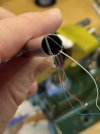
sme_s1_restored_ground.jpeg

Audio Silente signal wire (love that stuff, no affiliation...) plus an added litz thread soldered to the ground bracket, shown here before I shoved it far enough in the tube to not touch the connector. I'd say you could use any suitably cut springy and solderable piece of metal, preferably with some contact grease at the ends for a bit of protection against oxidation. Since the back end of this arm is plugged with a pressed metal part I couldn't figure out any nice way to connect the ground at that end.

I was able to find the coupling rubber pieces from SME Tonearms in Ontario, so I think I'm covered there.

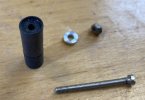
That "pieces" thing makes me think you may have a two part Series 2 isolator? This is what my original isolator looked like, not replaceable with the Series 2.

sme_s1_original_isolator_screws.jpeg

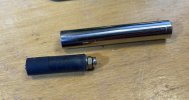
...and a peek inside, at the brass insert:

sme_s1_original_isolator_inner.jpeg

Did you manage sourcing a part like this? I couldn't find any nowhere. That could have spared me a heck of a lot of work...
 

Attachments

  • sme_s1_original_isolator.jpeg
    sme_s1_original_isolator.jpeg
    72.9 KB · Views: 5
Back
Top Bottom