Well, kinda...
Arm tubes without isolators is the modern approach, but in order to get there the entire arm design has also been rethought. The original problem from the sixties was in managing the mechanical vibrations from the cart into the arm tube. A design with a back stub hung on a flexible isolator breaks up the vibration of the arm tubes's resonance frequency into two smaller ones, ideally tuned to not enforce each other at any of their harmonics. And also, the rubber provides an additional damping of the vibrations.
The downside of the design of course is that damping part, not only affecting the arm resonances but also effectively killing off transients and timing.
One could replace the rubber with something harder, as with the teflon parts, but the only result of that would be a return to the pre 60's designs, with the arm tube doubling as a resonator. In fact, many of us have first hand experience of this. It is exactly what happens when an old isolator rubber hardens by age through post-curing or oxidation. The result tends to disappoint, often causing the owners to get rid of perfectly well designed arms because of their dull or overly shrill sound.
The modern approach does not attempt to damp those vibrations, but to transfer them into the mass of the plinth / chassis of the machine. But to achieve that, the entire arm must be made much more solid, with all bearings tight enough to carry the vibrations to the next step of the path without increasing the bearing friction. Also, the vibration path must be built without any major variations of the mechanical impedances, since those would reflect a part of the vibrations back into the arm tube. This is pretty much the basics of the Series V, Ittoks and everything that's been built after that. (Apart from the of the ultra low mass years).
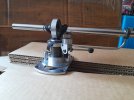
So yes, If you are willing to skip your Series 1 or 2, the proper solution is to get a modern arm instead. But in this case, I'm interested in having "my" (my client's, in fact) Series 2 sound as good as possible, which probably should be akin to how it was originally designed. From that perspective I'm pretty certain going undamped is plain wrong, but I would expect there to be some interesting effects to be had by adjusting the hardness, or contact areas, of the rubber isolator. I've always found SME's offer of only one type of Series 2 isolators a bit strange, considering them being used to tune arms of so different masses and materials. At least there should have been some variation between the stainless steel/aluminium tube, or 9 or 12 inch models.
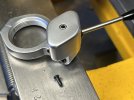
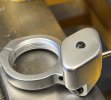
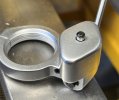
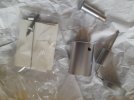
Some of the silicone ones I'll be trying out have a very nice fit, giving a reasonable feel to the arm stub. But I must give them a good listen before giving any verdict.
Another question, for which I don't have any answer, is if the isolators should be tuned for different cartridge compliances. But I think this too could be interesting.