• The move to the new server is done. There are some software and database maintenance updates in process. This has us passing the hat around to help out. We appreciate any donations. Seriously, even a dollar helps. The payment page may be found here - https://www.audiokarma.org/support.html

Roll call, SME series 1 3009, 3012 arm's

Some of us back in the 60's felt the arms had horizontal bearing resonant issues. Used with Ortofon cartridges they didn't mate up with very well. So I tried series II and seies III arms and stuck with a series II arm for a while. Then when Rabco came out with their linear arm I switched. 90% of the tracking issues went away which really made me happy using Ortofon MC cartridges, V-15's and Stanton 881 981 performed better also. Back in 06 when I wiped out my last 981 HZL cantilever, I switched to Dynavector MC series 20 cartridges. I now use a XX-2 MK II. I will say the Fat Boy arm on my Mark Levinson/VPI TT does quite well being a pivoting gimbaled tone arm with a 20 X 2. I detest VPI's uni point tone arms. If I were rich I might try a SME MK V arm or one of Grahams tone arms. I have heard them And know both are great. But they are way over your budget for sure.
 
This is how my original ground was set up. I don't know if it was from the factory, or done by the previous owner. The ugly setup and solders make me suspect him:

View attachment 3438511

Arm ground wire connected to a common signal ground. Not my cup of tea. So instead I did it like this:

View attachment 3438512

Audio Silente signal wire (love that stuff, no affiliation...) plus an added litz thread soldered to the ground bracket, shown here before I shoved it far enough in the tube to not touch the connector. I'd say you could use any suitably cut springy and solderable piece of metal, preferably with some contact grease at the ends for a bit of protection against oxidation. Since the back end of this arm is plugged with a pressed metal part I couldn't figure out any nice way to connect the ground at that end.


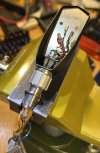
That "pieces" thing makes me think you may have a two part Series 2 isolator? This is what my original isolator looked like, not replaceable with the Series 2.

View attachment 3438520

...and a peek inside, at the brass insert:

View attachment 3438522

Did you manage sourcing a part like this? I couldn't find any nowhere. That could have spared me a heck of a lot of work...

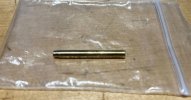
This is the brass spigot I was referring to. And, FWIW, you can buy replacement rubber pieces (Series 1) from SME Tonearms in Canada.
 

Attachments

  • 20250226_195145327_iOS.jpg
    20250226_195145327_iOS.jpg
    63 KB · Views: 6
Sorry for being so dense, but I still fail to find the series 1 isolator I've shown at what I think is the SME Canada site. All I can find are the Series II sets. Could you send me a link?
 
The one you linked to is what I call Series 2, which certainly didn't fit in the arm I've got. I know, since I bought one of those sets before realising I was in trouble with my restoration job. Those are glued in place. The ones I've got are mounted on a screw from behind. No glue. If you've got the "spigot" as a part of the back end of the arm, as shown in the image, you've got a Series 2 isolator.

The different SME types of arms are really confusing, I don't claim to be an expert. My guess is that they were built in the traditional post-WWII-British way, combining what bits and bobs were found lying around. From what I know, there were different combinations of end stub isolators, headshell mounts, anti-skating setups and whatnot, not necessarily with any combination consistently built before or after any other. You may very well have a Series 1 arm with a Series 2 type of isolator - I wouldn't be in the least surprised. No need for disappointment.

I needed the type of isolator I've shown, and since it seems to be unavailable from other sources I'll probably make some more for anybody needing them since I've already got the tooling for them. But if they would in fact be available from other sources there are many other things I could put my time into. Peddling them will be a bit tricky, though. Obviously I can't get away with just describing them as "Series 1 isolators"...

By the way, if you cant find any suitable rubber grommet for the wiring hole, that shouldn't be a problem. a piece of shrink tube on the wires should be enough to protect them from chafing.
 
Last edited:
Some of us back in the 60's felt the arms had horizontal bearing resonant issues. Used with Ortofon cartridges they didn't mate up with very well. So I tried series II and seies III arms and stuck with a series II arm for a while. Then when Rabco came out with their linear arm I switched. 90% of the tracking issues went away which really made me happy using Ortofon MC cartridges, V-15's and Stanton 881 981 performed better also. Back in 06 when I wiped out my last 981 HZL cantilever, I switched to Dynavector MC series 20 cartridges. I now use a XX-2 MK II. I will say the Fat Boy arm on my Mark Levinson/VPI TT does quite well being a pivoting gimbaled tone arm with a 20 X 2. I detest VPI's uni point tone arms. If I were rich I might try a SME MK V arm or one of Grahams tone arms. I have heard them And know both are great. But they are way over your budget for sure.
On most arms the advantage of 12" instead of 9" versions is only due to the increased effective mass. Unless I've gravely misread the literature, the reduced error in the tracking angle mostly affects 2nd harmonic distortion, which is in effect inaudible unless ridiculously high - it gets masked by the mechanisms in our hearing that compensates for the same kind of distortion generated in our ears. The same auditory mechanism applies to the distortion spectra from tubes/valves, btw.

But with the SME knife bearings the added mass also helps tame a bit of the chatter in the lateral (vertical) bearings, which is nice. I wouldn't consider these arms ideal by any means, but I'm interested in having them sound as good as possible.
 
The one you linked to is what I call Series 2, which certainly didn't fit in the arm I've got. I know, since I bought one of those sets before realising I was in trouble with my restoration job. Those are glued in place. The ones I've got are mounted on a screw from behind. No glue. If you've got the "spigot" as a part of the back end of the arm, as shown in the image, you've got a Series 2 isolator.

The different SME types of arms are really confusing, I don't claim to be an expert. My guess is that they were built in the traditional post-WWII-British way, combining what bits and bobs were found lying around. From what I know, there were different combinations of end stub isolators, headshell mounts, anti-skating setups and whatnot, not necessarily with any combination consistently built before or after any other. You may very well have a Series 1 arm with a Series 2 type of isolator - I wouldn't be in the least surprised. No need for disappointment.

I needed the type of isolator I've shown, and since it seems to be unavailable from other sources I'll probably make some more for anybody needing them since I've already got the tooling for them. But if they would in fact be available from other sources there are many other things I could put my time into. Peddling them will be a bit tricky, though. Obviously I can't get away with just describing them as "Series 1 isolators"...

By the way, if you cant find any suitable rubber grommet for the wiring hole, that shouldn't be a problem. a piece of shrink tube on the wires should be enough to protect them from chafing.
Interestingly, everything else on the arm appears to be Series 1 (vertical bearing is round, no anti-skate, rider weight mount is closed end style that attaches to the end of the stub, cuing has knurled dashpot and round ball on the lever, baseplate only has 'Made in England' on the bottom w/out a S/N). I'm sure you are correct with your "post-WWII-British way" supposition.

The end stub on mine is rifle-drilled with two different diameters, BTW, the rear hole is smaller than the front hole.
 
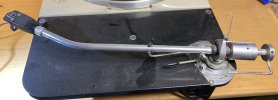
Well, since you asked. This is how mine looked like when I got it:

sme_s1_as_found.jpeg

Yours would seem more Type 1-ish than mine, apart from the isolator, which isn't even visible.
 
...Mine has s/n 7534, neatly marked on a label on the underside of the bedplate. Also came with an Ortofon-type of bakelite headshell, marked SME. From what I've learned here, this shouldn't be such an early model as the isolator and that headshell made me assume. Btw, all the missing parts in that photo above came in a box together with the deck. According to the SME model identification file this should be a series 2, despite the isolator and the twistable headshell mount. Go figure...
 
...Mine has s/n 7534, neatly marked on a label on the underside of the bedplate. Also came with an Ortofon-type of bakelite headshell, marked SME. From what I've learned here, this shouldn't be such an early model as the isolator and that headshell made me assume. Btw, all the missing parts in that photo above came in a box together with the deck. According to the SME model identification file this should be a series 2, despite the isolator and the twistable headshell mount. Go figure...
Yeah, the split yoke with the built-in antiskate rod is a bit of a giveaway for Series 2, but that seems to be a very early Series 2. Perhaps they decided to use up some Series 1 bits. Is that an aluminum armtube or steel?
 
While waiting for other owners, a historical fact,

1 - This series had no anti-skate when brought to the market, as was common along with other
brands Ortofon etc.
A short time later SME designed a user installed anti-skate accessory that could be bought at your dealer
as mounted on this example but hard to see.
Does anyone make a reproduction anti-skate accessory clip?
 
Well, since you asked. This is how mine looked like when I got it:
That's an early series 2 arm, your head shell is an S3 version pretty rare. Can you post a pic of the under side of the head shell / finger lift and showing the pin connection?
 
This is the brass spigot I was referring to. And, FWIW, you can buy replacement rubber pieces (Series 1) from SME Tonearms in Canada.
Don't think he sells the series 1 stub connectors as he mentioned at 1 point they needed to be vulcanized, I scratched my head on that one.
 
Don't think he sells the series 1 stub connectors as he mentioned at 1 point they needed to be vulcanized, I scratched my head on that one.
You can buy them, but the caveat is that with the Series 1, they will most likely sag over time due to the weight of the ginormous counterweight.

(I was on the phone a couple of times today with Alfred from SME Tonearms and he was extremely helpful)
 
That's an early series 2 arm, your head shell is an S3 version pretty rare. Can you post a pic of the under side of the head shell / finger lift and showing the pin connection?
This is the photo I had at hand. Both this and the Ortofon built headshells have the standard positions of the pins.

sme_s3_headshell.jpeg
 
Don't think he sells the series 1 stub connectors as he mentioned at 1 point they needed to be vulcanized, I scratched my head on that one.
I'm still dense... Exactly what are you referring to with the "stub connectors"?

I previously assumed the type of isolator I've shown was a series 1, in contrast to the series 2 that is availble today. Since @derekva has a series 1 arm with a series 2 "elastic coupling" that obviously was as wrong as most of my other assumptions.

If your "stub connector" refers to the same isolator that I have, at least all of them weren't vulcanised. Mine is not, which is why I could take its brass insert out and measure it for my copy.

Does anybody have any SME or third party documentation or info on this type of isolators? I haven't been able to find any - the closest I got were old ebay ads for a teflon part in the same shape.
 
Last edited:
Back
Top Bottom