• The move to the new server is done. There are some software and database maintenance updates in process. This has us passing the hat around to help out. We appreciate any donations. Seriously, even a dollar helps. The payment page may be found here - https://www.audiokarma.org/support.html

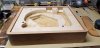
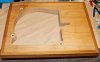
Russco Studio Pro Plinth Build

Thanks very much Bill…

Yeah we did paint the floor, it’s wood and we wanted to make it easier to sweep, paint keeps the dust particles from sticking….after a few years it doesn’t look as pristine :(

For those who don’t have a lot of experience doing things like this, the corners are miter edges, if one try’s to glue them without doing anything else, it can be a hair pulling experience—“slip sliding away” comes to mind.

Plus it’s end grain and that doesn’t glue as well and isn’t as strong, so we spline/dowel it.

So to keep it hidden, biscuits is one approach that works well. This is done with a plate joiner, more commonly known as a biscuit joiner.

Biscuits come in different sizes, 0, 10, 20 and you don’t want them too close to the surface, they swell with glue and will show through, called ”ghosting “.

The biscuits or dowels have to align precisely and be cut at an angle.

Some biscuit joiners have fences that adjust for such an approach, but most don’t.

So to accomplish this with a standard biscuit joiner, we put the 2 pieces we want the biscuit joints in back to back.

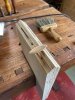
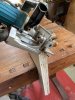
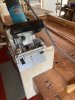
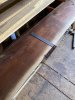
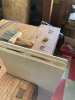
Then we align everything and use the two 45 deg cuts guid the joiner cuts….here’s some photos to make it clearer.

Remember to use the right biscuit and set the biscuit size, test cut locations on some scrap 45 miter cuts and ensure the fence is set at 90 deg.

Remember in most cases, “failure is not fatal” :no:8B9C679F-8F1D-4E88-8302-3BAE0260DEF6.jpeg4B39A783-A5A6-4A2D-849D-24B05C608C91.jpegFA724F69-DCF7-4BC4-A764-E21E6E89F20E.jpegEB9AB792-D890-4653-99A4-B7ED9ACEEBEE.jpeg
 
Last edited:
@Lapslah, yes to your first statement, the internal portion is layered with clearance for mechanical parts, vents for cooling and access to tonearm and such….. Can be done several ways and as Bill pointed out, it’s to stop the resonance or “echo effects” of the box.

Thanks for the clarification. I'm well aware of the stacked plywood plinth and its benefits. It was just that your OP made it sound like perhaps you weren't! The construction of your plinth will be very similar to the one I built last year for my Thorens TD124, except mine is wrapped in cherry rather than walnut, and I curved the dovetailed corners. The curve was a challenge I set for myself, and I like it, but it removes the cross-grain/end-grain contrast, especially after staining, so it's not as striking as I had hoped. Still, it was fun to do successfully.

20191012_132437.jpg 20191023_175114.jpg
 
Thanks for the clarification. I'm well aware of the stacked plywood plinth and its benefits. It was just that your OP made it sound like perhaps you weren't! The construction of your plinth will be very similar to the one I built last year for my Thorens TD124, except mine is wrapped in cherry rather than walnut, and I curved the dovetailed corners. The curve was a challenge I set for myself, and I like it, but it removes the cross-grain/end-grain contrast, especially after staining, so it's not as striking as I had hoped. Still, it was fun to do successfully.

View attachment 2293497 View attachment 2293498

That’s impressive, great craftsmanship :thumbsup: very thoughtful design and obviously well executed. Did you do a post capturing your project? Would be nice to add the link here if you did….

Woodworking Terminology for builds like these can be ambiguous, we tend to mix terms and metaphors but in my terminology your build is a “layered plinth”, it’s my preferred design/build approach for all idler tables and would not build otherwise unless the owner specified another method.

Intentionally don’t do this for a living, only as a hobby and mostly for equipment personally built and/or refurbished. However on occasion a friend will talk me into building something or my curiosity leads down some path that ends in building something just because of a personal challenge :confused:

Have done rounded dovetail corners and hidden dovetails, and I’m considering making another Russco Professional plinth with contrasting wood, and a more spacious plinth.

The plinth in this post has to fit into an existing space on a shelf so the area to work inside is restricted; actual working inside an area roughly 15” x 15” and the Russco has a veritable garden of appendices sticking out from underneath.

Probably won’t get back into the build until late next week, but as is common when I start a project like this, my mind is constantly musing about the design and new build concepts are bouncing around inside that empty space in my head where most people have grey matter :crazy:

VR
Andy
 
Be aware that a box with equal dimensions will become a resonant chamber. You mentioned the width restriction if you can make the depth and height an odd order so there are minimal standing waves setup inside the plinth.

IME rigidity and damping of vibrations makes a massive improvement in SQ.

Keep the photos coming.

If runs the bottom open it may not be :)
 
Marc Morin (RIP) advised those who run an AR XA in an original plinth to remove the bottom cover and sit it on an old piece of carpet, horse blanket or similar ;) Sure makes a difference :thumbsup:

VR
Andy

yea my PL-41 has a custom plinth that I run with an open bottom. One of my favorite tables.
 
Have revised my concept a bit - found Sorbothane dampers which will be screwed to the frame and sit in depressions in the top layer of the plinth, a bit similar to the TD124.
 
Have revised my concept a bit - found Sorbothane dampers which will be screwed to the frame and sit in depressions in the top layer of the plinth, a bit similar to the TD124.

Might be worth trying, but I would recommend making them easily removable so you can determine if the plinth does a better job of damping with or without them. One of the biggest reasons I made my massive stacked plinth for my TD124 was to eliminate the "mushrooms". The purpose of all that mass is to absorb vibration, and isolating the table from it with sorbothane won't allow for that. In my experience, you want to mate the table to the heavy plinth as solidly as possible and let physics do the rest. I used the TD124 mushrooms (new, soft ones) in my first stacked plywood plinth for a year or more. Then one day I removed them and went, "Oh! I get it now!"
 
What Lapslah said x 2. No sense in building a massive plinth if your going to isolate it from the rest of the turntable.
I even drilled the corner holes on my Russco to fit larger #10 screws as the stock holes were very small. I want to be able to pull the top aluminum casting down tight to the plinth.

BillWojo
 
Might be worth trying, but I would recommend making them easily removable so you can determine if the plinth does a better job of damping with or without them. One of the biggest reasons I made my massive stacked plinth for my TD124 was to eliminate the "mushrooms". The purpose of all that mass is to absorb vibration, and isolating the table from it with sorbothane won't allow for that. In my experience, you want to mate the table to the heavy plinth as solidly as possible and let physics do the rest. I used the TD124 mushrooms (new, soft ones) in my first stacked plywood plinth for a year or more. Then one day I removed them and went, "Oh! I get it now!"

I don't really want to make a "massive" plinth, just what i need for structural integrity and then some nice wood around it (because i like wood).

For my TD124 i replaced the mushrooms with Sorbothane grommets and suspended the motor on silicone gel grommets. It is rather quiet.
Made POM inserts for the Sorbothane, which fit in the hole and depression of the plinth
POM inserts.jpgInserts.jpg
 
Everyone has their own opinion/approach when it comes to plinth construction, or even If a plinth is needed :angel:

I’ve looked into the resonance/dampening concept(s) in considerable detail…

In a prior life competition shooting was one of my passions (many different classes and calibers) and vibration dampening is a prominent topic in many different classes, but it’s huge in .22 cal benchrest and very controversial (argued about incessantly) the controversy isn’t about if it works, it’s about the why and how it works, generally related to barrel vibrations, harmonics and dampening, and the best approach to achieve desired results.

A short story about very high power scopes and vibrations:

Many shooting ranges have huge concrete slabs, some are hundreds of feet long but normally 50 feet or so deep. In this particular situation the rifle sits on a rest that isolated from the bench by spikes and sorbothane pads, much like speaker spikes. On many occasions in just such a range I’d be looking through my scope with extremely high magnification, I’d notice it vibrating from someone walking behind me on the huge concrete slab!

My other experience, very different context, is related to woodworking, one of my local “mentors” is a multi generation woodworker that also made musical instruments for Juilliard school of music before he retired, so we naturally discussed wood types and harmonics, old vs new concepts in material selection and it’s effects on resonances…all that kind of stuff.

I’ve come to the conclusion that the best way to approach a build in which I’m trying to dampen vibrations and/or slow/stop the transference of sound, is to enhance the natural resonance characteristics of the wood being used.

However each type of wood is different, put one end of plain sawn red oak in water, blow on the other end and one can blow bubbles! So one determines how to take advantage/complement the build materials.

Using sorbothane balls is an effective solution, but it’s sorta a standalone solution, however sorbothane sandwiched/compressed between two boards is a combined approach. It requires application and observation to determine the correct mixture of material and method of employment, but it’s worth the effort in my opinion.:blah:

You get the point, this is just opinion albeit based on experience ;)


I’ll support whatever satisfies the user:thumbsup:

VR
Andy
 
The issue which must be tackled in a rim-drive turntable is the reduction of motor noise. In a belt-driven turntable it's relatively simple to mount the motor to a substantial chassis and mount the platter to a suspended sub-chassis so the only path for motor vibrations to get to the platter is via the compliant belt. What can be done with a rim-drive turntable? Certainly, bolting the whole thing to a massive object does nothing to break the path of vibrations from the motor to the platter. What it does do is increase the inertia of the turntable so the whole thing moves less, which is a good thing, but what effect is it having between motor and platter? :dunno:

Btw, I've heard it said on the forum many times that mass damps vibrations. No it doesn't. Big Ben weighs 13.7 tonnes and rings like a bell (obviously), so it should be obvious that mass per se doesn't have any vibration damping properties.
 
Last edited:
The issue which must be tackled in a rim-drive turntable is the reduction of motor noise. In a belt-driven turntable it's relatively simple to mount the motor to a substantial chassis and mount the platter to a suspended sub-chassis so the only path for motor vibrations to get to the platter is via the compliant belt. What can be done with a rim-drive turntable? Certainly, bolting the whole thing to a massive object does nothing to break the path of vibrations from the motor to the platter. What it does do is increase the inertia of the turntable so the whole thing moves less, which is a good thing, but what effect is it having between motor and platter? :dunno:

My experience is mostly with what most would consider high end idlers, like EMT 930, ROK TR 12H, Rondine Deluxe, Fairchild 412, a couple of 16” RCAs and of course this particular Russco Studio Pro.

Most of these use a large Hysteresis synchronous motor, lots of torque, and each model employed different methods for isolating the motor from the table.

In my experience it’s usually the idler, rim and shaft/well that are the noise contributors….when these motors are clean and the bearing in good condition, there’s usually no audible noise, and on many even the inaudible noise is very effectively quelled by the manufacturers isolation efforts (running the motor unengaged will confirm or deny this).

Each of the models listed use various approaches to limit the idle/rim/shaft noise when engaged, some use huge idlers, with very heavy platters and massive shafts, and others use small and/or multiple small idlers, and all of them employ vicious dampening of sorts…

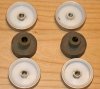
With modern materials we can enhance/ improve almost every aspect of these “noise makers”, for instance idlers constructed from delrin or similar material greatly reduces the transfer of vibrations/noise and similar things can be done in the shaft well with delrin pads, ceramic ball bearing and different viscosity fluids.

Reducing the noise/vibration transference is our goal with the layered plinth, we want to capture/reduce that stuff before it gets to the tonearm/cartridge. The plinth has to absorb/distribute or one might say redirect these unwanted vibrations/noises.

Our success or failure is easily detectable with just the human ear, by comparing the table without a plinth to one with…
When we reach audible success, we can then use a test record and W&F equipment to further quantify the results, if one wishes.

No epiphany here this is a known and proven approach with observable effectiveness.

Understanding the “In Vivo” doesn’t equal success in the “In Vitro” :whip:


VR
Andy
 
Very well written Andy. You summed up the philosophy of building a high performance idler very well. These are all tried and proven solutions.

BillWojo
 
BTW @rothwellaudio the Big Ben mass is intended to ring by design, but I’m sure you were just being a bit facetious :rolleyes:.
No, not being facetious at all - the example illustrates perfectly that mass per se doesn't damp vibrations. Or, simply having a lot of mass doesn't mean that something can't be resonant.
 
If the motor is well isolated from the plate that the platter bearings are mounted to, that leaves one to concentrate on a material that makes contact with the motor and the rim. With all the materials out there today one would think a person could find a drive material that could maintain a consistent speed, while reducing as much niose as posible from the motor spindle. Perhaps it will take more then one contact wheel of a particular material, to do it.
 
Back
Top Bottom