
• The move to the new server is done. There are some software and database maintenance updates in process. This has us passing the hat around to help out. We appreciate any donations. Seriously, even a dollar helps. The payment page may be found here - https://www.audiokarma.org/support.html

Sansui 5500 No Stereo, Clear Mono

I'm not sure my setup is correct, but I injected a 19kHz signal through a 0.02 uF ceramic capacitor into R401 with the SG running but pilot turned off and got a stereo light at around 12 ~14 mVrms.

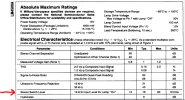
Below is a snip from the LM4500 MPX chip data sheet, for comparison. The LM4500 turns on at 12 (min) to 16mV (typical) V ac rms.

I don't know about the other non-adjustable stuff, to me, you MPX circuit raw sensitivity seems OK.

I would look more closely at the IF gain / detector output levels if your sensitivity for stereo does not compare to other tuners. A quick test is what RF input level (mono) gives you an almost noise free 1 kHz tone? it should be close to 1uV, i.e. close to 0 to 3 dBuV.
Or maybe it is the noise amp / muting...
Maybe now measure (if you can) the pilot levels coming to the MPX input from live over the air broadcasts that do not trigger stereo- most FFT based programs like ARTA will show you this via spectrum on a PC soundcard. If they exceed the levels you just measured, you have your answer.
 

Attachments

  • stereo switch level .PNG
    stereo switch level .PNG
    221 KB · Views: 3
Thanks @Bob@FM. My measured value seems to align well with that datasheet. I've concluded that my main issue is with the noise detection circuit (TR409, TR410, TR419). I've disabled that by pulling resistor R444 as @PE9ZZ recommended and I'm now able to adjust both stereo and muting thresholds using VR402 and VR403 respectively. I also now receive stereo broadcasts from the local stations I normally pull in. I'm still wondering what the source of all the noise is. Maybe FM IBOC, LED lights or SMPSs I have running in my shop or something else.

Next step is to run through the alignment one more time since I messed with a lot of things during troubleshooting. I'll take a look at the IF and sensitivity as you mentioned above while I'm doing the alignment and let you know what I find. Thanks for following up . . ..
 
I'm still wondering what the source of all the noise is. Maybe FM IBOC, LED lights or SMPSs I have running in my shop or something else.
Has to be IBOC. For once I'm glad I'm unable to verify here in Europe. What a stupid concept.
 
Has to be IBOC.
I agree. I just finished doing some reading on IBOC/HD Radio and its been a problem ever since it was fielded. What I've always attributed to poor reception in my lower lever workshop is probably, actually, IBOC noise on otherwise strong FM stereo signals. Some tuners are affected more than others, which makes sense. In this case, the circuit designed to detect noise is actually working as intended, with unintended consequences.

My tuner knowledge continues to grow. Thanks for everyone's help on this one.
 
Last edited:
Quick sidebar on this discussion. I just finished a Kenwood KR-2120 and there was so much noise in the background I could only listen to the strongest stations in my area, even thought the alignment went well and everything dialed in nicely (pun intended). Turns out my bench LED magnifier light and my other bench light, which also has an LED bulb in it were creating the noise and static. When i turned them off, the FM reception became crystal clear and very sensitive . . . makes me wonder if all the work on the muting circuit which i ended up disabling was unnecessary. Maybe all I needed to do was turn off my lights. The tuner in the 5500 is still working very well without that muting section active, so I think i'll leave it alone unless curiosity gets the best of me over the winter and I find some time to experiment.

I wonder if there are any 'quiet' LED bulbs out there . . . maybe I'll switch back to incandescent or CFL on the bench.
 
The noise issue with LEDs arises because they are almost always driven switched (on/off pulsed). This is done for efficiency and power supply cost reasons but the switched currents create a lot of electrical noise.
 
Back
Top Bottom