

You are using an out of date browser. It may not display this or other websites correctly.
You should upgrade or use an alternative browser.
You should upgrade or use an alternative browser.

Agree, I think you could say ALL Sansui amps in a given era share similar DNA. I guess my question is more of which came first? I think the reverse could also be possible: the 7700 is the "stripped down" version or "lower cost" version of the 9900/11000. The 20000 is different still from the 9900/11000 in terms of boards used - more similar to the CA/BA 3000. So, unless we have some company insights, I find it difficult to decipher which "came first" or what was a "prototype" for what. Do we even know when Sansui began development of either the Professional or the Definition series? To me they do seem out of the ordinary when compared to previous or subsequent "AU series" amps. Not wanting to come across as defensive, but trying to aim for accuracy.Someone more knowledgable than me could pick apart the circuit evolution among that generation of amps, but it appears to me they all share the same DNA, which started with the AU-7700

bolero
Super Member
Well look at the board numbers. They generally progress upwards numerically as time goes by. And then check the serial number database. AU-7700 serials start May 1974. Earliest AU-9900 is June 1975.Agree, I think you could say ALL Sansui amps in a given era share similar DNA. I guess my question is more of which came first? I think the reverse could also be possible: the 7700 is the "stripped down" version or "lower cost" version of the 9900/11000. The 20000 is different still from the 9900/11000 in terms of boards used - more similar to the CA/BA 3000. So, unless we have some company insights, I find it difficult to decipher which "came first" or what was a "prototype" for what. Do we even know when Sansui began development of either the Professional or the Definition series? To me they do seem out of the ordinary when compared to previous or subsequent "AU series" amps. Not wanting to come across as defensive, but trying to aim for accuracy.
Over a year later
It's pretty obvious if anyone bothers to look into it.
Unclear to me why you say the AU-7700 was the "prototype" for the AU-9900/11000/20000. The 7700 has no boards in common with any of the professional series amps. Internal layout and components used are completely different. If you follow Sansui's progression in the solid state integrated amps, for TOTL of the AU series, the progression seems to be 777, 999, 9500, 7700, 7900, 717, 919. Agree the 7700 shares many of the functions of the professional series, but internally they are quite different. It seems to me the "Professional" and "Definition" series were Sansui's attempt at "upping their game" to a higher level.
Unfortunately, the resolution of your image is too low to be readable. What is the source of that image? I'm not seeing it in the owner's or service manuals.
I downloaded the file Sansui-AU-7700-Brochure.pdf from the Sansui service manuals database two years ago (Oct '22) but I have just looked for it and it is no longer there. Perhaps an administrator removed it because it was not an appropriate addition to that folder. It was a four page promotional triumph released when the AU-7700 was just coming out.
I am going to attach the 1 MB pdf file with this comment and see if it comes through. It is a well illustrated and interesting short read.
I was also under the impression BTW that at the time, AU-7700 was a ground breaking amp which set the stage for the whole generation of amps coming out in the mid 1970s. - from the lowly AU-2900 and into the Professional series and beyond. (This includes the lower powered Amps which were not marketed in North America) But I don't have enough knowledge of electronic circuitry to back the claim.
Attachments

billyz
Super Member
I have the AU 9900. I do not believe the Volume Pot is Linear. It behaves exactly like an Audio taper control. In my experience , Linear tapers ramp up the Volume very quickly compared to the more gentle and Natural volume increase of the Audio taper. Granted there are several different Audio Tapers. 10% , 20%, 25, 30% and even Reverse Audio. The Ultimate Volume and power levels are not changed in any real way. I do not have experience with the AU 9900a , which I read has a different Volume taper. I suspect it is Linear. Often this was done to create the illusion of more power as the volume ramps up very quickly at first.Just want to mention that I (may be in a minority here) really like the linear volume pot on the 9900/11000/20000 series. With the three levels of muting, it really lets me dial in the volume level I want (and that volume knob IS smooth moving!) The problem I run into on my single digit receivers (with log pots and no muting switch) is listening at lower levels. It can be quite fiddly to get the right volume, since you are dealing with such a small range on the volume pot in low listening. No problem at all on the 9900. It's like it was made for any range of listening levels.
Lots of discussion on these terms on AK. Good brief explanation at this site. The AU-9900/11000/20000 have linear taper volume pots. Looking at the markings around the volume knob, you see that the change is a consistent 3 dB all the way around the pot, which is what you hear as you turn the knob. On the 9900A, the intervals start large (10 dB) then decrease as you go around the dial, whether you call this "logarithmic" or "audio taper" or something else, what you will hear is a rapid increase in the volume for small movements of the volume knob, which is not the case for the 9900/11000/20000. So, I think you have your terms switched for the two types of pots.I have the AU 9900. I do not believe the Volume Pot is Linear. It behaves exactly like an Audio taper control. In my experience , Linear tapers ramp up the Volume very quickly compared to the more gentle and Natural volume increase of the Audio taper. Granted there are several different Audio Tapers. 10% , 20%, 25, 30% and even Reverse Audio. The Ultimate Volume and power levels are not changed in any real way. I do not have experience with the AU 9900a , which I read has a different Volume taper. I suspect it is Linear. Often this was done to create the illusion of more power as the volume ramps up very quickly at first.
@Monicker1 thanks for posting the brochure. Interesting reading.
@bolero Your conclusions are logical based on those two data points. I know about the dates in the database and the board numbering. Probably getting hung up on the term "prototype" as I would not make that conclusion based on those two pieces of data. I lean more heavily on how Sansui presented the Professional and Definition series in their catalogs and brochures, which leads me to the opinion that these two lines were out of the ordinary for the Sansui line, but of course, these are just opinions. No matter the heritage of the Professional and Definition series, they are wonderful!

billyz
Super Member
If you look closely at sansui schematic and service manuals for products of this Age. Sansui list the control Pots on some with a (B) . The Volume pot on the AU9900 does not have this designation . B is a common designation for Linear Taper. Not always of course. But the way the pot behaves and the lack of the (B) designation indicates to me that it is in Fact an Audio Taper control.Lots of discussion on these terms on AK. Good brief explanation at this site. The AU-9900/11000/20000 have linear taper volume pots. Looking at the markings around the volume knob, you see that the change is a consistent 3 dB all the way around the pot, which is what you hear as you turn the knob. On the 9900A, the intervals start large (10 dB) then decrease as you go around the dial, whether you call this "logarithmic" or "audio taper" or something else, what you will hear is a rapid increase in the volume for small movements of the volume knob, which is not the case for the 9900/11000/20000. So, I think you have your terms switched for the two types of pots.
@Monicker1 thanks for posting the brochure. Interesting reading.
@bolero Your conclusions are logical based on those two data points. I know about the dates in the database and the board numbering. Probably getting hung up on the term "prototype" as I would not make that conclusion based on those two pieces of data. I lean more heavily on how Sansui presented the Professional and Definition series in their catalogs and brochures, which leads me to the opinion that these two lines were out of the ordinary for the Sansui line, but of course, these are just opinions. No matter the heritage of the Professional and Definition series, they are wonderful!
I am well verse in the differences of potentiometers . Sorry , but the link you referenced has nothing to say about the Volume pot , dual 250k, as used in the AU9900. The Function of the volume pot on the AU9900 is most consistent with a Logarithmic or Audio Taper potentiometer. From what I read about the Volume control of the AU9900a, it sounds like a Linear taper was used in the later model.
The Markings around the faceplate have nothing to do with the Taper, just the perceived volume.
Anyway, I don't mean to be obstinate , but I frequently read and hear others confusing the behavior of these different tapers. Until someone takes one out of the circuit and measures it , I will continue to believe it to be an Audio Taper volume control.
Potentiometers which have constant linear resistance have always been the cheapest to make. They give the user the effect of achieving quick volume rises at the low end of the range and then flatten past the half-way. Most of the lower and mid-range equipment have linear resistance volume pots which means we rarely go beyond 10 o'clock, on the volume knob. This was not a design to create the illusion of more power but instead a law of physics, electronics, and acoustics. The AU-20000 used a log taper which gives a constant volume gain throughout the range of the knob. Log taper pots are not as common and are more expensive. I frequently run my AU-20000 at the 12 O'clock level and sometimes higher knowing I have 25 or 30 dbs to spare. The same was true for the 9900/110000 series. The 9900A/11000A used the simple taper giving users the feeling of higher volumes at lower points on the volume - which some people prefer.. (Or maybe I have the 9900 vs 9900A series reversed,)
I am looking at low res pictures of the volume knobs of the 9900 and the 9900A. They are different. I think you are correct. The 9900 has the log taper, the 9900A has a linear taper. Sansui heard complaints from users who wanted to listen to their stuff at the lower positions on the knob so they put the linear pot in the later 9900A to accommodate this (irrational) preference.If you look closely at sansui schematic and service manuals for products of this Age. Sansui list the control Pots on some with a (B) . The Volume pot on the AU9900 does not have this designation . B is a common designation for Linear Taper. Not always of course. But the way the pot behaves and the lack of the (B) designation indicates to me that it is in Fact an Audio Taper control.
I am well verse in the differences of potentiometers . Sorry , but the link you referenced has nothing to say about the Volume pot , dual 250k, as used in the AU9900. The Function of the volume pot on the AU9900 is most consistent with a Logarithmic or Audio Taper potentiometer. From what I read about the Volume control of the AU9900a, it sounds like a Linear taper was used in the later model.
The Markings around the faceplate have nothing to do with the Taper, just the perceived volume.
Anyway, I don't mean to be obstinate , but I frequently read and hear others confusing the behavior of these different tapers. Until someone takes one out of the circuit and measures it , I will continue to believe it to be an Audio Taper volume control.
bolero
Super Member
Thanks for posting that. The 7700 was a special amp: the number 7 is significant to Sansui too. Their first solid state amp was the 777. So the first amp in their new circuit designs being 7700 is somewhat appropriate I think.I downloaded the file Sansui-AU-7700-Brochure.pdf from the Sansui service manuals database two years ago (Oct '22) but I have just looked for it and it is no longer there. Perhaps an administrator removed it because it was not an appropriate addition to that folder. It was a four page promotional triumph released when the AU-7700 was just coming out.
I am going to attach the 1 MB pdf file with this comment and see if it comes through. It is a well illustrated and interesting short read.
I was also under the impression BTW that at the time, AU-7700 was a ground breaking amp which set the stage for the whole generation of amps coming out in the mid 1970s. - from the lowly AU-2900 and into the Professional series and beyond. (This includes the lower powered Amps which were not marketed in North America) But I don't have enough knowledge of electronic circuitry to back the claim.
bolero
Super Member
It's not just those 2 data points. The schematics tell allLots of discussion on these terms on AK. Good brief explanation at this site. The AU-9900/11000/20000 have linear taper volume pots. Looking at the markings around the volume knob, you see that the change is a consistent 3 dB all the way around the pot, which is what you hear as you turn the knob. On the 9900A, the intervals start large (10 dB) then decrease as you go around the dial, whether you call this "logarithmic" or "audio taper" or something else, what you will hear is a rapid increase in the volume for small movements of the volume knob, which is not the case for the 9900/11000/20000. So, I think you have your terms switched for the two types of pots.
@Monicker1 thanks for posting the brochure. Interesting reading.
@bolero Your conclusions are logical based on those two data points. I know about the dates in the database and the board numbering. Probably getting hung up on the term "prototype" as I would not make that conclusion based on those two pieces of data. I lean more heavily on how Sansui presented the Professional and Definition series in their catalogs and brochures, which leads me to the opinion that these two lines were out of the ordinary for the Sansui line, but of course, these are just opinions. No matter the heritage of the Professional and Definition series, they are wonderful!

The Sansui history is an intriguing thing to unravel. See the Alpha circuit thread too. Enlightening!
I think we are all in agreement on what the volume pot on an AU-9900 does when turned up vs. that on a 9900A. So, the difference seems to be in the terminology used. At some point I'll spend more time reading about the physics of sound to educate myself. For now, thanks for the opinions.
Saw and listened to the AU-20000 today. Several different speakers were being tested by the group listening. Honestly, nothing stood out and grabbed me about the sound. It sounded good, but so does my AU-9900. Sound level was not particularly loud. About 9 or 10 O'clock, but did notice the top of the case was pretty warm - on the boarder of what I would call "hot", particularly the area over the driver boards. Not sure why it should be hotter over the driver boards than over the OTs? With no venting over the driver boards, no air movement to cool things for sure.
Here are some quick picks I snapped (never mind the Pioneer SX-1250 it is sitting on top of!) One long scratch on the top and one on one side of the case. Face plate looks pretty clean.

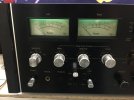
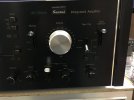
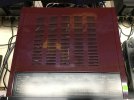
Here are some quick picks I snapped (never mind the Pioneer SX-1250 it is sitting on top of!) One long scratch on the top and one on one side of the case. Face plate looks pretty clean.
NoHas it been fully recapped ?
Three different pairs, a recapped set of KLH 5, recapped set of KLH 12, and a set of Klipsch, but I don't know the model number.Do you remember what speakers they used?
As far as the heat, bias would be my thought, but the guy who now owns the 20000 said he checked all the settings. He said it's normal for it to run hot, but that seems very doubtful to me given the volume setting. It had probably been on playing music for an hour when I arrived. I just thought it was suspect that the area over the driver boards was significantly warmer than the area over the OTs and transformer. Is that normal for a 20000? It's not for my 9900.
billyz
Super Member
If it has not been recapped at least , then a power supply cap could be drawing excessive current. And not just the Big main caps. I found several marginal Power supply caps in my AU9900. Just checking something doesn't instill much confidence to me. I know Biasing the AU9900 is not as easy as many other Sansui's I have owned. I would plan on a complete rebuild, not just "Servicing " Whatever that means. Is the Au20000 easier to bias ?No
Three different pairs, a recapped set of KLH 5, recapped set of KLH 12, and a set of Klipsch, but I don't know the model number.
As far as the heat, bias would be my thought, but the guy who now owns the 20000 said he checked all the settings. He said it's normal for it to run hot, but that seems very doubtful to me given the volume setting. It had probably been on playing music for an hour when I arrived. I just thought it was suspect that the area over the driver boards was significantly warmer than the area over the OTs and transformer. Is that normal for a 20000? It's not for my 9900.
I have owned maybe a dozen Sansui's and none of them ran hot when properly biased.

All of the toggles are silver; the pushbuttons are black. They did mix black and silver knobs though.Thx for the pics, beauty!
I didn't realize they had a mix of silver & black toggles
Do you remember what speakers they used?
Agree, I've not had any Sansui amps/receivers run "hot", but I also don't push my amps to high volumes, so I'm unsure what's "normal" for the 20000. It's my understanding that OTs generate the most heat in any amp/receiver, which is why they are mounted on large heatsinks. I've not experienced that driver boards generate more heat than output transistors.If it has not been recapped at least , then a power supply cap could be drawing excessive current. And not just the Big main caps. I found several marginal Power supply caps in my AU9900. Just checking something doesn't instill much confidence to me. I know Biasing the AU9900 is not as easy as many other Sansui's I have owned. I would plan on a complete rebuild, not just "Servicing " Whatever that means. Is the Au20000 easier to bias ?
I have owned maybe a dozen Sansui's and none of them ran hot when properly biased.
I've not looked at the bias procedure in the SM. Agree, setting bias on the 9900 takes more patience to do it right.
As far as I know, the guy who now owns it got it going out of non-working condition several months ago for the previous owner, but he did not do any additional "service." That is the major reason I'm very cautious about buying this from him. To meet my personal standard, I would do a full re-cap at minimum. However, the asking price he has on it is more in line with "e-bay prices" for a working 20000.