• The move to the new server is done. There are some software and database maintenance updates in process. This has us passing the hat around to help out. We appreciate any donations. Seriously, even a dollar helps. The payment page may be found here - https://www.audiokarma.org/support.html

Sansui AU-20000 vs AU-9900

Is the Au20000 easier to bias ?

I have owned maybe a dozen Sansui's and none of them ran hot when properly biased.
I've found adjusting the bias on the earlier model AU-20000, the one with the bias compensation transistor mounted on the output transistor heatsink, is more difficult to adjust than the later version with the bias transistor located on the driver board heatsink. My guess is having the bias transitor on driver board heatsink does a better job at keeping the bias in check and the amp running cooler.
 
Agree, I've not had any Sansui amps/receivers run "hot", but I also don't push my amps to high volumes, so I'm unsure what's "normal" for the 20000. It's my understanding that OTs generate the most heat in any amp/receiver, which is why they are mounted on large heatsinks. I've not experienced that driver boards generate more heat than output transistors.
I've found the driver board heatsinks are hot when compared to the output transistor heatsinks at low to mid listening levels. The regulated power supply board also contributes to the amount of heat generated in that area of the amp, to the right of the output heatsink vents, especially so on some earlier versions because of the location of the voltage dropping resistors.
 
I was just reading Sansui's document on transient intermodulation distortion ( TIM-D ) and they explain the driver stage in their previous generation of amps like the AU-20000 was the most challenging part of the circuit, often running high currents. That's why they came up with the diamond differential circuit.

Which was used in AU-919 & beyond.

So the AU-20000 driver stage running hot could be normal, and points to reasons Sansui evolved their circuits.

It also says maintaining constant current for the older generation driver stage was a challenge, which could be a clue why it was running hot?
 
Or maybe it was the AU-X1 & beyond.

There was a picture of the AU-919 right at the end of that section so I assumed they were referring to it.
 
All of the toggles are silver; the pushbuttons are black. They did mix black and silver knobs though.

It looks like the input select & muting toggles on this one are black anodized aluminum?

But in the 1976 HiFi Guide catalog it's the high/low filter & tape toggles that are black anodized
 
I’ve seen several of these later AU series with the knobs and toggle caps switched around, people don’t seem to be that concerned about details when they put them back together.

FWIW, my AU-11000A runs pretty cool, original, bias checked several years ago no adjustment necessary. The outputs might be generating some heat on that 20000 but with the substantial heatsink, ... the heat is all dissipated and it doesn’t get hot.
 
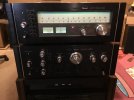
The toggles on the amp photographed by KeithD are reverse of what the AU-20000 was "supposed" to look like. But it doesn't matter I guess. The silver are on the upper right with the volume, the lower half of the face plate had the dark toggles. The semi flat silver toggles are those from the AU-7700 generation and the 7900 generation had the dark round ones. Everything else being absolutely equal, I would find it hard to believe the 20000 & 9900 amps would sound much different side-by-side.
 
Yeah I was just responding to "all the toggles are silver" comment, and then catalog details

We want to be accurate with info, don't we?

:D
 
Everything else being absolutely equal, I would find it hard to believe the 20000 & 9900 amps would sound much different side-by-side.
Yeah, that's my thought too. However, everything would not be equal between the two amps. My AU-9900 has been restored: completely recapped and many transistors and diodes replaced. The subject AU-20000 is mostly original, with some components replaced to get it working. However, it's running hot as far as I can tell, and the person who "fixed" it doesn't remember what he all did/replaced. I remember him telling me that he replaced a thyristor with a regular resistor on one of the boards (if I'm remembering right). Someone had been in there before because on at least one board the connector had been cut off and the wires soldered directly to the pins.

I'm going to pass on this one. He's asking 5x what I paid for my AU-9900, which was in all-original condition when I got it in 2019 from a fellow AK member. Given how hot the 20000 is running at moderate volume, I suspect it is going to develop a fault in the near future.

I put a lot of time into my AU/TU-9900 combo and both sound great. They're not going anywhere. :music:

IMG_0908.JPG
 
In boating we call it two-foot-itus, no matter how big, how new, how powerful, there’s this drive that’s almost as primal as eating that keeps us looking at the next boat. I have several hobbies, the affliction is universal and audio equipment seems to be just like everything else, ... even though you love what you have there is for some reason an inescapable curiosity to look, to try, to “upgrade”.

There is always someone with bigger, newer, better, ... there is almost no limit in this hobby so you can’t actually top-out.

Really, it might not be an upgrade at all (at least subjectively). If you don’t hear a flaw, if it doesn’t limit your enjoyment, then your current system is the logical solution.

I can find nothing wrong with the music from my office AU, vintage JBLs, streaming from my iPad, makes me very happy during my work day. Sound-wise I would maybe give the edge to the Onkyo A-10 or at least have a hard time deciding between them sonically (especially if challenged in a double-blind session) and IMO the Onkyo had a slight edge in robust design and build, ... sorry ‘Sui gang, but the AU with its gorgeous black face, knobs and toggles in silver and black with diamond-cut bevels, just the aesthetics of the whole package made it the hands-down winner to anchor the room and remind me to relax and enjoy the music. This series is visually stunning.

So yes, there is “better” out there subjectively until you get to the top of the AU series anyway, but music enjoyment is objective and you already love your 9900, I say you made a good choice to stick with what you have, logically.

From the other side of the brain though, you’ll likely always want to try the next step, who knows what’ll fall in your lap. Opportunity can be cruel sometimes in rare and desirable equipment. You can buy new, but if you want to stick with Sansui and only locally where you can see and touch it first you have to grab what you can. Cosmetics and completeness / originality are my basic requirements, provided it is all there and not damaged in any way as the internals all need service anyway and if it’s a keeper you are better off having it all completely serviced and restored yourself. If it’s in the budget then maybe reach out to one of the guys here who have a great reputation and high knowledge in Sansui restoration and get it scheduled, buy the damn thing, and eventually you have exactly what you want. Just another perspective. If you look at what it costs for a high-quality new audio amplifier and the initial depreciation on that you’re probably $$ ahead.

Thus the internal conflict between need and want. I’m down to one new system and one vintage and the new is now over a year old so that process never ends (unless I can stay away from this forum and all audio shows/stores). The nice vintage system OTOH will likely stay for a long time.

 
Once again, you have those adjustable turnover points on bass/treble of the 9900 that the 20000 does not have. That would be a huge factor me.
Agree, I use the tone controls frequently, so the 9900 is better than the 20000. There are also more options with the muting levels on the 9900, so that you can get the precision on the volume pot you want.

Honestly, I would never have considered an AU-20000 if one had not shown up for sale locally. I may some day go for a CA/BA-3000 pair. That would probably be the ultimate "end game" Sansui setup for me. So, I'll just keep my eyes out for when that set might come my way. Agree with your sentiments @SaturationPt , fortunately, the logical side of my brain generally rules over the other side!
 
You're set with the AU/TU-9900, the CA/BA-3000 probably won't sound much different either.

I'd go for something like an Alpha instead, for a different circuit & sound signature to contrast what you already have.

All those AU-7700-->20000 are based on the same circuits, there's posts everywhere here with owners saying they sound the same other than power handling. In fact, the "professional series" wasn't even called that at first, it was called the "high power series" in the first catalog.
 
One thing I was thinking about, but not sure if this logic makes sense: if you have a 9900 and 20000 with the same music source, same speakers, same setting on the volume knob, should the 20000 be significantly louder given it is 2x the output watts?
 
First, gain and knob position aren’t the same from unit to unit, and I’m not even sure that the 9900 and 20000 have the same taper (audio vs log).

Second, twice the power is 3dB, which is considered just enough for the human ear to perceive the difference.

So the answer is no based on power alone, but maybe if the pot is set up differently.
 
I thought 1dB was the minimum difference the human ear could percieve between 2 levels? And 3dB is double the power.

I just checked: turns out it's way more complicated than that. It was initially the "bel" named after Alexander Graham Bell. Then they subdivided it

 
Agree with SaturationPt though: comparing amps by volume knob position is kind of hopeless.

You could drive each power amp from the same preamp though, I'd think? And then compare.
 
Volume level as perceived by the human ear is said to approximately double every bel. Sound at a volume level of 8 bels is perceived to be twice as loud as the same source at 7 bels, which is perceived as double the volume of 6 bels etc. For precision, a bel is divided into 10ths which gives us deci-bels. A decibel is about the smallest difference in sound pressure deviations one can hear. In electromagnetics, the transducer of a speaker required 10 times the power in watts to increase an audio signal by 10db.

Sound pressure levels can not go higher than 180db at sea level. BTW. The physics of air pressure makes it impossible. Measurements of sound pressure are properly done by determining the difference in air pressure between the top and the bottom of an acoustic wave. The human ear can hear deviations of something like 2 parts in 10 billion. This is where 0db is set. Human pain starts around 60 Pa or 0.0006 atmosphere.
 
Agree with SaturationPt though: comparing amps by volume knob position is kind of hopeless.

You could drive each power amp from the same preamp though, I'd think? And then compare.
If both amps are calibrated correctly, then the AU-9900 should sound identical in volume (other sonic characteristics not withstanding) if it is set at (e.g.) -15 db and the AU-20000 set to -18db. The 0 db at the top of the volume knob is where there is full 100% gain with no attenuation, so this means that the preamps of both units should be putting out identical volume levels for this comparison test. I.e. the bigger amp's volume should be set about 3db lower on its knob than the smaller one since the power amp is capable of 3db more top end.
 
Ah, interesting!

For consistency I think running the same preamp into each power amp would give you a better idea of what the actual power difference is between them? Thus removing any other variables
 
Back
Top Bottom