

You are using an out of date browser. It may not display this or other websites correctly.
You should upgrade or use an alternative browser.
You should upgrade or use an alternative browser.


I am well verse in the differences of potentiometers . Sorry , but the link you referenced has nothing to say about the Volume pot , dual 250k, as used in the AU9900. The Function of the volume pot on the AU9900 is most consistent with a Logarithmic or Audio Taper potentiometer. From what I read about the Volume control of the AU9900a, it sounds like a Linear taper was used in the later model.
I am looking at low res pictures of the volume knobs of the 9900 and the 9900A. They are different. I think you are correct. The 9900 has the log taper, the 9900A has a linear taper. Sansui heard complaints from users who wanted to listen to their stuff at the lower positions on the knob so they put the linear pot in the later 9900A to accommodate this (irrational) preference.
I used to own an AU-9900 (a multi voltage model) - and the volume control was definitely linear which I didn't like, I might add. Seeing your comments makes me think there was some variation during manufacture, some getting a linear control and some a logarithmic control.


From what I've read in posts, seen in videos and in-person experience, AU-9900/11000/20000 and CA-3000 all had linear pots. AU-9900A/11000A and CA-2000 switched back to the typical pots on AU amps.I used to own an AU-9900 (a multi voltage model) - and the volume control was definitely linear which I didn't like, I might add. Seeing your comments makes me think there was some variation during manufacture, some getting a linear control and some a logarithmic control.

The A models also dropped the earlier non-A level switch concentric with the volume knob as it wasn’t necessary with the logarithmic pots.

I believe @SaturationPt has hit on the crux of this. The "A" variants (I have a 9900A here) went back to a logarithmic (audio taper) lot and in so doing eliminate the concentric three positions level switch present on the prior linear pot models. I can't speak to what - if any - other changes took place to the "A" variants compared to the non-A models, but the volume control was obviously the major change that took place.
A week or so ago I looked at all of the service manuals for the Professional and Definition series to see what the board differences were (didn't look at the BA-5000). Here's a rough chart I made where you can see the board number evolution and where the same boards were used in different models (highlighted in various colors).
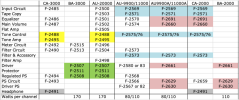
With respect to the "A" versions of the 9900/11000, the input circuit, tape copy, tone control and filter & accessory boards did not change. However, new versions of the equalizer, main volume, driver and power supply boards appeared in the "A" versions. As mentioned, the "A" version dropped the level set feature, thus a new volume board.
A couple of more observations.
1. CA/BA-2000 is just an AU-11000A in separate boxes and with power meters in the BA unit.
2. If board number progression is any indication, seems the CA/BA-3000 were designed first, then AU-20000, then AU-9900/11000.
With respect to the "A" versions of the 9900/11000, the input circuit, tape copy, tone control and filter & accessory boards did not change. However, new versions of the equalizer, main volume, driver and power supply boards appeared in the "A" versions. As mentioned, the "A" version dropped the level set feature, thus a new volume board.
A couple of more observations.
1. CA/BA-2000 is just an AU-11000A in separate boxes and with power meters in the BA unit.
2. If board number progression is any indication, seems the CA/BA-3000 were designed first, then AU-20000, then AU-9900/11000.
@KeithD, good of you to work that up. It is now evident there were updates beyond the mere change in the volume control. I'd have to look at the service data, but does the level set control on the non-A 9900 and 11000 tie back to circuitry in the EQ board perhaps? That would certainly explain it being updated as well. The other board changes were, I assume, just routine incremental improvements typical of Sansui practices.
It does not appear so. The level set switch is just three positions with resistors on two of the settings. The level set switch is right before the signal passes to the volume pot. Not seeing that there is any loop back to the equalizer on either the block diagram or the schematic. Assume Sansui had some reason to update that board in the A version. I have not looked in detail at the two boards in the SMs to see where the differences are.I'd have to look at the service data, but does the level set control on the non-A 9900 and 11000 tie back to circuitry in the EQ board perhaps?
Ok, implementation of the 3 way level control was more simplistic than I had figured. Which makes sense, I guess. Somehow I was picturing an attenuator circuit in the EQ board. Admittedly, I've never had a non-A version of either the 9900 or 11000 on my bench, though I do have a 9900A on hand.

I just recently reached a point with a DIY preamp project where it could be inserted into my system and tested on phono and one high-level input. I was surprised to discover that the volume control ramps up very quickly, and as a result, it's somewhat fiddly at lower levels. My backup preamp (Hafler) has approximately the same amount of total gain and feels completely different. The Hafler's VC is usually set around 10 o'clock or 11 o'clock for average listening levels in my system. The VC in the new preamp is barely nudged off the post for the same volume.I have the AU 9900. I do not believe the Volume Pot is Linear. It behaves exactly like an Audio taper control. In my experience , Linear tapers ramp up the Volume very quickly compared to the more gentle and Natural volume increase of the Audio taper. Granted there are several different Audio Tapers. 10% , 20%, 25, 30% and even Reverse Audio. The Ultimate Volume and power levels are not changed in any real way. I do not have experience with the AU 9900a , which I read has a different Volume taper. I suspect it is Linear. Often this was done to create the illusion of more power as the volume ramps up very quickly at first.
At first I thought the control I purchased might be a mis-marked linear taper, so I located the spare and made ohmmeter measurements. This confirmed that it's a log taper pot. However, compared to the chart below (which follows what I've always thought was the standard for a log pot), the taper is much steeper.

Next I looked up the manufacturer (TT Electronics) and found their chart for log taper. It's considerably different, and where the above shows about 4% resistance at 25% rotation, the TT chart shows 10%, and this agrees with my measurement. I also looked up Bourns, which agrees with the chart above. Finally, I went to Alpha. Their chart shows multiple curves for log taper pots, and there's a considerable gap between the most shallow version and the steepest.
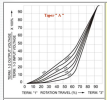
I wasn't previously aware that there were so many variations in log pots. Where the first chart indicates about 10% resistance at 50% rotation, Alpha has their steepest log pot showing 30% resistance at that position. The reason I'm posting this here is to make the point that a VC that seems to be creating a linear taper response might simply be a modified log taper. The only way to know for sure is to break out a meter and take a few measurements.
Jack