• The move to the new server is done. There are some software and database maintenance updates in process. This has us passing the hat around to help out. We appreciate any donations. Seriously, even a dollar helps. The payment page may be found here - https://www.audiokarma.org/support.html

Sansui AU-9500: Phono Stage RIAA Equalization Error

Leestereo

Super Member
The back to back restorations of a Sansui AU-9500 and a AU-717 last year provided an opportunity to sonically compare them against each other. With a source component connected through the line stage, the amplifiers were very similar sounding, making identification of which amplifier was playing at any given time difficult. However, when the source was a turntable, the amplifiers were easily identified: the AU-9500 had a "warmer" sound characteristic, and with source material with low bass content (<50Hz), that range also that sounded more prominent.

With another AU-9500 restoration project on the bench, a further examination of this subjective sonic difference seemed appropriate. An analysis of the RIAA equalization of the AU-9500 phono stage revealed that there was a significant deviation in the bass range (due to an error at the 3180µs correction).

AU-9500%20RIAA%20Stock%20800b_zpsr0jurcph.jpg


As can be seen in the graph above, with the stock AU-9500 phono stage, there is a rising bass response beginning at ~160Hz which reaches +3.4dB at 20Hz.

In contrast, the analysis of the AU-717 phono stage did not exhibit any such gross error, the frequency response was excellent; within a 0.3dB window from 20Hz to 20kHz (note the use of a higher resolution vertical scale):

AU-717%20RIAA%20Stock%20800_zpsbfj8z0tx.jpg
 
Last edited:
Register to hide this ad
I'd be interested to know what setup you are using to test for the response. You are measuring the response compared to the standard RIAA curve - correct?
 
The RIAA response deviation being reported for the AU-9500 above is theoretical, it is derived from calculations (the math is well characterized and there are on-line calculators which make the calculation effort trivial). Ideally, a flat signal subject to an inverse RIAA network would be injected into the phono input and any measured deviation from a flat response at the output would be due to an RIAA equalization error. Nevertheless, in this particular case, since the RIAA error in the AU-9500 is relatively large, the theoretical approach is sufficient for comparative analysis.
 
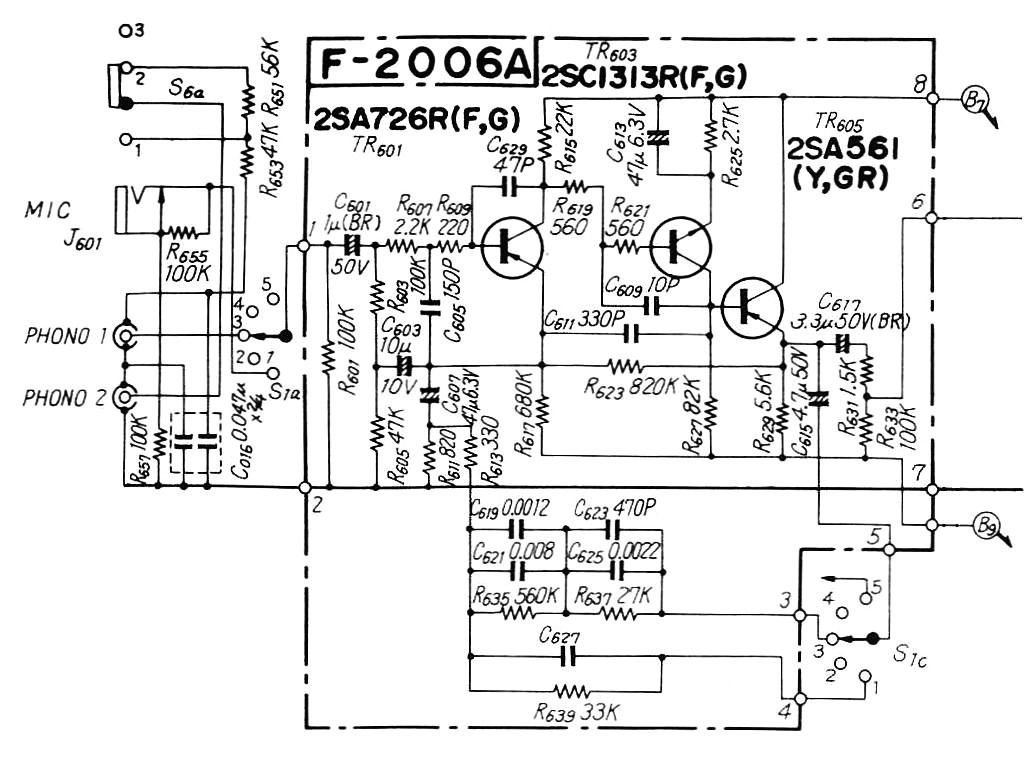
To correct for the 3180µs RIAA error, the AU-9500 phono circuit can be modified by replacing the 560kohm resistors at R635 and R636 with 330kohm resistors. This simple change will improve the RIAA equalization dramatically; the corrected response fits within a 0.25dB window.

AU-9500%20330kohm%20800_zpsfmsenbwx.jpg


Phono%20F-2006_zpsovg64v5l.jpg


The performance of the phono stage can be further enhanced by upgrading all of the components in the RIAA equalization with higher quality counterparts. The stock 560kohm carbon film resistors at R635/R636 were replaced with 332kohm 1% metal film types. Similarly, the stock 27kohm resistors at R637/R638 were replaced with 27.4kohm 1% metal film types. The stock 1200pF polyester film capacitors at C619/C620 were replaced with 2700pF C0G capacitors, and the parallel 8200pF polyester film capacitors at C621/C622 were replaced with 6800pF C0G types. The 2200pF capacitors at C625/C626 were replaced with 2700pF C0G types (the parallel capacitors at C623/C624 were removed). Note that the replacement resistor and capacitor values were adjusted to optimize the RIAA equalization.

Phono%20C0G%20RIAA%20label_zpskg78pziu.jpg


AU-9500%20RIAA%20Mod%20800_zpsf6h7r64m.jpg


As can be seen in the graph above, the fully modified AU-9500 phono stage has a RIAA equalization curve that is very "flat"; it is ±0.1dB for the majority of the audible range, only dipping to -0.2dB at 20kHz.
 
Lee,

Curious about your use of the ceramic C0G caps instead of film, even though the originals were film. Was it just that, since you were changing the values, you had the C0Gs in stock, or is their sound and specs comparable to film types?
 
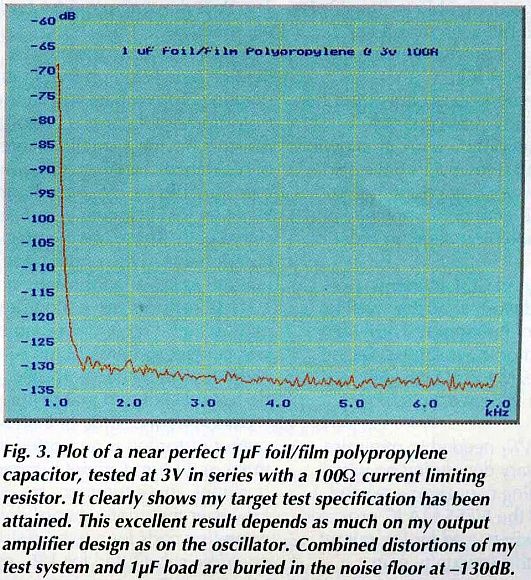
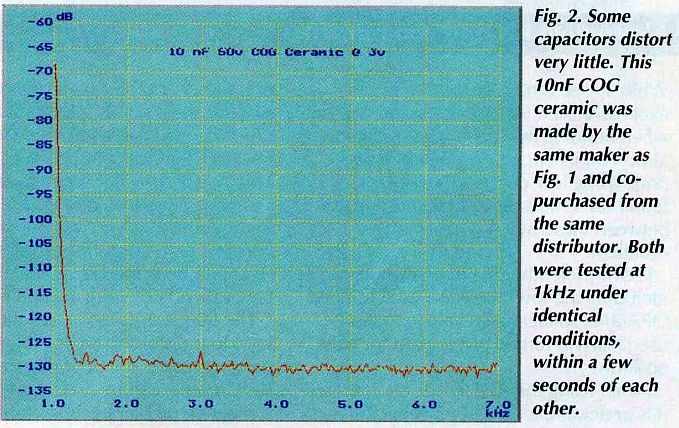
C0G capacitors are much better than polyester film capacitors; the use of C0G capacitors was examined in a Marantz 1090 Restoration that was completed a couple of years ago. The performance of C0G capacitors are comparable to that of polypropylene film capacitors, which along with polystyrene and teflon types, are very close to being the ideal.

PPCapdistortion_zps1d9623f4.jpg


C0GNPOCeramicdistortion_zps528e744e.jpg


All figures from the Capacitor Sound article by Cyril Bateman published in Electonics World (July 2002).
 
This is huge! Looking at the schematics...

AU-6500 (F-2028A)
AU-7500 (F-2028)
AU-8500 (F-2006A)

...they all look to be using the 560K in the phono equalization. So this may be an inherent characteristic of the AU-X500 family? If they all play records as if the bass knob is bumped up a notch, did no one notice that their records have more bottom than their equivalent CDs or digital sources? Would anyone ever complain? :)
 
I'm still fascinated by this discovery and surprised the discussion has been somewhat limited.

Only a handful of speakers approach being flat down low with most beginning roll off a bit higher... this error seems like a nice feature for we who listen to records with speakers with a less than perfect bottom response... or headphone listeners.

If nothing else it kind of answers the need for a loudness function that doesn't boost the high frequencies and is more subtle with raising the low end (+1dB at 50Hz vs the tone controls' +/-3dB steps).

Leestereo, could you look at the schematics and confirm that this feature is present in the others of this series? I think I see the 560 ohm resister there in the equivalent places. I provided the AU-8500 service manual to the docs the other day, so the whole series is up there now but I'm particularly interested in knowing of the AU-6500 since I have one... and wondering if the "lift" is the same frequency profile for all the amps of the series.
 
...Looking at the schematics...

AU-6500 (F-2028A)
AU-7500 (F-2028)
AU-8500 (F-2006A)

...they all look to be using the 560K in the phono equalization. So this may be an inherent characteristic of the AU-X500 family?...

To assess the RIAA equalization accuracy one has to take into consideration all of the components, e.g., in the type of phono stage circuit used in AU-6500 to AU-9500, this would be R1-R4, C2 and C3:

RIAA%20800_zpsayf9kfda.jpg


...Leestereo, could you look at the schematics and confirm that this feature is present in the others of this series?...I'm particularly interested in knowing of the AU-6500 since I have one... and wondering if the "lift" is the same frequency profile for all the amps of the series.
Looking at the schematic for the AU-8500, its RIAA equalization circuit is identical to that of the AU-9500 and as such, so is its RIAA error. The RIAA equalization circuit of AU-6500 and AU-7500 are identical to each other, but slightly different from that in the AU-8500/AU-9500. Accordingly, the RIAA error for the AU-6500/AU-7500 has a similar shape, but is slightly different from the AU-9500 shown above.

AU-6500%20and%207500%20RIAA%20stock%20800_zpsckk0lmzn.jpg


These RIAA equalization errors are not limited to Sansui phono stages, but rather are all too common in vintage phono stages designed prior to the late 1970s. The landmark Lipshitz RIAA paper, published in the June 1979 issue of the Journal of the Audio Engineering Society, pointed out that "Most current disc preamplifiers have audibly inaccurate RIAA equalization. These errors are due in part to the perpetuation in print of incorrect formulae for the design of the RIAA equalization networks..."
 
These errors are due in part to the perpetuation in print of incorrect formulae for the design of the RIAA equalization networks..."

Is it possible through the sound signature “tuning”, this “formulae error” warmth was also a desired feature at the time? Sansui did evolve into “straight wire with gain” sound signature over time which moved away from this sound, though.

The description sounds a lot like what most describe as vinyl’s attractive feature “warmth” and also suggests this RIAA error in most 70’s gear would explain the nostalgic vinyl sound signature we who grew up with recognize when heard, instantly.

This seems like an important thread!
 
Last edited:
This raises a question in my mind: if the 9500 phono amp tweaks the low end response so much, is this the reason for the highly differing opinions of it's sound?

The fact it would only affect playback via the phono input, and wouldn't exhibit that same response curve on tuner, tape or other line level sources has me wondering if that's why there seems to be some dislike of it's sound. Or is there something fundamentally different about it's overall sonic signature, separate and aside from the oddly spec'd phono EQ? I've never heard a 9500, so have no point of reference for it.

I'd be interested to see how the 999 and 7700 performed comparatively. The 9500 by all accounts is an outlier, as I've never seen much criticism of the 999 or 7700 here.
 
The 9500 by all accounts is an outlier, as I've never seen much criticism of the 999 or 7700 here.
Agree about the 999. I recently picked one up. The 999 does not have a "loudness" switch, but I found it quite easy to get a good "loudness" effect with the ample tone controls. It is a very nice sounding amp.
 
Back
Top Bottom