

You are using an out of date browser. It may not display this or other websites correctly.
You should upgrade or use an alternative browser.
You should upgrade or use an alternative browser.
Sansui big capacitor replacement - disappointment
- Thread starter mplsbob
- Start date
- Status
- Not open for further replies.


QuadBob
Quadraholic
Electrolytic capacitors in vintage equipment
After being contacted by a number of contributors to this thread........I guess I owe it to them to chime in. Although my first impulse these days is to simply ignore these discussions because those that logically look at the facts and science of electronics don't need to be convinced, and those that want to ignore the same..........won't be convinced in any case. Also, after so many years of spreading the information and providing the "proof" that some have asked for.........it really gets redundant posting the same information over and over.
This thread reminded me of one of my first posts here at AK. So, to save a lot of typing and if you'd like to see that Echowars used to be almost on the other side of this argument read this thread:
http://audiokarma.org/forums/showthread.php?t=5739
Now then (did you read the linked thread???????), I've noted a couple of major issues mentioned in this current thread:
1) Performance and aging of electrolytic capacitors
2) The "if it ain't broke...don't fix it" mindset
3) "Original" Sansui sound
So, let me try to introduce some "proof" and information to these 3 main topics. First up..........electrolytic capacitors!
The life expectency and failure rate of electrolytic capacitors has been studied extensively. It is truely the "achilles heel" of modern electronics. I'd wager a hefty sum that the guy who invents a component that does what an electrolytic capacitor can do as cheaply that DOESN'T fail due to age or that can last much longer could match Bill Gates in personal wealth! They exist in virtually every electronic device, and the cheaper the device........the more likely it is FULL of electrolytic capacitors.
The reality is that no one has thus far, and today most designers are concentrating on trying to minimize or eliminate them completely. You might ask Why?
Take a look at this chart from Nichicon:
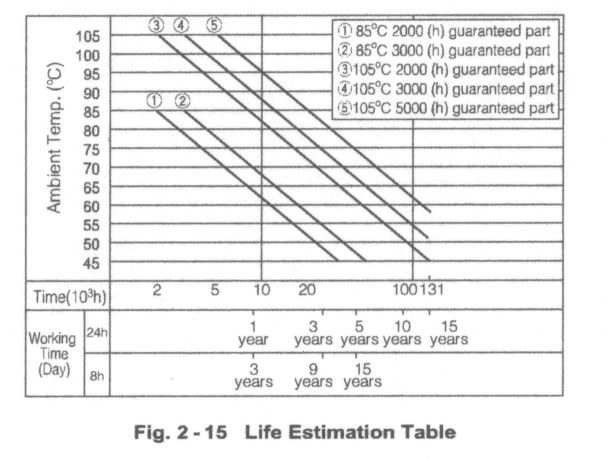
For those of you that are not technically inclined, concentrate on looking at line (1) for 85C 2000 hour capacitors.......because that is what is used in our Sansui (and all other vintage audio) equipment. Note that Nichicon rates these capacitors for "2000 hours of use". A little simple math will tell you that works out to about an hour a day for 5 and a half years (2007 hours) OR 15 years of non-powered storage at an ambient temperature of 45C (113F). So, this gives us our first "fact":
FACT: Most of our Sansui equipment is over 20 years old (check your serial number date code!).......therefore according to the MANUFACTURER of the electrolytic capacitors they are beyond their useful life whether the unit has been in continuous service OR unused and still new in the box!
Of course.........many of you that enjoy Sansui equipment might say "it sounds great" and still functions perfectly! And, luckily for all of us you're not entirely wrong! Because otherwise....ALL of our units would be completely non-functional and we'd never have become addicted to the looks and sound of vintage audio! The reality is that yes our beloved equipment "still works" at least mostly! All you have to do is follow the threads of failure after failure, and look at the trends of failures to start getting clues to the true reality and condition of our gear. At this point I really want to avoid "opinion" though and try to stick to the facts and science as much as possible. Which isn't easy as I've yet to find solid scientific research on "the aging of audio components" and the effects of that aging on both sound quality and reliability. Because the industry that supports us and would be best qualified to research it........would much rather simply sell us "new" equipment!!
Therefore.........lets look a little closer at the uses of electrolytic capacitors in our equipment, which for the most part falls into two main categorys:
1) Operating Voltage stabilizers
These are your power supply caps, both large and small. They include the main filter caps as well as the lower voltage dc power supplies and the stabilizer found in each circuit to maintain steady voltage for ICs and transistors. Their primary purpose is to hold a steady DC voltage for other components to operate from........much like a battery.
2) Signal path filter caps
These are found throughout the audio signal path and provide DC blocking....allowing only the audio signal to pass.
Now let's take a look at what happens to these caps when they are well past their useful rated life and see what impact that has on the unit itself. Let's start with 1) above........the electonic batteries:
Their ability to "hold a charge" drops....and their charge/discharge time slows (they are not as reactive). Which means that SLOWLY over the years........their "fully charged" voltage drops. This can be measured.
Amplifier rail voltages that for example should be +/- 75 volts DC, begin to drop..........73, 72, 71....etc. Luckily, in the best designs these voltages can be calibrated so we can compensate for the drop by raising the supply voltage. But, in most of OUR equipment.........it is fixed and non-adjustable. So, you might think that being as the drop is only slight its actual affect won't be that great. And, for the most part you'd be right. But, this brings us to our second fact:
FACT: James Joule defined the relationship between Power (in watts) and voltage/current in what we now refer to as Joules Law:
Electric power, like mechanical power, is represented by the letter P in electrical equations. The term wattage is used colloquially to mean 'electric power in watts'.
In direct current resistive circuits, instantaneous electrical power is calculated using Joule's Law, which is named after the British physicist James Joule, who first showed that electrical and mechanical energy were interchangeable.
P=IV
where
P is the power (watt or W)
I is the current (ampere or A)
V is the potential difference (volt or V)
The key for our purposes here is that Voltage and Current are inversely proportional in a circuit to produce a given Power. And, also that a given CIRCUIT OR OTHER COMPONENT which draws or needs a certain power will be affected by Joules Law. So when a given Sansui power supply that for example is rated at 75volts and 5 amps sees a drop in voltage........the current "draw" will increase to compensate and maintain the power required by the circuit. This is also why our units have fuses in them that are rated in "amps" (current). As voltage drops..........current increases!
And, just what does that mean in our equipment?
In the worst case scenario........blown fuses. But what about those "vintage" electrolytic caps that haven't failed totally yet.......but cannot maintain the voltage they were designed for? It means a slight and ever increasing (over time) current draw. And, as that current draw approaches the maximum rating of the OTHER components in the circuit.....we can start to see the results of the "cancerous" electrolytic capacitors:
1) Resistors.........increased current can cause them to physically get hot (should I define Ohm's Law now?........Google it!). Their overheating and being subjected to higher than designed current causes them to change value.
2) Transistors.............increased current causes them to fail (worst case), or become non-linear (pops, distortion, etc.)
3) ICs..............increased current most commonly simply causes failure as they short internally.
4) Pots (variable resistors).......increased current causes the same effects as fixed pots.......but more commonly causes "burned" windings and contact points.
5) Switches/Relay points.......increased current can actually melt the contact points and minimally causes pitting and carbon buildup.................
Which brings us to another important factor....."carbon buildup". When individual components are stressed from an over current condition they will discolor and develop a carbon "trail". So, let's apply this "theory" to our Sansui equipment. Take a look at a new IC or transistor. Note that the legs of the transitors and pins of the IC are a dull "bare" metallic color. Now take a look inside your favorite Sansui unit (the one you listen to ALL the time ). Look at the IC pins.........look at the legs of the small (low voltage) transistors in the preamp or phono sections. Are they bare metal color? Or, are they a dull black "carbon" color? Now you know Why!
If yours is still a nice metallic color...........congrats! You have a "low milage" unit. It simply means that it hasn't been run enough to show visible damage yet..........but it certainly doesn't mean that you're "safe" and don't have anything to worry about! If you put the unit into regular service now with the original caps installed.............all of the above applies and they will suffer the damage NOW rather than already exhibiting it.
Not enough proof for you skeptics? Let's apply this to what we commonly see TODAY in our vintage equipment:
Sansui amplifier driver pcbs - Changed values of emittor resistors (causing DC imbalance and protection circuits to activate)
Control Pots - Carbon buildup on contact surfaces causes "scratchy controls". And, yes DeOxit is wonderful stuff.............but you are ONLY treating the symptom, not curing the root problem! And, I suppose you thought those controls were "dirty". From what? Smoke? Dust? Then explain why even SEALED controls exhibit the same symptoms! Explain why a "new" piece of gear can be used in the filthiest environment and not exhibit the same symptoms? Or for that matter why the over 50 QRX-9001's that I've totally recapped over the last 10 years don't need their controls cleaned every yearl! (Oops.........I wanted to stay away from anecedotal evidence!!......stick to the facts QB!).
Which brings us to my original points 2) and 3). I'm going to hold number 3 for another post. But I think this post adequately covered number 2) as well!
Because running a unit with original 20+ year old caps in it..........IS DAMAGING IT SLOWLY BUT SURELY EVERYTIME YOU TURN IT ON. And, while "new" caps may be cheap and a pain to replace labor wise.....what about those transistors, ICs and controls that we just don't have new anymore?
Luckily.......the life expectency of a transistor, IC, resistor or mechanical control is easily in the hundreds of years......so long as:
1) It isn't physically damaged or destroyed
and
2) The VOLTAGE AND CURRENT it is rated for stays within its designed parameters.
So.............next note, we delve into sound quality and what if any affect old caps have on that!
QB
After being contacted by a number of contributors to this thread........I guess I owe it to them to chime in. Although my first impulse these days is to simply ignore these discussions because those that logically look at the facts and science of electronics don't need to be convinced, and those that want to ignore the same..........won't be convinced in any case. Also, after so many years of spreading the information and providing the "proof" that some have asked for.........it really gets redundant posting the same information over and over.
This thread reminded me of one of my first posts here at AK. So, to save a lot of typing and if you'd like to see that Echowars used to be almost on the other side of this argument read this thread:
http://audiokarma.org/forums/showthread.php?t=5739
Now then (did you read the linked thread???????), I've noted a couple of major issues mentioned in this current thread:
1) Performance and aging of electrolytic capacitors
2) The "if it ain't broke...don't fix it" mindset
3) "Original" Sansui sound
So, let me try to introduce some "proof" and information to these 3 main topics. First up..........electrolytic capacitors!
The life expectency and failure rate of electrolytic capacitors has been studied extensively. It is truely the "achilles heel" of modern electronics. I'd wager a hefty sum that the guy who invents a component that does what an electrolytic capacitor can do as cheaply that DOESN'T fail due to age or that can last much longer could match Bill Gates in personal wealth! They exist in virtually every electronic device, and the cheaper the device........the more likely it is FULL of electrolytic capacitors.
The reality is that no one has thus far, and today most designers are concentrating on trying to minimize or eliminate them completely. You might ask Why?
Take a look at this chart from Nichicon:
For those of you that are not technically inclined, concentrate on looking at line (1) for 85C 2000 hour capacitors.......because that is what is used in our Sansui (and all other vintage audio) equipment. Note that Nichicon rates these capacitors for "2000 hours of use". A little simple math will tell you that works out to about an hour a day for 5 and a half years (2007 hours) OR 15 years of non-powered storage at an ambient temperature of 45C (113F). So, this gives us our first "fact":
FACT: Most of our Sansui equipment is over 20 years old (check your serial number date code!).......therefore according to the MANUFACTURER of the electrolytic capacitors they are beyond their useful life whether the unit has been in continuous service OR unused and still new in the box!
Of course.........many of you that enjoy Sansui equipment might say "it sounds great" and still functions perfectly! And, luckily for all of us you're not entirely wrong! Because otherwise....ALL of our units would be completely non-functional and we'd never have become addicted to the looks and sound of vintage audio! The reality is that yes our beloved equipment "still works" at least mostly! All you have to do is follow the threads of failure after failure, and look at the trends of failures to start getting clues to the true reality and condition of our gear. At this point I really want to avoid "opinion" though and try to stick to the facts and science as much as possible. Which isn't easy as I've yet to find solid scientific research on "the aging of audio components" and the effects of that aging on both sound quality and reliability. Because the industry that supports us and would be best qualified to research it........would much rather simply sell us "new" equipment!!
Therefore.........lets look a little closer at the uses of electrolytic capacitors in our equipment, which for the most part falls into two main categorys:
1) Operating Voltage stabilizers
These are your power supply caps, both large and small. They include the main filter caps as well as the lower voltage dc power supplies and the stabilizer found in each circuit to maintain steady voltage for ICs and transistors. Their primary purpose is to hold a steady DC voltage for other components to operate from........much like a battery.
2) Signal path filter caps
These are found throughout the audio signal path and provide DC blocking....allowing only the audio signal to pass.
Now let's take a look at what happens to these caps when they are well past their useful rated life and see what impact that has on the unit itself. Let's start with 1) above........the electonic batteries:
Their ability to "hold a charge" drops....and their charge/discharge time slows (they are not as reactive). Which means that SLOWLY over the years........their "fully charged" voltage drops. This can be measured.
Amplifier rail voltages that for example should be +/- 75 volts DC, begin to drop..........73, 72, 71....etc. Luckily, in the best designs these voltages can be calibrated so we can compensate for the drop by raising the supply voltage. But, in most of OUR equipment.........it is fixed and non-adjustable. So, you might think that being as the drop is only slight its actual affect won't be that great. And, for the most part you'd be right. But, this brings us to our second fact:
FACT: James Joule defined the relationship between Power (in watts) and voltage/current in what we now refer to as Joules Law:
Electric power, like mechanical power, is represented by the letter P in electrical equations. The term wattage is used colloquially to mean 'electric power in watts'.
In direct current resistive circuits, instantaneous electrical power is calculated using Joule's Law, which is named after the British physicist James Joule, who first showed that electrical and mechanical energy were interchangeable.
P=IV
where
P is the power (watt or W)
I is the current (ampere or A)
V is the potential difference (volt or V)
The key for our purposes here is that Voltage and Current are inversely proportional in a circuit to produce a given Power. And, also that a given CIRCUIT OR OTHER COMPONENT which draws or needs a certain power will be affected by Joules Law. So when a given Sansui power supply that for example is rated at 75volts and 5 amps sees a drop in voltage........the current "draw" will increase to compensate and maintain the power required by the circuit. This is also why our units have fuses in them that are rated in "amps" (current). As voltage drops..........current increases!
And, just what does that mean in our equipment?
In the worst case scenario........blown fuses. But what about those "vintage" electrolytic caps that haven't failed totally yet.......but cannot maintain the voltage they were designed for? It means a slight and ever increasing (over time) current draw. And, as that current draw approaches the maximum rating of the OTHER components in the circuit.....we can start to see the results of the "cancerous" electrolytic capacitors:
1) Resistors.........increased current can cause them to physically get hot (should I define Ohm's Law now?........Google it!). Their overheating and being subjected to higher than designed current causes them to change value.
2) Transistors.............increased current causes them to fail (worst case), or become non-linear (pops, distortion, etc.)
3) ICs..............increased current most commonly simply causes failure as they short internally.
4) Pots (variable resistors).......increased current causes the same effects as fixed pots.......but more commonly causes "burned" windings and contact points.
5) Switches/Relay points.......increased current can actually melt the contact points and minimally causes pitting and carbon buildup.................
Which brings us to another important factor....."carbon buildup". When individual components are stressed from an over current condition they will discolor and develop a carbon "trail". So, let's apply this "theory" to our Sansui equipment. Take a look at a new IC or transistor. Note that the legs of the transitors and pins of the IC are a dull "bare" metallic color. Now take a look inside your favorite Sansui unit (the one you listen to ALL the time
). Look at the IC pins.........look at the legs of the small (low voltage) transistors in the preamp or phono sections. Are they bare metal color? Or, are they a dull black "carbon" color? Now you know Why! If yours is still a nice metallic color...........congrats!
You have a "low milage" unit. It simply means that it hasn't been run enough to show visible damage yet..........but it certainly doesn't mean that you're "safe" and don't have anything to worry about! If you put the unit into regular service now with the original caps installed.............all of the above applies and they will suffer the damage NOW rather than already exhibiting it.Not enough proof for you skeptics? Let's apply this to what we commonly see TODAY in our vintage equipment:
Sansui amplifier driver pcbs - Changed values of emittor resistors (causing DC imbalance and protection circuits to activate)
Control Pots - Carbon buildup on contact surfaces causes "scratchy controls". And, yes DeOxit is wonderful stuff.............but you are ONLY treating the symptom, not curing the root problem! And, I suppose you thought those controls were "dirty". From what? Smoke? Dust? Then explain why even SEALED controls exhibit the same symptoms! Explain why a "new" piece of gear can be used in the filthiest environment and not exhibit the same symptoms? Or for that matter why the over 50 QRX-9001's that I've totally recapped over the last 10 years don't need their controls cleaned every yearl! (Oops.........I wanted to stay away from anecedotal evidence!!......stick to the facts QB!).
Which brings us to my original points 2) and 3). I'm going to hold number 3 for another post. But I think this post adequately covered number 2) as well!
Because running a unit with original 20+ year old caps in it..........IS DAMAGING IT SLOWLY BUT SURELY EVERYTIME YOU TURN IT ON. And, while "new" caps may be cheap and a pain to replace labor wise.....what about those transistors, ICs and controls that we just don't have new anymore?
Luckily.......the life expectency of a transistor, IC, resistor or mechanical control is easily in the hundreds of years......so long as:
1) It isn't physically damaged or destroyed
and
2) The VOLTAGE AND CURRENT it is rated for stays within its designed parameters.
So.............next note, we delve into sound quality and what if any affect old caps have on that!
QB

Can't really say I was ever on the other side of the issue...I suppose that my unfamiliarity with your work, and a level of astonishment as to the number of caps in the TOTL Sansui quads caught me off guard. But...good post. Shows a lot more patience than I.
mplsbob, 2200uf is too bloody small for an output coupling cap. 4700uf is more like it.
What do you mean you can't measure the voltage? Do you own a meter? Anyway, IF they are output caps for sure, the loss of 5V of rating very likely means very little.
Newark sells what looks like a good cap for the job...a Cornell Dubilier 5300uf 75V screw terminal cap, measuring 35mm x 54mm. Newark #59K0158. Reasonably priced too.
mplsbob, 2200uf is too bloody small for an output coupling cap. 4700uf is more like it.
What do you mean you can't measure the voltage? Do you own a meter? Anyway, IF they are output caps for sure, the loss of 5V of rating very likely means very little.
Newark sells what looks like a good cap for the job...a Cornell Dubilier 5300uf 75V screw terminal cap, measuring 35mm x 54mm. Newark #59K0158. Reasonably priced too.

TheAnalogman
Tell me about it.
Thanks QuadBob!!

Thank You!
First off........THANK YOU for taking the time to write all this in this thread.
Also thank you for pointing out the thread from 2003 on this subject. VERY ENLIGHTENING!
I only wish I'd caught that thread earlier as it would have educated me sooner. I'm not hard headed, but I don't believe every opinion without some hard evidence to back it. You have indeed provided that evidence in detailed form. AGAIN.........THANK YOU! :thmbsp:
Your detailed explanation has indeed shown me the "reality" of cap replacement in great detail.
I am NOW A BELIEVER in why "electrolytic capacitors" must be replaced.
Unfortunately I now have to decide if vintage stereo equipment is still going to give me the " big bang for the buck" I thought I was getting. ( I don't need another "expensive" hobby as building choppers covers that)
Now I also need to hear a totally recapped Sansui to compare to one that is not to see if I still "LIKE THE SOUND". :scratch2: :scratch2: :scratch2:
Yes.........point 1 & 2 seems to have been answered............
Now I'm interested in point 3.
How is that sound quality effected.
This question is also three pronged I think...................
1 - Is there REALLY a difference between brands of electrolytic capacitors as far as sound???
2 - Will a recap ruin or improve the sound I and others like so much?
3 - How about prices buying this stuff since we have to take into account the cost of total recaps to preserve the equipment and prevent further damage.
Are some of these selling prices we see really fair in context??? Would people pay these prices if they realized how much money & time was needed to truly bring the equipment up to snuff? I mean let's face it.......in context....all this vintage stuff bought on ebay and elsewhere is actually in need of repair if not already restored.
In my opinion............these are "NOW" some of the most important questions when it comes to vintage Hi-Fi equipment.
This really is opening up a big can of worms.:scratch2:
QuadBob said:......................................................................................
This thread reminded me of one of my first posts here at AK. So, to save a lot of typing and if you'd like to see that Echowars used to be almost on the other side of this argument read this thread:
http://audiokarma.org/forums/showthread.php?t=5739
Now then (did you read the linked thread???????), I've noted a couple of major issues mentioned in this current thread:
1) Performance and aging of electrolytic capacitors
2) The "if it ain't broke...don't fix it" mindset
3) "Original" Sansui sound
So, let me try to introduce some "proof" and information to these 3 main topics. First up..........electrolytic capacitors!....................................................................................................................
QB
First off........THANK YOU for taking the time to write all this in this thread.
Also thank you for pointing out the thread from 2003 on this subject. VERY ENLIGHTENING!
I only wish I'd caught that thread earlier as it would have educated me sooner. I'm not hard headed, but I don't believe every opinion without some hard evidence to back it. You have indeed provided that evidence in detailed form. AGAIN.........THANK YOU! :thmbsp:
Your detailed explanation has indeed shown me the "reality" of cap replacement in great detail.
I am NOW A BELIEVER in why "electrolytic capacitors" must be replaced.
Unfortunately I now have to decide if vintage stereo equipment is still going to give me the " big bang for the buck" I thought I was getting. ( I don't need another "expensive" hobby as building choppers covers that)
Now I also need to hear a totally recapped Sansui to compare to one that is not to see if I still "LIKE THE SOUND". :scratch2: :scratch2: :scratch2:
Yes.........point 1 & 2 seems to have been answered............
Now I'm interested in point 3.
How is that sound quality effected.
This question is also three pronged I think...................
1 - Is there REALLY a difference between brands of electrolytic capacitors as far as sound???
2 - Will a recap ruin or improve the sound I and others like so much?
3 - How about prices buying this stuff since we have to take into account the cost of total recaps to preserve the equipment and prevent further damage.
Are some of these selling prices we see really fair in context??? Would people pay these prices if they realized how much money & time was needed to truly bring the equipment up to snuff? I mean let's face it.......in context....all this vintage stuff bought on ebay and elsewhere is actually in need of repair if not already restored.
In my opinion............these are "NOW" some of the most important questions when it comes to vintage Hi-Fi equipment.
This really is opening up a big can of worms.:scratch2:

Morden2004
Relaxin'
My BIG summary of this thread
Cars with failed oil filters need expensive repairs to ancillary damage caused by that failure; vintage electronics with old electrolytics which have failed need expensive repairs to ancillary damage caused by that failure.
Seems simple to me. :yes:
Paul
- Everyone has an opinion.
- Not everyone's opinion is wrong even when it's in disagreement with another.
- Each to his own, and
- Electrolytic capacitors are the same as automobile engine oil filters; they get used up and get old and stop working -- eventually.
Cars with failed oil filters need expensive repairs to ancillary damage caused by that failure; vintage electronics with old electrolytics which have failed need expensive repairs to ancillary damage caused by that failure.
Seems simple to me. :yes:
Paul

xoaphexox
Supernatural Anesthetist
As I continued to recap all the units that came in my possession I got lazy and started skipping the large main power filter caps in units that they appeared the most difficult to do so (Yamaha CR-1000, CA-1000).
Having replaced every other cap in these units, is it worth going back and replacing these large can caps? I was moderately frightened by QBs massively informative and appreciated post.
Having replaced every other cap in these units, is it worth going back and replacing these large can caps? I was moderately frightened by QBs massively informative and appreciated post.

MarkMeyer
Active Member
I also want to thank QB for bringing a LOT to the mix with his detailed reasoning on the subject. I've read his contributions elsewhere and he never fails to add clarity to whatever he discusses.
I was going to start a new thread with this following question, but I think it might fit in here so I ask those who know:
I have a gorgeous AU-777A that's definitely worthy of restoring. However, it has the typical "weak channel" on one side.
My question is this; should I diagnose the problem and fix that before going any further with restoration, or should I just go ahead and replace all the caps and suspect resistors first, and THEN go looking for the bad channel problem.
I'm really just asking for an opinion on recommended procedure of repair and restoration in order to do it in the most efficient way.
This question actually applies to ANY unit that has a particular "problem", but one that is also in line for a full re-cap restoration anyway.
TIA
I was going to start a new thread with this following question, but I think it might fit in here so I ask those who know:
I have a gorgeous AU-777A that's definitely worthy of restoring. However, it has the typical "weak channel" on one side.
My question is this; should I diagnose the problem and fix that before going any further with restoration, or should I just go ahead and replace all the caps and suspect resistors first, and THEN go looking for the bad channel problem.
I'm really just asking for an opinion on recommended procedure of repair and restoration in order to do it in the most efficient way.
This question actually applies to ANY unit that has a particular "problem", but one that is also in line for a full re-cap restoration anyway.
TIA
MarkMeyer
Active Member
xoaphexox said:Having replaced every other cap in these units, is it worth going back and replacing these large can caps? I was moderately frightened by QBs massively informative and appreciated post.
Is so many areas of life issues, it never ceases to amaze me that the truth of things many times turns out to be VERY frightening.

While the "truth hurts", it's also very scary, but that's why we need to know the truth so that we can deal with it.
Sounds like replacing the big caps are in order. :yes:

I've seen plenty of units have a week channel caused by bad caps. If you're going to do it anyway, recapping might not be bad place to start, IMO. I would recommend breaking it down into bite size pieces, recap a board, run it, make sure nothing got worse, move on to the next board. It really sucks to recap a whole amp (or whatever) and discover that you put one in backwards "somewhere" and have to try and find it.MarkMeyer said:I have a gorgeous AU-777A that's definitely worthy of restoring. However, it has the typical "weak channel" on one side.
My question is this; should I diagnose the problem and fix that before going any further with restoration, or should I just go ahead and replace all the caps and suspect resistors first, and THEN go looking for the bad channel problem.
TIA
Thanks QuadBob for a very informative post!
Morden2004 said:
- Electrolytic capacitors are the same as automobile engine oil filters; they get used up and get old and stop working -- eventually.
Well, if the successful working of an amplifier is the only feature that counts, nobody would buy anything but the most modern gear. And there would be no need for a vintage forum, instead a forum for museum enthusiasts.
For myself, I have had vintage components (capacitors, etc.) in my hand from Europe, USA and Japan, and I learned one thing - if we speak of electrolytic capacitors say 60 years old, the percent good capacitors is much higher for certain European brands than most US brands. So I can well understand the fear of using out-dated components if the experience comes from old US equipment.
Good European electrolytics: Siemens, Philips, FRAKO, Hunts, Ducati, and many others - picked from early post-war equipment - they are almost always in good condition. And the same can be found in European radios form the 50's and 60's (later quality declined).
So I wonder if the US tradition for changing capacitors has a specific historical reason.
And I think our vintage Japanese equipment is somewhat in between - if a capacitor has survived 30-40 years, it has in a way proved stable and may last in 100 more years.
So my point is: We do absolutely know nothing about the life span of an individual electrolytic capacitor. Individual units may last 2 years, 30 years, 100 years or maybe 1000 years. However, for a specific brand and production batch life span may be described as an (unknown ?) statistical function.


nosirrah
RIP 11-19-2019
this thread
Very good posts, with the number of units here at the museum it's good to have all the possible scenarios about repair that I can have, I don't do it perfectly, as QB may, however as I said in an earlier post caps do die from age and cycles, and any that exhibit damage need to go for sure.
It's too bad my eyesight is going due to age and cycles as well, gets harder to see the crappy schematics and silk screened circuit board data as the eyeballs get older.
Good to see the post back on subject, and a bit of controversy is good for all, keeps the juices flowing. LOL
Casey
Very good posts, with the number of units here at the museum it's good to have all the possible scenarios about repair that I can have, I don't do it perfectly, as QB may, however as I said in an earlier post caps do die from age and cycles, and any that exhibit damage need to go for sure.
It's too bad my eyesight is going due to age and cycles as well, gets harder to see the crappy schematics and silk screened circuit board data as the eyeballs get older.
Good to see the post back on subject, and a bit of controversy is good for all, keeps the juices flowing. LOL
Casey
Morden2004
Relaxin'
tarior said:I've seen plenty of units have a week channel caused by bad caps. If you're going to do it anyway, recapping might not be bad place to start, IMO. I would recommend breaking it down into bite size pieces, recap a board, run it, make sure nothing got worse, move on to the next board. It really sucks to recap a whole amp (or whatever) and discover that you put one in backwards "somewhere" and have to try and find it.
Thanks QuadBob for a very informative post!
Excellent advice. I might add that if you work your way through the unit from 'output' to 'input' and finally the power supply you also minimise the risks further and make problem solving easier.
In the software business it's often called 'step-wise refinement'.
Paul

Bob, thanks for taking the time to put that response together. It is very informative.
To address the question of altering the sound with new caps, it is certainly objective. We can debate the relative affect on the sound all day and there will be strong opinions on both sides of the argument. But consider the alternative if you don't replace the caps. Decreasing reliability and eventual loss of sound. How long will the "classic" sound continue before failures occur? The more you use the unit, the quicker it will fade.
Also, there may be differences in the quality of original caps, and maybe some of the European suppliers had higher quality, but this is the Sansui forum and all the caps used were garden variety Jap Caps.
- Pete
To address the question of altering the sound with new caps, it is certainly objective. We can debate the relative affect on the sound all day and there will be strong opinions on both sides of the argument. But consider the alternative if you don't replace the caps. Decreasing reliability and eventual loss of sound. How long will the "classic" sound continue before failures occur? The more you use the unit, the quicker it will fade.
Also, there may be differences in the quality of original caps, and maybe some of the European suppliers had higher quality, but this is the Sansui forum and all the caps used were garden variety Jap Caps.
- Pete
xoaphexox
Supernatural Anesthetist
MarkMeyer, sometimes a weak channel is simply caused by dirty pots and/or switches. Have you tried deoxiting them first to see if that clears up the issue?
Sometimes a unit will sound like one channel is weaker than the other until you get to a certain point in the volume pot, and then they both SPL equally. I think there are 'patches' of nonconformity in the pots, whether caused by oxidation or manufacturing, I don't know.
At the end of the day you will want to recap the unit anyhow, especially after the additional information in this thread has shown us the facts.
Sometimes a unit will sound like one channel is weaker than the other until you get to a certain point in the volume pot, and then they both SPL equally. I think there are 'patches' of nonconformity in the pots, whether caused by oxidation or manufacturing, I don't know.
At the end of the day you will want to recap the unit anyhow, especially after the additional information in this thread has shown us the facts.

targeteye
Super Member
Quadbob,
Thanks for an excelent post. Getting back towards the specific original Topic of this post.
When replacing the Main Filter caps, what manufacturer/series do you generally use and have you found any types you would recommend shying away from?
As others have stated finding the perfect fit can be pretty difficult and I would think puting in "any ole cap that will fit" wouldn't be the best thing to do either.
I posted in another thread about putting Nichicon KG Golds in my marantz 300DC. I can not find the ESR rating for these caps to see how the compare to the Screw terminal "computer grade" some have referenced.
Steve
Thanks for an excelent post. Getting back towards the specific original Topic of this post.
When replacing the Main Filter caps, what manufacturer/series do you generally use and have you found any types you would recommend shying away from?
As others have stated finding the perfect fit can be pretty difficult and I would think puting in "any ole cap that will fit" wouldn't be the best thing to do either.
I posted in another thread about putting Nichicon KG Golds in my marantz 300DC. I can not find the ESR rating for these caps to see how the compare to the Screw terminal "computer grade" some have referenced.
Steve
QuadBob said:After being contacted by a number of contributors to this thread........I guess I owe it to them to chime in. Although my first impulse these days is to simply ignore these discussions because those that logically look at the facts and science of electronics don't need to be convinced, and those that want to ignore the same..........won't be convinced in any case.
I can not remember I have seen or read any scientific proof why different brands of capacitors sound different, or why capacitors produced before 1980 sound very different (better ?) to later production.
However we often experience attempts from the "technical staff" to explain differences in sound as caused by aging. This can not explain sound differences betweens new brands, and also not explain why selected old components produced f.ex. 1970 and measure perfect, sound different.
Another wrench in the gears?????????
Kjell-B seems to have thrown the wrench of doubt into the gears of the "generally" accepted Hi-Fi science here with this part of his post------->
<quote>
"And I think our vintage Japanese equipment is somewhat in between - if a capacitor has survived 30-40 years, it has in a way proved stable and may last in 100 more years.
So my point is: We do absolutely know nothing about the life span of an individual electrolytic capacitor. Individual units may last 2 years, 30 years, 100 years or maybe 1000 years. However, for a specific brand and production batch life span may be described as an (unknown ?) statistical function." <end quote>
Is it just a brand/quality thing that dictates length of service......or do "all brands" only have the lifespan quadbob describes in his explanation of cap life.
Or again..........as Kjell-B describes..........is it all really just a guess (opinion) and nobody really knows the true life of individual caps?
I mean folks............this really is a truly important issue in my book.
Truly I admit not having a real clue about the inside or percentage of condition my caps have. But to the layman's eye...........there really does seem to be a whole load of seemingly great working original receivers about.
My issue is I hate to waste money doing anything that does not really need done.
And what is the most effective way to test caps to know...........or is there no cost effective way for the average hobbyist to know?
Maybe the way is to just use em..........and wait and see?????
I mean if there seems to be no proved fact that shows new caps REALLY improve sound.........and you have a $150 receiver that works just great for years after you buy it.........:scratch2: .........
LBPete said:Bob, thanks for taking the time to put that response together. It is very informative.
To address the question of altering the sound with new caps, it is certainly objective. We can debate the relative affect on the sound all day and there will be strong opinions on both sides of the argument. But consider the alternative if you don't replace the caps. Decreasing reliability and eventual loss of sound. How long will the "classic" sound continue before failures occur? The more you use the unit, the quicker it will fade.
Also, there may be differences in the quality of original caps, and maybe some of the European suppliers had higher quality, but this is the Sansui forum and all the caps used were garden variety Jap Caps.
- Pete
Kjell-B seems to have thrown the wrench of doubt into the gears of the "generally" accepted Hi-Fi science here with this part of his post------->
<quote>
"And I think our vintage Japanese equipment is somewhat in between - if a capacitor has survived 30-40 years, it has in a way proved stable and may last in 100 more years.
So my point is: We do absolutely know nothing about the life span of an individual electrolytic capacitor. Individual units may last 2 years, 30 years, 100 years or maybe 1000 years. However, for a specific brand and production batch life span may be described as an (unknown ?) statistical function." <end quote>
Is it just a brand/quality thing that dictates length of service......or do "all brands" only have the lifespan quadbob describes in his explanation of cap life.
Or again..........as Kjell-B describes..........is it all really just a guess (opinion) and nobody really knows the true life of individual caps?
I mean folks............this really is a truly important issue in my book.
Truly I admit not having a real clue about the inside or percentage of condition my caps have. But to the layman's eye...........there really does seem to be a whole load of seemingly great working original receivers about.
My issue is I hate to waste money doing anything that does not really need done.
And what is the most effective way to test caps to know...........or is there no cost effective way for the average hobbyist to know?
Maybe the way is to just use em..........and wait and see?????
I mean if there seems to be no proved fact that shows new caps REALLY improve sound.........and you have a $150 receiver that works just great for years after you buy it.........:scratch2: .........
Oh yes.........another question to add perspective...........
What's the "ballpark figure" on the cost of all caps needing replaced say in a 7070 for example. Mid-range brand quality. Not labor.....just parts.
And how many caps are the types needing replaced in same receiver.
What's the "ballpark figure" on the cost of all caps needing replaced say in a 7070 for example. Mid-range brand quality. Not labor.....just parts.
And how many caps are the types needing replaced in same receiver.
targeteye
Super Member
Crazy,
"it has in a way proved stable and may last in 100 more years" This I would contend is a bit of wishful thinking. Even if it doesn't fail in a catosrophic way little would be left of its original electrical characteristics.
I would submit its a gamble. If you like the way your vintage stuff sounds as is then by all means run it! If its an item you would be heart broken if you see it go up in smoke then it probably worth recapping.
The good news for us SS fans is at least we don't have those nasty paper caps to deal with as they are almost as bad as electrolytics.
Steve
"it has in a way proved stable and may last in 100 more years" This I would contend is a bit of wishful thinking. Even if it doesn't fail in a catosrophic way little would be left of its original electrical characteristics.
I would submit its a gamble. If you like the way your vintage stuff sounds as is then by all means run it! If its an item you would be heart broken if you see it go up in smoke then it probably worth recapping.
The good news for us SS fans is at least we don't have those nasty paper caps to deal with as they are almost as bad as electrolytics.
Steve
- Status
- Not open for further replies.