• The move to the new server is done. There are some software and database maintenance updates in process. This has us passing the hat around to help out. We appreciate any donations. Seriously, even a dollar helps. The payment page may be found here - https://www.audiokarma.org/support.html

Sansui Eight help - hum on one channel

Replaced trimmers on R channel driver board.

Was not able to make much change on main amp current on that channel, about 3 mA. May be an issue there. Turning VR803 didn't do much.

Then adjusted VR801, 802, 804. Was able to get 0.5 V across R804 pretty easily. DC offset adjusted to about -52mV and VR804 to about 1mV. Could not do much better than that. Sames as on L channel, if I adjusted VR804 up, I could get lower DC offset, so this was a balance.

Listened through headphones. Have both channels stereo. Will try some throwaway speakers next.

If that is ok, go through the same procedure on full line voltage?
 
Great work guys. Hope the other channel is much easier than this one. Learned something valuable about the adjustments being they can cause extreme offset if not right.
Just curious, did the output stop being a kinda jumpy?
Thanks for all your help, Bob. You really jump started this when we were at a dead end.

The output did settle down. At most ±5mV, but more like ±1mV.

Playing radio through some small Sony 3Ω surround sound speakers on DBT. Sounds pretty good.

Will wait to hear if you all think it's ok to go to line voltage.

Thanks!
 
Well, couldn't wait. Didn't see any reason not to go to full line voltage. Interestingly, doing all the settings was much better on line voltage.

Was able to set both L and R main amp current at fuse holders. On DBT I could not get R channel to move, but was a breeze on line voltage. Set both sides to about 9 mA.

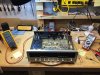
Then did L channel driver board adjustments. All went great. 0.5 V across R804, less than a milivolt DC offset and difference on TR801 and 2 emitters. Same on R channel. Here is my three DMM setup. Put a postit note by each one so I could remember which was showing what reading. Only took a couple of rounds of adjustment on each side.

IMG_0878.JPG

Right now listening to FM stereo with a set of Boston Acoustics bookshelf speakers. I'm likin' it! :music:

So, I think this one is good! Wow, took a while, but thanks again to John and Tom for sticking with me on this and Bob for shining a new light on it and coming to a very quick resolution. Can't thank you all enough. Lots of good Karma here! Looking forward to comparing this to the sound of my 9090.

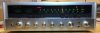
All buttoned up, and applied the missing button labels I was able to get from fellow AK member.

IMG_0879.JPG
 
Outstanding, the eights are really good sounding units. Good job getting the bias adjusted, kinda screwy procedure but it makes sense if you look at the circuit.
I worked at a shop in the seventies and we were a sansui warranty station among others. Worked on a lot of really great stuff. Always had kenwoods myself but finally got my sansui. Need to get in gear now and get the parts ordered for it.
Enjoy!
 
Thanks again Bob. I assume there is a reason the adjustments were easier to get in spec on line voltage vs. DBT. I was doubtful it would come in spec after being on the edge on DBT, but all went well. Not being able to increase the main amp bias current on the R channel on DBT was really strange, but I just moved on. It completely adjusted and fell in line on line voltage. Maybe the downside of how overengineered the Eight is, is the fact that you can adjust so many parameters. On low end amps you might not get to adjust anything. Mid level might be just DC offset. High end models (like my 9090) you can set idle current and DC offset. The Eight in contrast has two additional variables per channel. Maybe it is not surprising things can get out of wack.

This thing is really singing driving my Boston Acoustics HD7 speakers and listening to some CDs. Can't wait to test it on full size speakers. I put 1/2 A fuses in F005 and 6, since the speaker protect board doesn't seem to be doing anything. I actually disconnected it at some point just to see if that would make any difference (it didn't).

I'm super relieved this turned out OK. I would have been very bummed if this was beyond repair. I think replacing all those parts was a good investment. There are lots of small e-caps on the tone control board (F-1235) that I'm sure are out of spec, but not going to tackle that any time soon. Just going to enjoy this for a while!
 
Wohoo - Greetings from Copenhagen, pouring a craft beer to celebrate this victory. The Eight is the pinnacle of an era and a statement of ambition still echoing 5 decades later. Well done KeithD !
 
Wohoo - Greetings from Copenhagen, pouring a craft beer to celebrate this victory. The Eight is the pinnacle of an era and a statement of ambition still echoing 5 decades later. Well done KeithD !
Thanks Tom, and thanks for your help and encouragement along the way! Did some comparison listening to my 9090 using a speaker switch. Very similar sounding, but I’m thinking the Eight as a bit of an edge. The 9090 sounds just slightly “thinner” than the Eight. Bass is also a bit more punchy on the Eight. So glad I picked this up when I saw it. Can’t remember for sure since I did not play it a lot after initially getting it going, but it does seem to sound better with the new components in there. :music:
 
Hey, since we have some experts here, question about the 10k (r810) resistor feeding the 7 volt zener on the driver board. Its designated as SL in the service manual parts list but SL is not in the legend. Any thoughts on that, maybe low noise?
Also curious that they did not place a filter cap across the zener.
 
Elsewhere they use the abbreviation S.R. for 'Solid Resistor'

So I suggest 'SL' means 'Solid Lesistor' :)

All joking aside, it might mean 'Straight Lead' having looked at further Sansui 'standard parts' lists.
 
Last edited:
Wow, the Eight sounds wonderful. Been playing it almost daily, as I can't get enough. Hearing details that were masked with other receivers. Clarity is excellent, stereo separation is excellent, better bass and clearer highs than I've heard with my other receivers. I put some music on just to listen to a song or two, and I end up wanting more. Why does this thing sound so good? It's even edging out the 9090! There were only two e-caps on the driver boards, which I replaced. Replaced all VRs on the drivers as well as the differential pair. PS recapped. Replaced four OTs and 4 driver transistors. Other than that I have not modified anything. Even the tuner sounds better than my other equipment. Also, I find the quiet passages in music dead silent on the Eight. What did I do that made this sound so good? Am I mostly hearing the new OTs and/or driver transistors?

What needs to be serviced next in the Eight? The tone control board has quite a few e-caps, after that, not too many other than the tuner, which I don't plan to mess with.
 
Somewhere back in the day I wrote a post with the conclusion that when I went from original Drivers with New MJ21194's to Onsemi drivers as well ("onsemi all the way"), I thought it was a sonic upgrade. I still remember checking my tweeter setting after installing the drivers because there was more top end detail. I have the same config in my 999, even when I still have the old drivers - to my ear, it's an upgrade bar none.

The pre-amp and phono amp transistors were quite noisy in mine. At the time I replaced all of them with 1845's, today I might pay a bit more attention to FT/IC/cob and the like, so the 1845 might not be ideal in all places, BUT it worked and quieted the amp while wringing out a bit more of detail. I also had 2 x12000uf cans in there - this added a bit low end reserve, but less improvement that what I saw on the 999.

P.s Here is the story of the guy I sold it too, it still makes me warm and fuzzy thinking about how happy this guy was when he heard it the first time: https://audiokarma.org/forums/index.php?threads/saying-goodbye-to-the-eight.645142/
 
Thanks Tom, Since you had an Eight and now have an Eight Deluxe and a Six, what would you say are the differences in sound between those receivers? If I remember right, opinions seem to be the Eight sounds different than the Six and Eight Deluxe? There was a long thread on here with many sharing the opinion that the Eight is the "engineer's receiver", but the Eight Deluxe sounds better. Would you agree?

I'm so impressed with the Eight, I'm wondering if it is worth picking up a Six or Seven, or Eight Deluxe for comparison, or would I not hear much difference?
 
My Deluxe is not restored, so don't really know it's full potential - I've had all the single digits in my rack and they do sound very similar. I think they are so close that differences in condition/level of restoration have more sway - an Eight for instance can sound marvelous when fully balanced and when not you loose imaging.

My current Deluxe, in present state, could not match my restored Eight, but I suspect it might deliver a bit more refined top end once fully restored. It also seems to be a bit faster in the sound - will it once restored beat the Eights magnificent mid section and punch - only time will tell.
 
Sounds like it might not be worth pursuing one of the other single digits, since they would be very close to the Eight I have. Any opinion on how the single digits compare to the x000 series? There are a couple of 5000's available locally. One a 5000 that has a few issues, and one is a 5000x where the tuner is not working. I'd be interested in picking one of those up for a sound comparison with the Eight. Would I notice much difference there?
 
I have a mint 4000, the entire X000 line will sound different because it's an older amp topology, populary referred to as "cap coupled", where the Eight is direct coupled. The cap coupled sound is generally a bit looser like bass more booming and mids very present or "opened up" When listening to a direct coupled amp right after a cap coupled, you'd often miss a little liveliness but also appreciate what appears to be more tightness and precision and power.... just cleaner overall. There are excellent examples in both category, sort of like different flavors. Normally the cap coupled amps suffers from lack of power since they are single rail, which is an inefficient and certainly expensive way to go if you want reasonable power, however the 5000 and 7000 has mid level power, so I'd be surprised if power is a complaint there.
 
Ah, yes cap coupled receivers. That would be an interesting comparison. Got me thinking about my QR-4500 and QR-6500. Looking at the schematics, it appears they are both cap coupled, am I reading that correct? If so I could just do some direct comparisons between one of those in two channel and the Eight.

The cap coupled sound is generally a bit looser like bass more booming and mids very present or "opened up" When listening to a direct coupled amp right after a cap coupled, you'd often miss a little liveliness but also appreciate what appears to be more tightness and precision and power.... just cleaner overall.

After reading that, it reminded me that when listening to my Eight and then the QR-6500 using the same CD, if felt pretty much like what you described. So, if the QR-6500 is cap coupled, then what you say matches my experience.
 
Back
Top Bottom