

You are using an out of date browser. It may not display this or other websites correctly.
You should upgrade or use an alternative browser.
You should upgrade or use an alternative browser.
Sansui SP-3500 - An AK'er Gift and Restoration Project
- Thread starter drbiggles
- Start date

Very nice work.
Could you please say again why you use bleaching? What benefit it offers?
Hi Ymarko,
I'm specifically using Bar Keeper's Friend, it's got Oxalic acid in it. I've tried using Oxalic acid in powder form and I find for what I'm using it for, BKF works better.
I can't speak for what benefits for new wood, but for old veneer it's vital in getting an even color/hue. Wood is a natural product, it ages and changes color. Even with severe sanding, you cannot get your veneer to come out with an even color. There will be darker areas, lighter areas and not necessarily just with the grain. It can be all over the place. Most people, pacers by won't notice. But once it's pointed out to you once, you'll notice forever more.
When you use BKF with a little warm water and an ultra fine scotch brite pad to work it in over about 3 to 50 minutes, the color of the veneer evens out. The color changes are gone and what you're left with is what appears to be "new" veneer.
Today, I will not cosmetically restore vintage veneer without doing this process.
Biggles

ymarko
Super Member
This is very interesting approach.
The reason I asked, I noticed on your last photo (post #293) that wood looks much lighter now then it is in original SP-3500. I like lighter color. It this the result of sanding, bleaching, or both?
In other words, does bleaching only "equals" wood or it actually makes it lighter?
The reason I asked, I noticed on your last photo (post #293) that wood looks much lighter now then it is in original SP-3500. I like lighter color. It this the result of sanding, bleaching, or both?
In other words, does bleaching only "equals" wood or it actually makes it lighter?
This is very interesting approach.
The reason I asked, I noticed on your last photo (post #293) that wood looks much lighter now then it is in original SP-3500. I like lighter color. It this the result of sanding, bleaching, or both?
In other words, does bleaching only "equals" wood or it actually makes it lighter?
I like lighter color too, this is why I moved to the Neutral Danish Oil versus the Medium or Dark Walnut Danish Oil. I like to see the wood, the grain, colors and contrast.
Generally speaking, if you have old veneer that's seen some battle time, scratches, pock marks and a few gouges, you need to sand it. The Sansuis have a clear lacquer, so that needs to be sanded off (I used grit 100 sandpaper). As you go through the lacquer (white dust), you get down to the walnut veneer (brown dust((I used 150 grit)). Once that's taken care of and it looks good, you start with bleaching. Your sanding is mostly done and the bleaching has taken care of artifacts in the color, nice and smooth looking!
Next, I'll come back with an over-all final sanding with 180. Smooth as a baby's bottom, color is even, time for oil or stain then a clear coat if that's the way you want to go.
As you can probably guess, that's the severely shortened version. If you want to know more, there are absolutely tons of threads here that go in to great detail about the restoration of vintage loudspeakers. I am by NO means The Go To Guy here for that. There are many ways of doing the same thing, one just needs to find out what works best for you. This procedure works well for me, I get the results I'm looking for.
It's 8:23am here and the sun ain't out yet. Am going to wait until I can get some sun to warm things up a bit. I want the pores of the veneer to be open a bit to accept as much oil as they can. For the oil to be warm and thin enough to really saturate the dry veneer. It's cool, overcast and it's no fun being outside at the moment. Our typical summer!
Biggles

Copa1934
My ears are bleeding
I'm using the same product on a pair of KLH Six speakers and I like the results. Not sure what I'll do as "staining" goes, just have to see how the rest of the speaker looks after removing the horrible black half-moon stain. Consider me sold on the product.Hi Ymarko,
I'm specifically using Bar Keeper's Friend, it's got Oxalic acid in it. I've tried using Oxalic acid in powder form and I find for what I'm using it for, BKF works better.
I can't speak for what benefits for new wood, but for old veneer it's vital in getting an even color/hue. Wood is a natural product, it ages and changes color. Even with severe sanding, you cannot get your veneer to come out with an even color. There will be darker areas, lighter areas and not necessarily just with the grain. It can be all over the place. Most people, pacers by won't notice. But once it's pointed out to you once, you'll notice forever more.
When you use BKF with a little warm water and an ultra fine scotch brite pad to work it in over about 3 to 50 minutes, the color of the veneer evens out. The color changes are gone and what you're left with is what appears to be "new" veneer.
Today, I will not cosmetically restore vintage veneer without doing this process.
Biggles
I'm using the same product on a pair of KLH Six speakers and I like the results. Not sure what I'll do as "staining" goes, just have to see how the rest of the speaker looks after removing the horrible black half-moon stain. Consider me sold on the product.
Depending on what made that stain, the BKF will knock the bejeezus out of it. If it's a moisture/mold stain, it'll bleach it out immediately. If it's a burn stain, more sanding will help even more.
Biggles

Welp, preliminary rumor is some clerical error shut off money valve at work this last Friday, everyone was sent packing. Ah well, time to get back on the projects, eh?
I got the first application of oil on this morning! The tone of the wood from top to bottom, from side to side is very even. It's not going to be after at least the 3rd application that I'm going to get the depth and grain filling that I'm wanting. Feels good so far!

Biggles
Copa1934
My ears are bleeding
Look pretty nice to me.
Welp, preliminary rumor is some clerical error shut off money valve at work this last Friday, everyone was sent packing. Ah well, time to get back on the projects, eh?
I got the first application of oil on this morning! The tone of the wood from top to bottom, from side to side is very even. It's not going to be after at least the 3rd application that I'm going to get the depth and grain filling that I'm wanting. Feels good so far!
Biggles

Welp, preliminary rumor is some clerical error shut off money valve at work this last Friday, everyone was sent packing. Ah well, time to get back on the projects, eh?
Sorry to hear about the cash flow Bigs! It looks like your getting somewhere now, almost done. I am going to try and put a coat of Watco on my 23's a bit later today or tomorrow.
Thank you! Yeah, these things are finally moving along. Having to wait 3 days between applications is going to kill me! So close I can taste it.
Next I need to sleuth out the issue with the "weak" volume on one of the 1959 Voice of Music speaker/amp combo rigs.
Time to get busy!
Biggles
Next I need to sleuth out the issue with the "weak" volume on one of the 1959 Voice of Music speaker/amp combo rigs.
Time to get busy!
Biggles

Happy late Wednesday afternoon!
At least that's what it is here anyways. Here's a few updated images. The corner repair is far more obvious in the images versus what it's like in person. But it's still pretty obvious. I think it'll blend in better with more applications of the oil, the grain will fill in and it'll get a bit glossier, nicer.
The second enclosure has already had 1 application of Bar Keeper's Friend on the top, maybe more tomorrow. Once that's complete, it'll be time to oil that one!
I can't remember which of his projects he listed 5 coats of oil applied, but GD70's finish is what I want. 5 total applications, the last 4 will be rubbed in with ultra fine steel wool. For me, I can hardly wait to finish application #3, that's when the veneer really starts to shine.
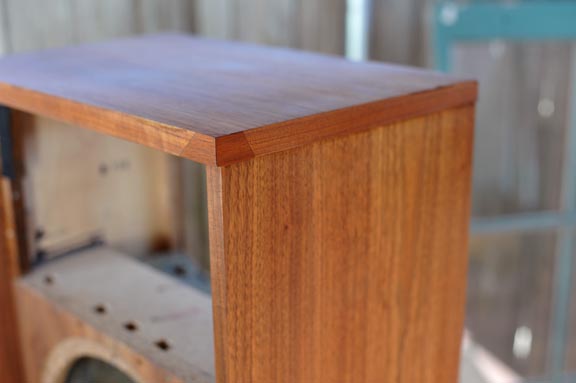


Biggles

cablephil212
Super Member
Looking at the pics, I think I would try to tape off the corner repair. It already 1>2 shades darker than the rest of the cabinet. Best case, after the 2nd coat on the rest of the cabinet, it would blend in better.
Worst case, It's lighter than the rest. If that's the case, just go over the corner, and proceed on.
After the 2nd coat, pull the tape off and see if it's a closer match.
Those are gonna be real stunners when they're done.
Worst case, It's lighter than the rest. If that's the case, just go over the corner, and proceed on.
After the 2nd coat, pull the tape off and see if it's a closer match.
Those are gonna be real stunners when they're done.

PioneerGuy75
Certified Lurker
Lookin Great Biggles!! :thmbsp: :thmbsp:
Long ago I had a pair of those and my modification was to take that tweeter plate and flip it around so they pointed outwards instead of inwards. IMHO it made them sound much better, less muddy.
Thanks for the great pictures and write up as you go!

:thmbsp:Long ago I had a pair of those and my modification was to take that tweeter plate and flip it around so they pointed outwards instead of inwards. IMHO it made them sound much better, less muddy.
Thanks for the great pictures and write up as you go!
Hi PioneerGuy,
Thank you and I remember you! I remember the thread you posted the flipping off the tweeters. I do a lot of reading here at AK, like to be a tad bit informed as to what's happened in the past about what I'm up to today.
I haven't made it to that portion of the restore, yet. I'm actually more worried about the grills than I am of anything else. How the gosh am I going to get them to match the freshened up veneer? In any case, will consider your modification for sure. Have been attempting to not get too far ahead of myself. If I do? My mind gets a little wonky, gotta keep focused.
Biggles
Thank you and I remember you! I remember the thread you posted the flipping off the tweeters. I do a lot of reading here at AK, like to be a tad bit informed as to what's happened in the past about what I'm up to today.
I haven't made it to that portion of the restore, yet. I'm actually more worried about the grills than I am of anything else. How the gosh am I going to get them to match the freshened up veneer? In any case, will consider your modification for sure. Have been attempting to not get too far ahead of myself. If I do? My mind gets a little wonky, gotta keep focused.
Biggles

Hooboy, it's HOT and STICKY here !!!! We don't do HOT here. But we most certainly do Danish Oiling in hotter weather. I got the second application of oil on earlier and it's looking a bit better. A little more grain filling, color is a little deeper, finish is more even, it's good.
No second application over the repaired veneer, not as obvious now.


Need to take a short nap, because that's what you do on hot, sunny days.
Biggles

DrBiggles IS.......the Wood Whisperer. 
Honestly, amazing level of patience you have. Looking fabulous.
Honestly, amazing level of patience you have. Looking fabulous.
DrBiggles IS.......the Wood Whisperer.
Honestly, amazing level of patience you have. Looking fabulous.
Thanks mang! I've walked passed them a dozen time or more today, much better. The wood now has a luster to it, grain has depth and plays with your eyeballs as you pass by. It dances! The grain is slowly filling in a bit, still quite a bit there though.
Oh man, I can hardly wait for application #3.
Biggles
Copa1934
My ears are bleeding
Looking gooooood!Thanks mang! I've walked passed them a dozen time or more today, much better. The wood now has a luster to it, grain has depth and plays with your eyeballs as you pass by. It dances! The grain is slowly filling in a bit, still quite a bit there though.
Oh man, I can hardly wait for application #3.
Biggles

Yeah! I was feelin' the love yesterday and got the second enclosure bleached, hit by hand with the 180 and the first application of neutral oil applied.
If you look fairly close at 2 of the images, you can see the corner repair.
I could see from nearly the very beginning that both enclosure's veneer did not match. It wasn't until I got the oil on that I could really see the difference from 20 feet away. The images don't tell the entire story, they're very different. Honestly, I could care less. They're both beautiful! But if I had to choose a winner? I would choose the darker of the two. The color is so deep, rich and creamy. It's only got 1 application on it, so the depth isn't there. And as near as I can see, it won't be until maybe the 3rd application that I'm going to get an even sheen to it.
As of yesterday, both enclosures have oil on them and they're on their way. I think I still need to recap the second crossover though. Not a big deal since I now know how to separate the crossover cup from the circuit board, easy peasy.


Biggles