

You are using an out of date browser. It may not display this or other websites correctly.
You should upgrade or use an alternative browser.
You should upgrade or use an alternative browser.
Show us Videos of your systems! Let's see and hear them!
- Thread starter GD70
- Start date
From my listening sessions this weekend on two of my systems:
Musicality versus refinement can be heard and discerned. The exact same track was streamed from Tidal. The first one was played back at DSD1024 while the second one was played back 24-bit/88.2KHz, both through HQPLAYER.
Musicality versus refinement can be heard and discerned. The exact same track was streamed from Tidal. The first one was played back at DSD1024 while the second one was played back 24-bit/88.2KHz, both through HQPLAYER.

I Peaked 82db measured roughly around your same settings playing Tin Pan Alley. Yamaha RX-3070 Pure Direct 2 channel 150 watts 2 channels driven using Radio Shack 33-2055 digital. I'm really interested in what the Bi-amp system does. Thanks Todd! Was fun for me to do this actually.Meter is set to read Peak Response, Linear Weighting. Volume on Yamaha Receiver is at -18.5 dB, and is maybe about 1 dB louder than I would normally listen to this track.
Garry~

Gilles83
Active Member
Hello,A clean system never sounds as loud as it really is.
Il est toujours intéressant de comparer, votre système à une meilleure définition dans l'aigu que mon large bande.
Je préfère quand l'image sonore du large bande.
It's always interesting to compare; your system has better treble definition than my full-range one.
I prefer the soundstage of the full-range.
J'aime bien celle là aussi sur mes large bande.
cordialy
Last edited:

Good midrange richness! I like the clean transition between the mids and highs.Hello,
Il est toujours intéressant de comparer, votre système à une meilleure définition dans l'aigu que mon large bande.
Je préfère quand l'image sonore du large bande.
It's always interesting to compare; your system has better treble definition than my full-range one.
I prefer the soundstage of the full-range.
cordialy
Une belle richesse parmi les médiums ! J'aime la transition nette entre les médiums et les aigus.
Gilles83
Active Member
Good midrange richness! I like the clean transition between the mids and highs.
Une belle richesse parmi les médiums ! J'aime la transition nette entre les médiums et les aigus.
Oui, le système 3 voies a des avantages, quand j'écoute mes L96/4313 que je trouve très analytique et très efficace sur la musique classique mais peuvent être fatigante à la longue, le large bande est plus facile à écouter.
Le large bande est sympa avec tweeter aussi.
cordialement.
Last edited:
I haven't had a two-way system in a long time (college days). So I don't recall the specifics.
Je n'ai pas eu de système bidirectionnel depuis longtemps (depuis l'université). Je ne me souviens donc pas des détails précis.
But, for loud or long listening sessions, I like smooth midrange. I'm an Alnico magnet fanboy from long ago.
Mais pour les séances d'écoute à fort volume ou prolongées, j'apprécie la douceur des médiums. Je suis un inconditionnel des aimants Alnico depuis bien longtemps.

Je n'ai pas eu de système bidirectionnel depuis longtemps (depuis l'université). Je ne me souviens donc pas des détails précis.
But, for loud or long listening sessions, I like smooth midrange. I'm an Alnico magnet fanboy from long ago.
Mais pour les séances d'écoute à fort volume ou prolongées, j'apprécie la douceur des médiums. Je suis un inconditionnel des aimants Alnico depuis bien longtemps.
Gilles83
Active Member
I haven't had a two-way system in a long time (college days). So I don't recall the specifics.
Je n'ai pas eu de système bidirectionnel depuis longtemps (depuis l'université). Je ne me souviens donc pas des détails précis.
But, for loud or long listening sessions, I like smooth midrange. I'm an Alnico magnet fanboy from long ago.
Mais pour les séances d'écoute à fort volume ou prolongées, j'apprécie la douceur des médiums. Je suis un inconditionnel des aimants Alnico depuis bien longtemps.
Il est vrai que le LE5-02 médium à moteur Alnico est très redoutable, puissant, analytique et pas trop fatiguant.

I've graduated from LE-5 to blue LE-85s. Je suis passé des LE-5 aux LE-85 bleus.Il est vrai que le LE5-02 médium à moteur Alnico est très redoutable, puissant, analytique et pas trop fatiguant.


The cabinets that hold the 2241s have an internal reflection/standing wave that creates a dip in that range of the bass. Couple that with the floor bounce in the recordings and there's the major difference in "depth/fullness."Hello,
Il est toujours intéressant de comparer, votre système à une meilleure définition dans l'aigu que mon large bande.
Je préfère quand l'image sonore du large bande.
It's always interesting to compare; your system has better treble definition than my full-range one.
I prefer the soundstage of the full-range.
J'aime bien celle là aussi sur mes large bande.
cordialy
Now that I've finally got the treble definition/articulation where I like it, I can get back to the bass. The cabinets are MDF and were made with NO internal bracing and came with NO insulation. I put a layer of that stick-on stuff that they typically use on cars, and covered that with a layer of convoluted foam and put tension-able cross braces on the sides and top and bottom walls. But they still have a major suck-out from an internal reflection and I need to try insulation or such. I was going to use the Blue Jean insulation, but too many said they didn't like it. There is a guy locally that has foam squares and I was thinking of trying to use one as an "acoustic curtain" to break up the standing wave.
As for soundstage..., this is not conveyed by YouTube when recording with a camera with the two mics together on the front. But the soundstage on my system is totally unbelievable and unlike anything I've ever heard at any of the stereo stores or shows. I think there is a tie-in between soundstage and clarity. To precisely pin-point an instrument, it should/must be clear. It is harder to pin-point someone behind smoked glass than someone behind clear glass. Maybe it is a synergy between how I constructed the speakers to work with the room.
Last edited:
Yes sir! Room dynamics can be the final touch in a system. There's a whole subset of folks involved in it.Maybe it is a synergy between how I constructed the speakers to work with the room.
I came across an older version of Tin Pan Alley and for those who say YouTube is BS, it certainly serves well here to hear differences.
Especially listen at ~2:15 and you can hear a very pronounced resonance in the first cut. Is it the room or the speakers?
Doesn't matter because I was able to address it through changing the speaker position and minor changes to the crossovers and you will note that this resonance is pretty much gone and everything is more articulate in the second take.
Especially listen at ~2:15 and you can hear a very pronounced resonance in the first cut. Is it the room or the speakers?
Doesn't matter because I was able to address it through changing the speaker position and minor changes to the crossovers and you will note that this resonance is pretty much gone and everything is more articulate in the second take.
Nice videos! I like the second one!
My guess would be room resonance on that percussive sound at 2:15. Those types of attacks can be difficult to tame.
Just out of curiosity, is that "A" weighted dB? I have no idea why, but my meter defaults to dBA. So that's what I read.
Good job!
My guess would be room resonance on that percussive sound at 2:15. Those types of attacks can be difficult to tame.
Just out of curiosity, is that "A" weighted dB? I have no idea why, but my meter defaults to dBA. So that's what I read.
Good job!
I am referring to the guitar riff at 2:13 on the first cut..., forth/fifth note of the riff "do do do doooo." I guess the picking is "percussive" (as it should be). In the second cut this is tamed to remove the resonance. BTW, as one would expect, this resonance would show up in lots of other stuff and drive me crazy.Nice videos! I like the second one!
My guess would be room resonance on that percussive sound at 2:15. Those types of attacks can be difficult to tame.
Just out of curiosity, is that "A" weighted dB? I have no idea why, but my meter defaults to dBA. So that's what I read.
Good job!
Meter was set on Fast Response, Linear Weighting. My meter does A, C, and Linear. Linear is what we actually hear even though the brain interprets it as A. I bought mine back in 1976 with the calibrator and it still works like new. I did noise and air quality studies for compliance with the California Environmental Quality Act for ~38 years before retiring.
Last edited:
Okay, sorry, let me re-listen to the videos.I am referring to the guitar riff at 2:13 on the first cut..., forth/fifth note of the riff "do do do doooo."
Meter was set on Fast Response, Linear Weighting. My meter does A, C, and Linear. Linear is what we actually hear even though the brain interprets it as A.
I keep my meter set to dBA. So, I'm not sure if 92 dBA = 92 dB linear? Prolly not. Need to Google that.
Okay, I hear that guitar riff. I don't think that is solely room resonance. My guess is that's Stevie's strong pick attack and hot studio mic'ing. That's how I would mimic it. Now, if you have a live room, it's going to enhance it. Maybe, to the point of exaggeration. I guess that's a matter of the listener's interpretation.
In my opinion, the second video seems to "recover" from that pick attack more quickly and naturally.
dB vs dBA – What’s the Difference in Sound Measurement? dB vs dBA: Key Differences Explained
Learn the difference between dB and dBA, how A-weighting affects readings, and why most safety standards use dBA for exposure limits.
sounddbmeter.com
Yes, the room was enhancing that portion of the band, and I revised the crossovers to remove some of that portion from the output signal. If you look at the schematic that I previously posted, this is the job of Resistors R5 and R6. R1s serve a similar purpose for the 2241s. How many crossovers actually go to these lengths? Like I said, synergy with the room.Okay, sorry, let me re-listen to the videos.
I keep my meter set to dBA. So, I'm not sure if 92 dBA = 92 dB linear? Prolly not. Need to Google that.
Okay, I hear that guitar riff. I don't think that is solely room resonance. My guess is that's Stevie's strong pick attack and hot studio mic'ing. That's how I would mimic it. Now, if you have a live room, it's going to enhance it. Maybe, to the point of exaggeration. I guess that's a matter of the listener's interpretation.
In my opinion, the second video seems to "recover" from that pick attack more quickly and naturally.
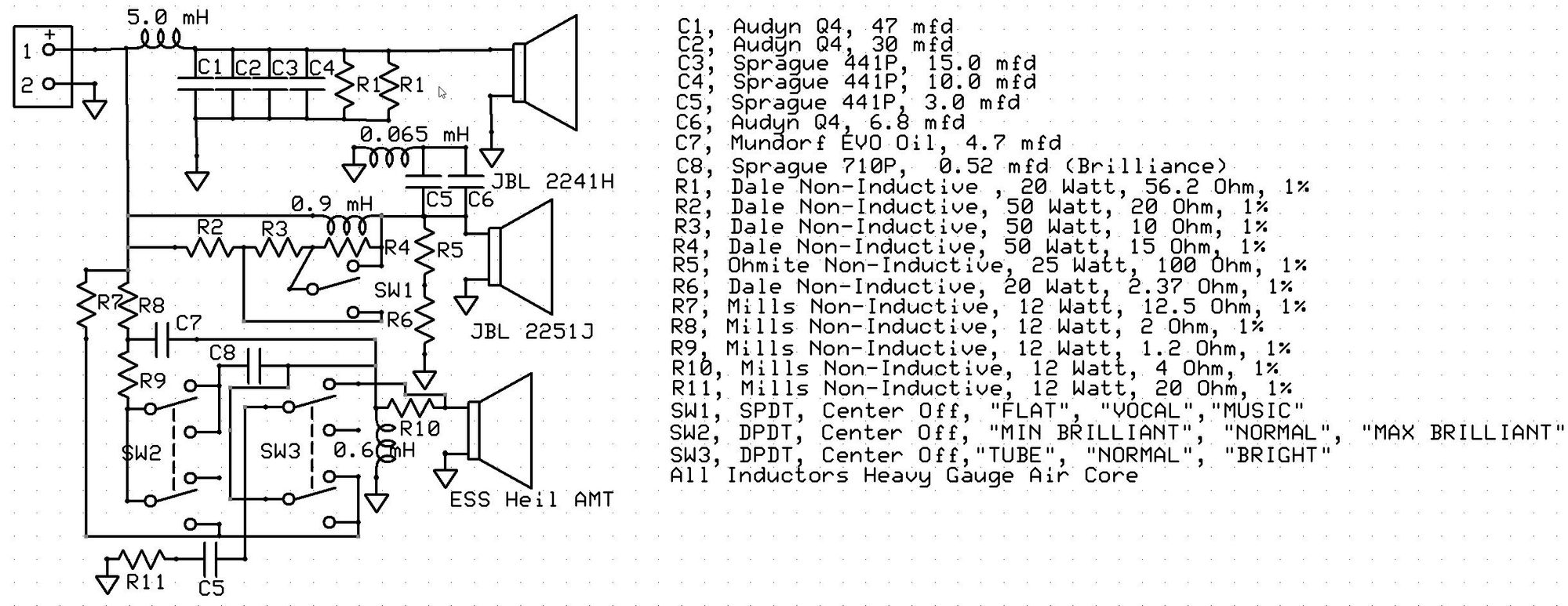
I must admit I haven't played too much with crossovers. Knowing me, it's prolly best that they are out of sight.
Now, acoustic panels... that's one of my vices.
Now, acoustic panels... that's one of my vices.
Thanks.Phone mic.

Found this short video and photo on my phone. Part of the camera and mixer setup for the video I uploaded. The mic patch cords are not attached to minimize clutter in the photo. All the cords and sound panels add a lot of confusion. You can see my portable light panel on the right side.
Drift Away.
Dobie Gray - "Drift Away." DECCA Records. STEREO. 33057. 45 RPMs. Bernie Grundman mastered. 1973.
Runout: 7-L 16,250 WL □-G-□ (Gloversville, NY. MCA plant logo).
Makes me wonder how good mine could sound properly recorded.
 Would certainly add to the separation and help alleviate floor bounce and all those bring.