• The move to the new server is done. There are some software and database maintenance updates in process. This has us passing the hat around to help out. We appreciate any donations. Seriously, even a dollar helps. The payment page may be found here - https://www.audiokarma.org/support.html

Show us your V-Fet / SIT gear

rottalpha

Yamaholic
Subscriber
I see the different flavors spread across multiple forums but I reckon, this very special gear deserves it's own space.

Show me yours, I show you mine....I will break the ice with the entire Sony silver face set:

1720851086927.png

Share what you have in your collection and your listening experiences.
 
Last edited:
Register to hide this ad
Studiomaster Mosfet 500 and two TSR 150,that's all my V-Fet amplifiers :)
 

Attachments

  • IMG_2381.jpeg
    IMG_2381.jpeg
    187.1 KB · Views: 44
  • 20230113_181531_Original.jpeg
    20230113_181531_Original.jpeg
    121.4 KB · Views: 44
  • 20230113_181450_Original.jpeg
    20230113_181450_Original.jpeg
    165.2 KB · Views: 44
Here is another:
Digital do MaiN B-1a amplifier (made in the 2000's) inspired by the 1970's Yamaha B-1 legend.
The Yamaha's own B-1 is a statement amplifier of all times. Unfortunately The Yamaha B-1 was a cost no object / lead-loss product. Yamaha likely never recovered the cost of Research and Development investment, hence they needed to build different siblings to increase gross sales (read B2 and B3). During the 80s economic crisis in Japan and rest of the world, and with the earlier introduction of Mosfets by Hitachi (which were much cheaper to produce), it was a lost business case for any major Japanese manufacturer to continue to produce v-fet amplifiers or preamplifiers.
That said, most of everyone that had the privilege to listen to a v-fet amplifier, knows that they provide one of the most engaging listening experience of new or old amps.
This was the case for a wealthy Japanese billionaire (Mr. Kazuhiko Nishi the founder of ASCII corporation) during the 2000's, who was so impressed with the original Yamaha B-1, enough to want to re-imagine a modern version of (modern by 2000s ). To be successful, Mr Nishi hired an old Yamaha Engineer and also hired the NEC foundry to produce a new version of the old B-1 v-fets, using NOS Yamaha silicon. The naming scheme of the new v-fets was just as that of the amplifier model, which was to add an "a" at the end of each v-fet model. For example, the old Yamaha output v-fets, the 2SK77, was named 2SK77a for the Digial do MaiN version.
As a result, the new Digital do MaiN B-1a is born as an Yamaha B-1 inspired amplifier that uses a relatively similar amplifier circuit, simpler protection circuit, a servo for dc balance, mono-block / BTL setup and and other thought to be improvements. In the end, the B-1a is an excellent amplifier. I own one of these rare birds and I can say that it sounds neither better or worse than the original Yamaha B-1, but that it sounds rather different.
Only a very limited number of the B-1a 's were produced, each was made as special order only and for a hefty price of about $10,000 (year 2000's dollars) each.
Eventually I will upload a video of the B-1a on my tube channel here:
https://www.youtube.com/channel/UCbhA9G0JwKaxB_3Nyv0plCQ
In the meantime I am sharing some photos with the group.

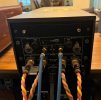
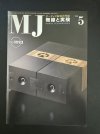
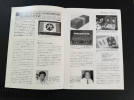
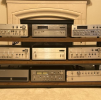
IMG_1999.jpgIMG_2001.jpgIMG_2006.jpgIMG_2002.jpg

1721205339164.png
 
Well yeah....never saw one of these so far,great job for getting one of the Japanese Legends,Cheers
 
I have 6 V-FET amps mate :) however not the very best legends like you guys,the closest one will be my RSD Studiomaster Mosfet 500 2x250w rms V-FET :)
 
I mentioned the B1a on this forum many years ago. I had stumbled upon a mention somehow. Anyway I mentioned it once as an aside.

I am so thrilled to see you have ownership of this. Congratulations. With the excellent liearity of the SIT transistor type It has occured to many that a much simpler circuit like a Class A no negative feedback single ended circuit could be applied to the technology. It is not altogether the aim of all amplifier designers to go with such a hair shirt approach but a linear power transistor makes the idea less nebulous.

Kudos to that Japanese ex-V-Fet designer who said we can't just abandon this. The number one thing needed is for a new manufacturer to step up and produce a decent batch of Power SITs. I cannot see how there would not be a market for products incorporating them.

A thought that has occurred to me is to incorporate a SIT in place of the tubes in a David Berning type circuit. That would be interesting I feel. Although I haven't used one in years. I lived and loved mine every day for many years. Very fondly remembered and something I would gladly revisit if I had my life over.
 
I have 6 V-FET amps mate :) however not the very best legends like you guys,the closest one will be my RSD Studiomaster Mosfet 500 2x250w rms V-FET :)
I sense some confusion here. A Vertical MOSFET/ V-MOSFET is not a Vertical FET, also referred as Static Induction Transistor/ SIT.
Some reading is necessary on your part.
 
I mentioned the B1a on this forum many years ago. I had stumbled upon a mention somehow. Anyway I mentioned it once as an aside.

I am so thrilled to see you have ownership of this. Congratulations. With the excellent liearity of the SIT transistor type It has occured to many that a much simpler circuit like a Class A no negative feedback single ended circuit could be applied to the technology. It is not altogether the aim of all amplifier designers to go with such a hair shirt approach but a linear power transistor makes the idea less nebulous.

Kudos to that Japanese ex-V-Fet designer who said we can't just abandon this. The number one thing needed is for a new manufacturer to step up and produce a decent batch of Power SITs. I cannot see how there would not be a market for products incorporating them.

A thought that has occurred to me is to incorporate a SIT in place of the tubes in a David Berning type circuit. That would be interesting I feel. Although I haven't used one in years. I lived and loved mine every day for many years. Very fondly remembered and something I would gladly revisit if I had my life over.
It took many years to hunt one down.
 
All the amplifiers except Sony are named Mosfet Amplifiers,eather is V-FET,L-FET or Hex-Fet,same in my case the amplifier is named RSD Studiomaster Mosfet 500,but the outputs are Toshiba V-FET :) the bigger brother RSD Studiomaster Mosfet 1000 is L-Fet Hitachi,but both amplifiers are called: Mosfet,Ecler PAM,DPA series are named Mosfet Amplifiers and use Vishay Hex-Fets,C Audio SR,ST,RA,TA,HH Electronics M,V,Avitec Pro,B.K Electronics,Hafler,Soundcraftsman,Zoffmusic,Citronic PPX,Conquest,Audio Management DNA,Rauch,Matrix,Ohm,NJD,McGregor,Harrison and many other brands of amplifiers are named Mosfet Amplifiers,but are L-fet's,Cloud CV series VTX etc etc also called Mosfet Amplifiers but are Toshiba V-FET :) so basically the name Mosfet is written on all,meaning that the outputs are: Metal Oxide Silicon Field Effect Transistos,however what type of FET's are used,that's another thing :) please correct me if i'm wrong,i'm not a V-Fet Master :)
 
Last edited:
Jesus....i tried 10 times to post this photo :) now it works,this is the outputs i have in my amps,however i don't own any SIT transistors,had many years ago a Sony TA-F series V-FET,probably was with SIT transistors,i don't remember the model....the best sounding Sony i ever had,and i owned like 5-6 Sony including the TA F-5A.
 

Attachments

  • IMG_2358.jpeg
    IMG_2358.jpeg
    122.2 KB · Views: 33
Last edited:

The SIT​

The static induction transistor is a three terminal, vertical current flow, semiconductor device that most closely resembles a solid state version of the triode vacuum tube. It is a voltage controlled device and is one version of a field effect transistor (FET), where the voltage on the gate controls the current flow between the drain and source regions. It’s a special design of a junction field-effect transistor (JFET) and were originally referred to as vertical field effect transistors (VFET). They are capable of high-speed and high-power operation, with low distortion and low noise.
It is a vertical structure device with short multi-channels. The device was originally known as a VFET, with V being short for vertical. Being a vertical device, the SIT structure offers advantages in higher breakdown voltages than a conventional FET. For the SIT, the breakdown voltage is not limited by the surface breakdown between gate and drain, allowing it to operate at a very high current and voltage.

The most obvious differences between the SIT and other FET’s is both its vertical structure and that it uses two internal gate contacts. Most FET’s have a single gate that controls current flow in a channel that is parallel to the gates plane. The SIT is a vertical device, with two gate contacts on opposing sides of its channel. It is this vertical current flow and additional gate control that causes the SIT to exhibit non-saturating current characteristics similar to triode vacuum tubes when under high voltage gate bias conditions. It is this unique characteristic that sets it apart from other FET’s.
 
Back
Top Bottom