

You are using an out of date browser. It may not display this or other websites correctly.
You should upgrade or use an alternative browser.
You should upgrade or use an alternative browser.
Show us your V-Fet / SIT gear
- Thread starter rottalpha
- Start date


Ok, you got it.The SIT
The static induction transistor is a three terminal, vertical current flow, semiconductor device that most closely resembles a solid state version of the triode vacuum tube. It is a voltage controlled device and is one version of a field effect transistor (FET), where the voltage on the gate controls the current flow between the drain and source regions. It’s a special design of a junction field-effect transistor (JFET) and were originally referred to as vertical field effect transistors (VFET). They are capable of high-speed and high-power operation, with low distortion and low noise.
It is a vertical structure device with short multi-channels. The device was originally known as a VFET, with V being short for vertical. Being a vertical device, the SIT structure offers advantages in higher breakdown voltages than a conventional FET. For the SIT, the breakdown voltage is not limited by the surface breakdown between gate and drain, allowing it to operate at a very high current and voltage.
The most obvious differences between the SIT and other FET’s is both its vertical structure and that it uses two internal gate contacts. Most FET’s have a single gate that controls current flow in a channel that is parallel to the gates plane. The SIT is a vertical device, with two gate contacts on opposing sides of its channel. It is this vertical current flow and additional gate control that causes the SIT to exhibit non-saturating current characteristics similar to triode vacuum tubes when under high voltage gate bias conditions. It is this unique characteristic that sets it apart from other FET’s.
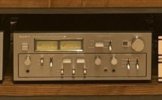
None of the amps you have use V-FETs/SIT transistors. That does not mean they do not sound good. If your old amp was the Sony TA-F7, that would have been a bjt/vfet hybrid. Very good sounding amp.
Sony TA-F7
The manufacturers who made vfet / SITs:
NEC and later Tokin
Yamaha
Sony
Hitachi
Digital do Main (NEC using Yamaha NOS silicon)
SemiSouth (for Nelson Pass)
Russian company that I can’t recall the name of.
Last edited:
It is true primarily for the first generation Sony amps.I seem to recall learning that some of these VFET amps could NOT be brought up on a Variac or you would blow the outputs.
Are any of these like that and if it’s true, why?
(I suppose I could try searching it out myself but then we wouldn’t learn anything!)
vfets are depletion devices that are fully ON and if Vds is applied without first applying Vgs (bias the transistors/ to turn them off), they would instantly fry.
The first gen Sonys require full mains voltage to deliver Vgs potential immediately after power up as they do not have a auto-bias or other protection circuit to fend against "meltdown". Other models such as all the three Yamahas have a "defense" (auto-bias for the b2 and b3 and a protection circuit for the b1) mechanism against this type of failure, hence their higher historical survivability rate.
EDIT: I added additional details above and below....
CLARIFICATION: Some vfet amplifiers have a more robust auto-bias or protection circuits than others, HOWEVER, I DO NOT SEE ANY REASONS TO EVER POWERING UP A VFET AMPLIFIER OF ANY MODEL, USING A VARIAC OR DBT!!!
Last edited:

Just to be clear, are you saying that this only applies to first gen Sonys?It is true for the first generation Sony amps.
vfets are depletion devices that are fully ON and if Vds is applied without first applying Vgs, bias the transistors/ to turn them off, they would instantly fry.
The first gen Sonys require full mains voltage to deliver Vgs potential immediately after power up.

yes but not tested or assessed on the Hitachi, Victor and Sansui. I added additional details to my prior message to dispel confusion.Just to be clear, are you saying that this only applies to first gen Sonys?
Last edited:
No confusion on my part. But there might be for some of the less experienced. To my thinking it's always good to be specific when it comes to these sonic beauties ...yes but not tested or assessed on the Hitachi, Victor and Sansui. I added additional details to my prior message to dispel confusion.

Always good insights from you @theophileI mentioned the B1a on this forum many years ago. I had stumbled upon a mention somehow. Anyway I mentioned it once as an aside.
I am so thrilled to see you have ownership of this. Congratulations
That is up for debate. A simpler circuit with no feedback means low gain, low power (with high distortion / THD that starts to get noticeable above a few watts), thus a specialized use. If one is interested in that type of amp I would recommend the wonderful FirstWatt offerings from Nelson Pass. I think the latest one is FW SIT-4 that uses Tokin transistors, which is available for sale now.With the excellent liearity of the SIT transistor type It has occured to many that a much simpler circuit like a Class A no negative feedback single ended circuit could be applied to the technology. It is not altogether the aim of all amplifier designers to go with such a hair shirt approach but a linear power transistor makes the idea less nebulous.
SemiSouth tried and supplied them to Nelso Pass for the FW amps (except the SIT-4)Kudos to that Japanese ex-V-Fet designer who said we can't just abandon this. The number one thing needed is for a new manufacturer to step up and produce a decent batch of Power SITs. I cannot see how there would not be a market for products incorporating them.
With the exception of Yamaha B1, all Japanese vfet amps including the B-1a are very much wire with gain (read: extremely transparent, detailed / very low THD)A thought that has occurred to me is to incorporate a SIT in place of the tubes in a David Berning type circuit. That would be interesting I feel. Although I haven't used one in years. I lived and loved mine every day for many years. Very fondly remembered and something I would gladly revisit if I had my life over.
Yamaha B1 and the FirstWatt SIT-X amps from Nelson Pass do have that tube sound with a matching single ended triode THD profile.
Yamaha B-1 further stands out because it can do "triode" but also "beast" since it is a >200wpc amp. A refined beast is what the Yamaha B-1 is.
So, the choices are there with the SIT-4 available for sale as we speak.

I like a combination of 'nested negative feedback' with a compensatory amount of global negative feedback. That's usually a great way to do it. The thing about a very linear device is that it gives the designer more options. The simpler open loop circuits though limited in their practical application can be applied to 'per driver' function in a diy active loudspeaker. Removing the reactive passive crossover elements and passing the signal directly to the driver in an active configuration frees the stage from a fair bit of what it doesn't like.
I'm generally a fan of getting rid of as much as can be shaved away from the signal path. I do understand that simple can be too simple but in general where there is robustness and the ability to do the work, less reveals more.
I'm generally a fan of getting rid of as much as can be shaved away from the signal path. I do understand that simple can be too simple but in general where there is robustness and the ability to do the work, less reveals more.
And I would agree with all of thatI like a combination of 'nested negative feedback' with a compensatory amount of global negative feedback. That's usually a great way to do it. The thing about a very linear device is that it gives the designer more options. The simpler open loop circuits though limited in their practical application can be applied to 'per driver' function in a diy active loudspeaker. Removing the reactive passive crossover elements and passing the signal directly to the driver in an active configuration frees the stage from a fair bit of what it doesn't like.
I'm generally a fan of getting rid of as much as can be shaved away from the signal path. I do understand that simple can be too simple but in general where there is robustness and the ability to do the work, less reveals more.

I love the interest in the right type of HiFi ......but I thought your soul was sold to active speakers
I have a car amp that says V-fet on itI remember it was a black amp with no vu-meters and written on it V-FET Twin Drive and someting about Full Symetrical or something like this
That does not make it a v-fet amp. There was a lot of misunderstanding of these SIT devices and clever marketers wanted to take advantage of the confusion between vertical mosfets and v-fets.Sony did have the Wega series which was black but I do not know if there was a no-vumeter version. Certainly not a TA-F7.

EmPro
Member
,,I have a car amp that says V-fet on it That does not make it a v-fet amp.''
Indeed 90% of car amplifiers are stated ,,Mosfet Amplifier'' but has nothing to do with it,the outputs are pure complementary bipolar transistors the only part where the mosfets are used usually IRFZ44N is in the inverter stage to provide the necessary symetrical supply the amp market is quite tricky
That does not make it a v-fet amp.''Indeed 90% of car amplifiers are stated ,,Mosfet Amplifier'' but has nothing to do with it,the outputs are pure complementary bipolar transistors
the only part where the mosfets are used usually IRFZ44N is in the inverter stage to provide the necessary symetrical supply the amp market is quite tricky 
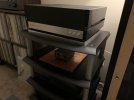
I've listened to nothing but Active speakers, at home, for the last 21 or so years. Initially diy. Which meant I could experiment with brand name high fidelity amps driving my active loudspeakers. Hence the Yamaha B-2. It sounds great in a passive system but have you heard it in an active system? It's a different application and an education to hear it used in this way.And I would agree with all of that
I love the interest in the right type of HiFi ......but I thought your soul was sold to active speakers
The most frequent downside many cite for their reluctance to adopt active speakers is the inability to choose the amplification. It need not be. If one owns many individual pieces of power amplification it can merely be a case of procuring an active crossover and routing some leads to the drivers. It's a diy dream.
I only settled with the KRKs because they are quality and I got a 12 month old pair which had probably only been used for less than 100 hours. They were studio monitors for a failed studio. The owner was selling everything. I got them for a bit more than 25% of new price. The purchase was made with the thought that I could recoup if I didn't like them. I've never owned or used anything that was as responsive to the input signal. This bodes well when the input is hifi quality. All analogue. No ADC to DAC conversion. Mono amps to each driver. Class A discrete to 10 watts. Class AB to 140 watts. KRK got a dedicated hifi amp designer to custom spec the amplification. Not off the shelf. They are just chameleon like. That's their number one signature. There might be many much better amps and speaker combinations. First I've listened to enough gear at many price points to know that they are great for even full price. My champagne tastes at sparkling white wine budget means I lean on my experience to wring value out of what I buy. I only want overacheivers because I can't afford the majority of components which do it well enough.
I got lucky because the KRKs came along after I got the best turntable I'd ever owned. The KRKs love this system. A cartridge change has things better than ever so the reward for taking the road less travelled hifi wise has lately been a lottery winner for me. I have sincerely said that I am grateful to have had the privelege of living with these components. That is satisfaction with one's selections.

damacman
Resident Psycho
My buddy Mikey G was a VFet fan - with lots of B1 and B2 amps over the years. He preferred the B2 even to his beloved McIntosh MC2205. We lost him last as some may recall.
Mike told me once, Man, I've got a stash of VFets to keep 'em running. He wasn't lying ...
Mike told me once, Man, I've got a stash of VFets to keep 'em running. He wasn't lying ...
Attachments

Off topic. It has been a pleasure to participate on this site for almost 21 years. The best bit along with the evolution of my own system is vicariously enjoying seeing fellow members experiment and evolve their own systems. Some members have amazing systems and sometimes have a multitude of great components and multiple awesome systems. I love seeing people using items I've only read about pre-internet and sharing with others how they stack up.
I like the fact that many members seek out obscure gear simply for the chance to play with it. It might be their destination piece or another roadmarker. Their curiosity gives me a chance to say "how does it sound" and pick their brains. There's a lot of experience and knowledge here and it is other members' systems which educate me also.
I like the fact that many members seek out obscure gear simply for the chance to play with it. It might be their destination piece or another roadmarker. Their curiosity gives me a chance to say "how does it sound" and pick their brains. There's a lot of experience and knowledge here and it is other members' systems which educate me also.
It was a pleasure to bring it back to life for you and thanks to your generous contribution at the time, a couple of other B-1's have since lived on too.My Vint Age restored B-1:

Yes indeed! Truly sonic bliss, both yesteryear and today.that's a thing...simply amazing....
