

You are using an out of date browser. It may not display this or other websites correctly.
You should upgrade or use an alternative browser.
You should upgrade or use an alternative browser.
Smart phone and speed app
- Thread starter DLStryker
- Start date
Register to hide this ad

I think they are "accurate enough".
I question how good they really are, especially with respect to the position and accuracy of the accelerometer in the phone, but still use the Turntable Speed (Android) one pretty often and I have been satisfied. When I use a strobe disc and light I get similar results but no actual numbers of course. I have the Strobily App as well as other ways to get my 60hz light.
I question how good they really are, especially with respect to the position and accuracy of the accelerometer in the phone, but still use the Turntable Speed (Android) one pretty often and I have been satisfied. When I use a strobe disc and light I get similar results but no actual numbers of course. I have the Strobily App as well as other ways to get my 60hz light.

They're never truly accurate. Or more precisely, they can't compensate for the fact that the weight of the phone affects the rotational accuracy.
If the weight of the phone will affect the rotation speed, then ... something is wrong 
After all, we use a "heavy" clamp to improve the sound, and it is certainly heavier than a smartphone ...
More important is the interpretation of the results, according to how the measurement was carried out!
After all, we use a "heavy" clamp to improve the sound, and it is certainly heavier than a smartphone ...
More important is the interpretation of the results, according to how the measurement was carried out!

cafe latte
Addicted Member
Platters are balanced to within grams, planking a smart phone on the platter even if you use a roll of tape or similar to try to reduce the resulting platter imbalance it will still put the platter balance way off.If the weight of the phone will affect the rotation speed, then ... something is wrong
After all, we use a "heavy" clamp to improve the sound, and it is certainly heavier than a smartphone ...
More important is the interpretation of the results, according to how the measurement was carried out!
Also smartphone apps are not calibrated.
If you compare a Shaknspin which is calibrated to a phone app ( I have tried) the numbers are quite different and the Shaknspin is the correct one not the phone.
Chris
cafe latte
Addicted Member
Neon not fluoro and you cant check wow and flutter ir look for other issues like bearing knock with a strobe diskStrobe disc and a flourescent light is all that is needed.
My take: Wow and flutter
cafe latte
Addicted Member
Your phone gives consistent numbers just not the correct ones.My take: Wow and flutter
Cheis

cafe latte
Addicted Member
And with B&O a phone is way too heavy.A phone is OK for comparative measurement between decks but I wouldn't trust it for any thing precise or absolute.
Ask me how I know

All measurement devices are relative. Go try any two traps measures, they won't agree at 10', and i promise nether is exactly 10'. Or do you have a calibrated foot? Consistency is what you need to build a house, precision is irrelevant.
A reliably consistent device is all any of us need to measure platter speed. Line frequency can vary +/- 0.02%. That's your maximum precision with a strobe. The rotational measurements the phone are (by the numbers) more precise. If your phone app gives you reliably consistent results, then it's just as good as a strobe. If you can give as consistent results as your phone, then your strobe readings as just as good as the app.
And seeing that a strobe tells you zero about w&f, any poo-pooing of the phone results, which are reliably consistent, is misplaced.
It's like arguing that a vu meter is more accurate than a digital readout. Do we do that?
A reliably consistent device is all any of us need to measure platter speed. Line frequency can vary +/- 0.02%. That's your maximum precision with a strobe. The rotational measurements the phone are (by the numbers) more precise. If your phone app gives you reliably consistent results, then it's just as good as a strobe. If you can give as consistent results as your phone, then your strobe readings as just as good as the app.
And seeing that a strobe tells you zero about w&f, any poo-pooing of the phone results, which are reliably consistent, is misplaced.
It's like arguing that a vu meter is more accurate than a digital readout. Do we do that?

tadawson
Well-Known Member
Flourescent works as well . . . it also pulses at line freq, although not as sharp as neon.Neon not fluoro and you cant check wow and flutter ir look for other issues like bearing knock with a strobe disk

The android app works well for refurbishing the spindle bearing - my TT went from a .14 2sigma number to this after cleaning, re-lubing, and replacing the thrust pads with teflon. The app also agrees with the strobe. Does the phone introduce a minor imbalance? Probably, but who cares?


mr_petit
High on Vinyl
A very simple test I did years ago that I remarkeably haven't seen anyone else do....:
This shows differences between 2 phones. As you can see especially the rpm is pretty different but wow/flutter is rather close, but of course you can do the same test after this with different apps.
Most people have multiple smartphones lying in drawers or from family members available and with most apps being free, why not do these simple experiments yourself?
I think in most cases the phone and app is accurate enough concerning W/F, as I think the biggest question stays unanswered: how much W/F is needed before it can be heard (in double blind test)?
I mean, I see so much experiments in how to measure it as accurately as possible with the most beautiful graphs etc, but no one is doing/reporting controlled experiments that reveal how much W/F is required before it can be heard in music.
So I see these apps mainly as a simple and cheap tool to see if there's clearly something wrong with a turntable (like if it reports 0,3% W/F or something like that), but not really to 'grade' the quality of the drive.
This shows differences between 2 phones. As you can see especially the rpm is pretty different but wow/flutter is rather close, but of course you can do the same test after this with different apps.
Most people have multiple smartphones lying in drawers or from family members available and with most apps being free, why not do these simple experiments yourself?
I think in most cases the phone and app is accurate enough concerning W/F, as I think the biggest question stays unanswered: how much W/F is needed before it can be heard (in double blind test)?
I mean, I see so much experiments in how to measure it as accurately as possible with the most beautiful graphs etc, but no one is doing/reporting controlled experiments that reveal how much W/F is required before it can be heard in music.
So I see these apps mainly as a simple and cheap tool to see if there's clearly something wrong with a turntable (like if it reports 0,3% W/F or something like that), but not really to 'grade' the quality of the drive.
Last edited:
This is, in my opinion, what the app/phone is good for...comparison.The android app works well for refurbishing the spindle bearing - my TT went from a .14 2sigma number to this after cleaning, re-lubing, and replacing the thrust pads with teflon. The app also agrees with the strobe. Does the phone introduce a minor imbalance? Probably, but who cares?
But...
I don't think you can tell, if there's an actual change or not without following a certain protocoll. To compare results before and after, your measurement method and execution must be consistent/repeatable:
- mat placed on table the same way/angle relative to platter
- same run-in/warm-up time of TT
- same point of phone above spindle (same for phone carrier/cup/roll of tape and what not)
- same phone's orientation/angle relative to mat/platter
- same phone and app, obviously.
This way any difference, for the better or worse, can be atributed to your work.
I was curious......
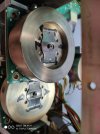
The position of the flywheels holding clips (Revox B215 and H1) affect W&F in a measurable way. The thingies are tiny, the flywhell is much lighter and smaller than a turntable platter, but it spins much faster (300rpm). Who would have thought?!...well, the service manual did.
I've noticed with the iPhone 17 Pro that Apple must have moved the accelerometer. The wow measurements are consistent but the speed on the 17 pro is a bit slower - a tiny amount. Where it used to read 33.33 it now reads 33.31.
hat being said I think the phones are great for this purpose and are a wonderful tool for establishing a baseline. I could see why a professional would use something more precise but for someone wanting to know if their table is performing as it should/healthy the phone apps are excellent.
One thing I'm curious about is the variation between phones in terms of actual accuracy. How would a ten year old iPhone compare to a modern one? Are the sensors getting better and better?
hat being said I think the phones are great for this purpose and are a wonderful tool for establishing a baseline. I could see why a professional would use something more precise but for someone wanting to know if their table is performing as it should/healthy the phone apps are excellent.
One thing I'm curious about is the variation between phones in terms of actual accuracy. How would a ten year old iPhone compare to a modern one? Are the sensors getting better and better?
I'm using a brand-new Pixel 10 Pro, and as I said it reads 33.3 and the strobe is dead still.
At 300 RPM minor imbalances become major. My former hobby was giant-scale R/C aerobatic airplanes and prop balancing was key. The prop tips go supersonic at times.
At 300 RPM minor imbalances become major. My former hobby was giant-scale R/C aerobatic airplanes and prop balancing was key. The prop tips go supersonic at times.

flavio81
Turntable technician
Platters are balanced to within grams, planking a smart phone on the platter even if you use a roll of tape or similar to try to reduce the resulting platter imbalance it will still put the platter balance way off.
Exactly, this means unbalancing the platter (applying an off-center weight on the platter) and most turntables can't cope with this, seriously.
For wow measurement this is a problem. The turntables that turn out fine are the ones that have servos that correct the imbalance, or the ones with really strong motors and massive platters. That's why Direct Drive turntables measure unrealistically (i.e. 5-10x) better than the average belt drive turntable, when using a cellphone for measurement: because they have a servo. (Note: and i'm a DD proponent...)
For checking platter speed, i find a strobe disc on the platter + strobe phone app (giving a 60Hz or 50Hz light) a much more trustable tool.

The absolute best way to test speed is by installing a Roadrunner type device. Are you sure your frequency is exactly 50 or 60 HZ? It probably isn’t. The Roadrunner places a tiny magnet under the edge of the platter and a sensor reads every time it passes - then calculates revolutions per minute. Pretty simple, accurate and foolproof. Roadrunners can also be used to control speed in higher end turntables like SOTA. I got lucky here at exactly 33.333…..
Attachments

Similar threads


- Replies
- 21
- Views
- 2K


