• The move to the new server is done. There are some software and database maintenance updates in process. This has us passing the hat around to help out. We appreciate any donations. Seriously, even a dollar helps. The payment page may be found here - https://www.audiokarma.org/support.html

So what about the plinth?

I don't know much about Lencos, but would think that's not stock!! I googled that model and found lots of pictures, but they don't look THAT heavy!! Do you have pictures of yours?

The second one has 2 pieces of steel inside that weigh 25lbs each.

IMG_2149.jpg


lenco043_zps702f0c4b.jpg


Marc mc
 
The use of 'dynamics' seems a bit odd to me, the question is if using the rubber mushroons is creating some resonance that is not wanted IMO.
I thought that also, unless the term is used differently in this circumstance.... (poster is in Belgium)
 
Great pictures. Made me think you can't casually set those in a normal stereo rack, or shelf.

One has the entire top shelf of a double wide stand to itself.

The top one sits on this stand by itself. The McAlister Audio PH-6 phono stage sits on the shelf below, and the rest of the gear is on another wall.

IMG_2128.jpg


Marc mc
 
New Plinths

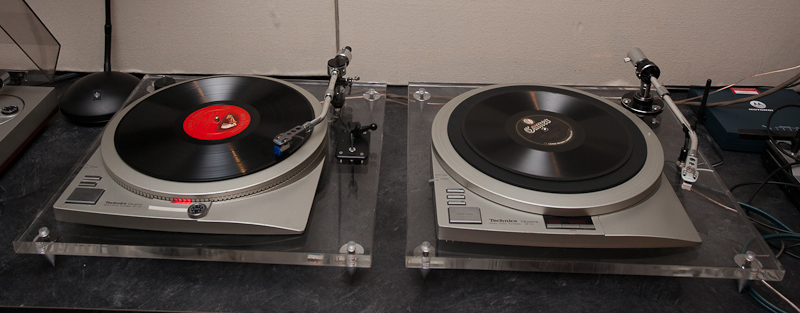
As I mentioned earlier in the thread, I'm working on new plinths for my two SP's. Here they are. The SP-25 is on the left, with the SP-15 next to it:

Technics%2520SP-3697.jpg


My Technics SL-1500 MK II is peeking in from the left.

Here's the SP-25:
Technics%2520SP-3698.jpg


Here you can see the fire polished edges and the speaker spikes I used as feet:

Technics%2520SP-3699.jpg


And here's the SP-15. I'm going to neat up the wires.

Technics%2520SP-3708.jpg


Both sound great. I transcribe the 78's using a flat phono pre-amp.
 
Waterjetguy, where have you been all of my life?
Don

I've been here and there, trying to keep my eyes (and mind) open...

If you folks enjoy this "science of vibration as applied to turntables", I'll start working on some posts to give a more organized overview.

Off the top of my head, some of the subjects would be:

Resonance/Natural Frequency

Vibrational Modes

Damping

Vibration Transmissibilty

Scale of the mechanical information in a record groove


Keep in mind that I'm not a tunable/tonearm/cartridge designer, so I don't have direct experience with the details of their design. (Stuff like cantilever mass, typical tonearm natural frequencies, typical rumble of various bearings, etc.)

But I do have a very good handle on the physics behind all of it.
 
Young's Modulus.
Poisson's Ratio

From:

http://audioqualia2.webs.com/rawdata.htm


material G Pa Poisson ratio kg/m³ factor


aluminium 70 0.34 2700 0.004
chipboard 3.8 0.2 680-800 0.101
balsawood 3.5 0.4? 144 0.013
copper 135 0.35 8300 0.010
brass 104 0.37 8500 0.013
cork 0.03 180 0.050
epoxy thermoset 3.5 0.25 1200
glass soda 65 0.23 2500 0.033
glass fibre RP 26 0.28 1800
granite 66 0.25 2600
lead 16 0.45 11100 0.032
polyamide (nylon) 3 0.42 1100
polycarbonate 2.7 0.42 1200 0.033
polyester thermoset 3.5 0.25 1300 0.341
polyethylene (HDPE) 0.7 0.42 950
polypropylene 0.9 0.42 890 0.052
polyurethane elastomer 0.03 0.5 1200 0.287
PVC rigid 1.5 0.42 1400 0.145
spruce 9 0.3 600
steel 210 0.29 7800 0.008
slate 64 0.25 2500 0.017
limestone 35 0.3 2600
walnut 11 550 0.044
mdf 4 0.28 680-830 0.017
oak 11 0.33-0.50 570 0.102
pine 9 0.32-0.48 0.51 0.064
plywood 1.2-7.5 0.14-0.28 500-650 0.040
acrylic 3.2 0.4 1200 0.070
 
Damping factors

From :
http://audioqualia2.webs.com/dampingfactors.htm

material damping factor at frequency Hz

wood


balsawood 0.013
bamboo 0.200
chipboard 0.101
cork 0.050
fibreboard (flooring) 0.257 113
hardboard 0.062 134
mahogany 0.032
mdf 0.017
oak 0.102 540
olive wood (oiled?) 0.273 264
panzerholz 0.387
pine 0.064 226
Russian 7 ply 0.040
torlyte (copy, ply+cork) 0.088
walnut 0.044


ceramics

fired clay 0.012
glass (strengthened) 0.033
marble 0.009
slate 0.017
soapstone 0.027 1338


metals


aluminium 0.004
brass 0.013
copper 0.010 175
lead 0.032
steel 0.008


plastics


acetal (delrin) 0.013 121
carbon fibre/epoxy 0.022
carbon /glass fibre 0.061 239
expanded polystyrene 0.055-0.168
perspex (acrylic) 0.070
polypropylene 0.052
ptfe (teflon) 0.021
vinyl foam board 0.046
vinyl floor tile 0.145 272


viscoelastics and foams

'blutack' 0.104
closed pore foam 0.151
expanded polyethylene 0.167
foam for glass bricks 0.288
foamboard (RPI Products) 0.030 94
polyurethane foam 0.054 120
polyurethane foam block 0.109 141
polyurethane foam reconstituted 0.149 82
plasticine' 0.301
'Newplast' 0.398
rho c (polyurethane) 0.287
smart (silly) putty 0.134
sorbothane 0.197
tungsten loaded putty 0.318 102
Wickes' 'lead' flashing 0.161

 
Damping factors

From :
http://audioqualia2.webs.com/dampingfactors.htm

material damping factor at frequency Hz

wood


balsawood 0.013
bamboo 0.200
chipboard 0.101
cork 0.050
fibreboard (flooring) 0.257 113
hardboard 0.062 134
mahogany 0.032
mdf 0.017
oak 0.102 540
olive wood (oiled?) 0.273 264
panzerholz 0.387
pine 0.064 226
Russian 7 ply 0.040
torlyte (copy, ply+cork) 0.088
walnut 0.044


ceramics

fired clay 0.012
glass (strengthened) 0.033
marble 0.009
slate 0.017
soapstone 0.027 1338


metals


aluminium 0.004
brass 0.013
copper 0.010 175
lead 0.032
steel 0.008


plastics


acetal (delrin) 0.013 121
carbon fibre/epoxy 0.022
carbon /glass fibre 0.061 239
expanded polystyrene 0.055-0.168
perspex (acrylic) 0.070
polypropylene 0.052
ptfe (teflon) 0.021
vinyl foam board 0.046
vinyl floor tile 0.145 272


viscoelastics and foams

'blutack' 0.104
closed pore foam 0.151
expanded polyethylene 0.167
foam for glass bricks 0.288
foamboard (RPI Products) 0.030 94
polyurethane foam 0.054 120
polyurethane foam block 0.109 141
polyurethane foam reconstituted 0.149 82
plasticine' 0.301
'Newplast' 0.398
rho c (polyurethane) 0.287
smart (silly) putty 0.134
sorbothane 0.197
tungsten loaded putty 0.318 102
Wickes' 'lead' flashing 0.161

There's a lot of good information here, which can help in choosing one material over another. So long as you really understand the meaning behind the numbers, and where they are important to consider and where they can be ignored.

Keep in mind that damping factors are usually frequency dependent, that is the damping factor often varies with frequency. That's one of the reasons that good vibration performance is so hard to design without testing. Very often, the numbers for various material properties we use are approximations or ranges.
Which means that what looks perfect on paper could be a disaster.
 
There are a lot of practical lessons about materials to be heard in this video:

http://www.youtube.com/watch?v=IU3V6zNER4g

Note the times when she changes only one variable (i.e. different mallets/ same force or different part of the drumstick/ drumhead). Nothing else has changed but the sound is different. You can see how mere discussions about 'materials' fails to take into account shape, combinations, placements of interfaces between different materials(i.e is the interface between elements located on a spot which nulls resonance or amplifies it). All these factors combine with the type of material and its mass and thickness to produce an end result.

There is a lot more to be considered than those factors. If we are truly seeking to be scientific we will address all of them. I doubt that it will get to that.
 
I was just on the ProJect website, and the base model, The Essential, that sells for 229 Euros weight 3.9 KG, and as the prices go up, so does the weight, all the way to The Signature wich sells for 9 500 Euros weight 34.5 KG, i guess that being from the same manufacturer they must have the same desing phylosophy, now, if they're wouldn't be an advantage from a heavyer desing, why would they bother taking that route?
 
I was just on the ProJect website, and the base model, The Essential, that sells for 229 Euros weight 3.9 KG, and as the prices go up, so does the weight, all the way to The Signature wich sells for 9 500 Euros weight 34.5 KG, i guess that being from the same manufacturer they must have the same desing phylosophy, now, if they're wouldn't be an advantage from a heavyer desing, why would they bother taking that route?

For the same reason that the new Audio Technica direct drives have a useless slab of metal bolted into their guts: Some people equate weight with virtue when we are talking about turntables. It takes more than weight to lick the problems.
 
As a nerd, this is fascinating to me. As a new owner of a td124, it's extremely interesting.

As I see it, and someone please correct me if I'm wrong, your mushrooms (and mine) isolate the top plate of the td124 from the plinth. Normally, this would be a good thing. However, the td124's motor is bolted to the top plate. So any work you're doing to make the plinth massive and non-resonant would be lost, because all of the noise and vibration on the td124 occurs at the top plate. So if it's isolated from the plinth, you would lose the benefits of having this mass and engineering.

This is where I'd like guys like waterjet to weigh in.

My thought would be to go in one of the following directions (as specifically applied to your (or my) td124:

1. Build (or have your friend build) the copy of the birch ply plinth you referenced a while back. Make it even more massive with lead shot, sand, rubber feet, etc. Disconnect the motor from the top plate, and bolt it to the plinth. Then isolate the top plinth using the mushrooms (or even more effectively, some sorbothane mushroom substitutes).

2. Keep the top plate configuration as is, with the motor and other ancillaries bolted to it. However, in this configuration, you'd want to lose the mushrooms, and bolt the top plate directly to the plinth, so that any vibration from the motor or bearing is attenuated directly by the massive plinth.

Am I on the right track?

Thanks for an incredibly informative and interesting read. One of the better threads on ak.
 
Disconnect the motor from the top plate, and bolt it to the plinth. Then isolate the top plinth using the mushrooms (or even more effectively, some sorbothane mushroom substitutes).
I never even thought about that. I wonder if anyone has done that.

I know on my other TT, a Sota, the motor is completely external.
 
For the same reason that the new Audio Technica direct drives have a useless slab of metal bolted into their guts: Some people equate weight with virtue when we are talking about turntables. It takes more than weight to lick the problems.

So what you're saying is that manufacturers built their turntables heavyer as the prices go up, just because peoples think that heavyer is better.

What about, good , better, best, couldn't that be the reason why?, i mean, we are talking about a lot of reputable TT manufacturers here.
 
So what you're saying is that manufacturers built their turntables heavyer as the prices go up, just because peoples think that heavyer is better.

What about, good , better, best, couldn't that be the reason why?, i mean, we are talking about a lot of reputable TT manufacturers here.

I don't see that he is saying that. I think his point is more that weight is a poor way to judge the quality of a turntable. The best sounding turntable I ever had was a Rega P9. It was no where near to the heaviest. If you discount the power supply and the ceramic platter, I don't think it was that much heavier than a P3.
As has been pointed out, making a good sounding light table is much more challenging then a good sounding heavy one.
 
Back
Top Bottom