• The move to the new server is done. There are some software and database maintenance updates in process. This has us passing the hat around to help out. We appreciate any donations. Seriously, even a dollar helps. The payment page may be found here - https://www.audiokarma.org/support.html

Sony TA-N86B restoration/repair

szfe

New Member
I purchased a TA-N86B on eBay a while back. It looks and sounds almost perfect except for an occasional big shot sound in the left speaker, after which the amplifier cannot be used for a few minutes even if I switch it off and then on slowly. No sound whatsoever for a minute or two. Then it works again for a while, for a few minutes or an hour, then the same happens again. I think my speakers are gonna be shot sooner or later if it happens again.

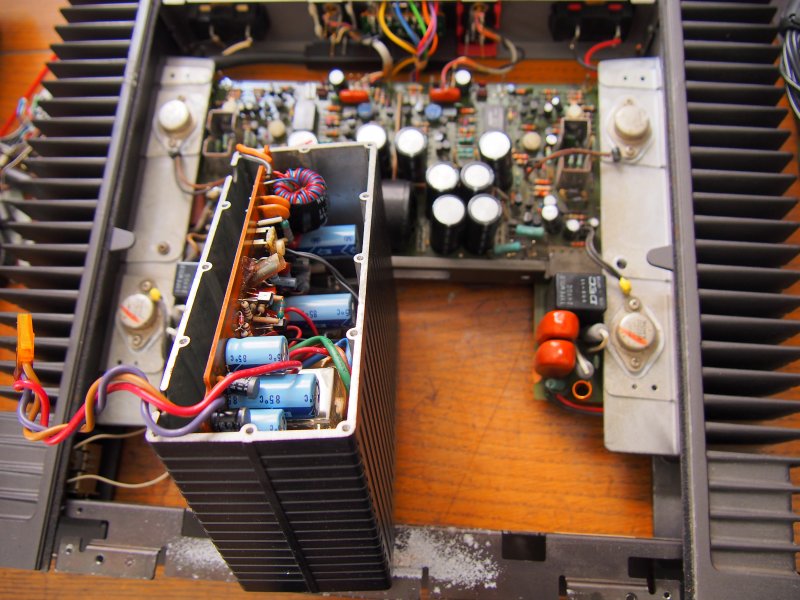
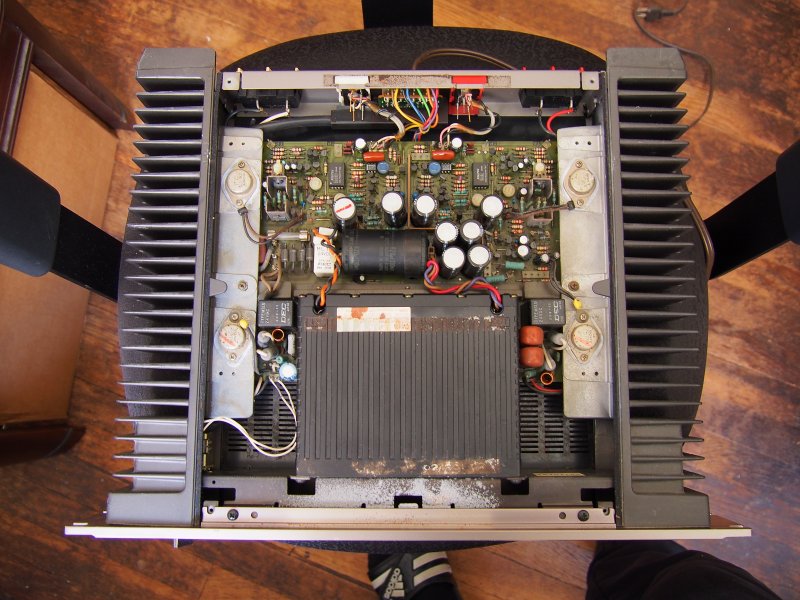
Now I took the amplifier apart, took the PLPS out, opened its box, unscrewed all five screws on the opposite side but I cannot take the PCB out of the casing. It is stuck. So I can't get to the parts to see what's potentially wrong inside. I plan to recap the PLPS. I assume the problem is in there. Can someone help me out?
 
Register to hide this ad
If you really got all the screws out then it is just plain old stuck and you need to un-stuck it. Spray some lubricant and wiggle it out! Use lubricant that is PCB and plastic safe. Pour very hot water on the outside of the metal housing may also help by expanding it.
 

Attachments

Thanks for the pdf. From the pictures in the service manual pdf, it seems like the there is an insulation sheet between the back of the diecast case and the PCB. Can it be melted? And it may hold the two parts together?? I'd not be surprised since the diecast case was sometimes very hot. But I'll try what you suggest.
 
It is hard to advise on something like this without getting my hands on it.

I doubt it gets hot enough in their to melt metal. But sometimes over the years the resin on the PCB might fuse with the metal housing. I'd like to see a pic of the other side of that PLPS. As long as you are applying pressure on the PCB in a way that does not torque it you should be ok. Is the other end open so you could get a small piece of wood and put it against the end of the PCB and very gently/lightly try to tap on it with something to see if it starts moving out?
 
I am not sure the insulator sheet can be metal. I guess not, but who knows.

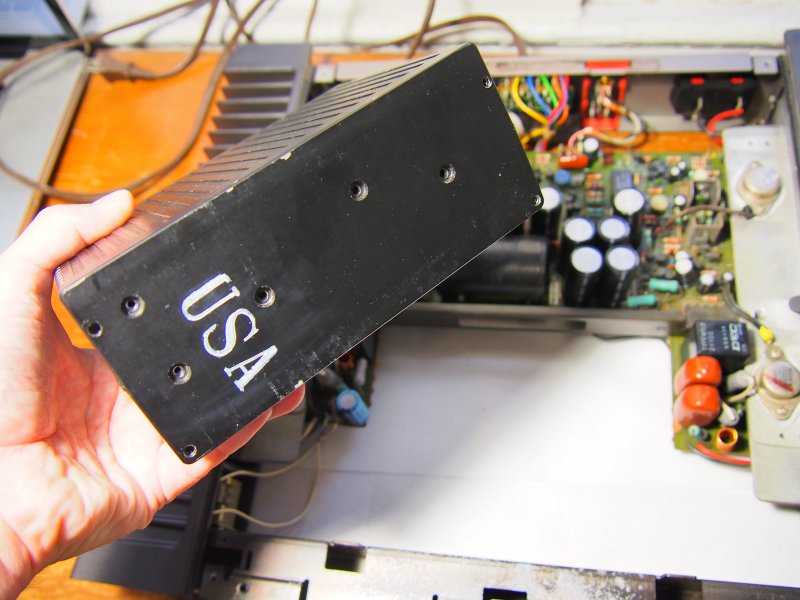
The other end of the diecast case is closed. Actually it is one piece on the other five sides. However, the other end has 5 holes for the 5 screws holding the PCB in place. Those are the 5 screws in the lower picture on Page 8. Though I unscrewed them, the PCB did not become loose, it is still firmly in place. No idea what holds it in place now.
 
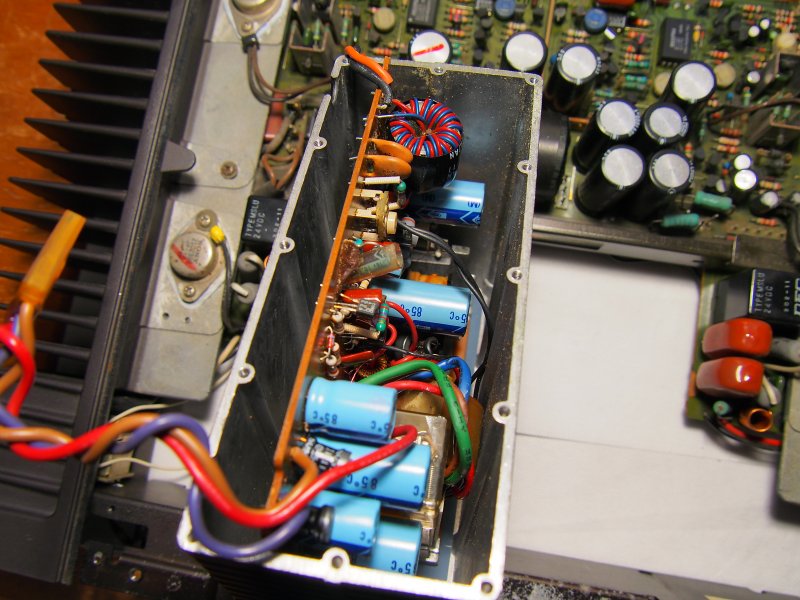
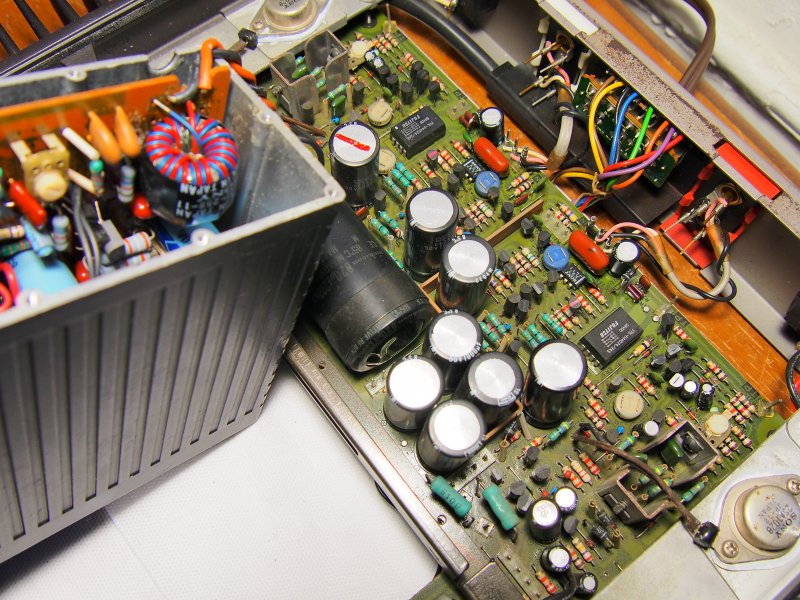
A few more photos of the PLPS case. The back with the 5 removed screws that supposedly hold the PCB in place. Two photos of the inside of the PLPS unit. Apparently, there is a blueish sheet at the bottom, which might be the insulator. And another photo of the other parts, caps, etc. on the main board.

 
Anybody has perhaps any idea as to how to get the PCB out of the PLPS box?

At this point I will assume you have been struggling with and tried everything. My next step would be to get out the Dremel and make some strategic cuts in the PLCB to open it up and do it in a way that it will fit back together. You need to isolate it while your cutting it, like put it in a plastic bag or take it out completely, so metal filings don't go everywhere and clean it very good once it's out.
 
It's probably just 'stuck' to the insulation sheet - the manual shows a diecast part that'll have quite a large contact area on the insulation sheet.

It's hard to see in the manual exactly where some of the retaining bolts screw in, but you may be able to use the 5 X pcb retaining screws (bolts) to 'push' it free, e.g., screw them back in (so the threads are engaged / protected), but not fully, then apply pressure to them to 'push' the pcb assembly (carefully) away from the insulation sheet, hopefully enough to break the seal as it were. If the bolts are not long enough, then just use longer M3 bolts. I'd say the emphasis should be on the word 'carefully' - but that's the first approach I'd use.
 
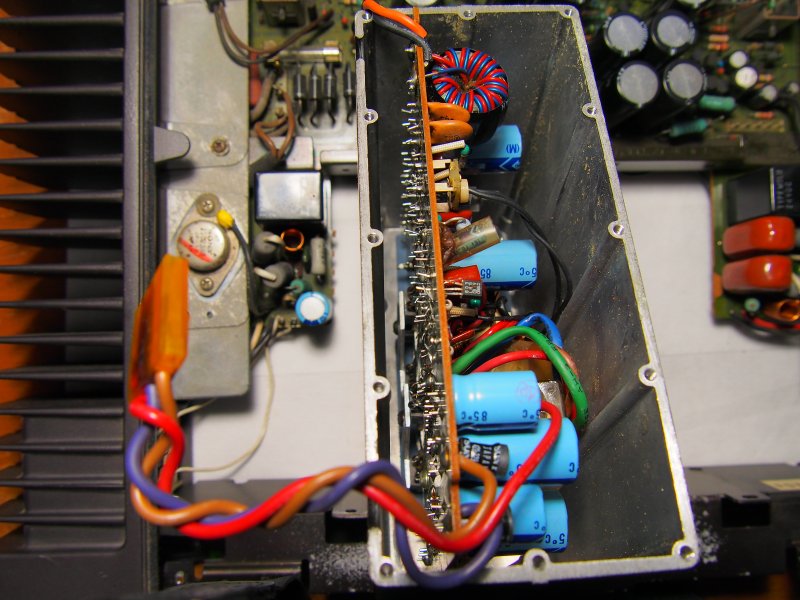
I was using @Goldie99 's method and after several trials, first very gentle, then gentle, then even more force, eventually some (gentle) hammering on the bolt that I partially screwed back in as he suggested, I got the PCB out. A few photos of what's inside the box:
P7040460.JPG P7040461.JPG P7040458.JPG P7040457.JPG
It doesn't look terribly bad. What do you think?

What is not so good, however, is the what you can see in the last photo's lower right corner: one of the ceramic cement resistors broke into two. Not sure when it actually happened, but now the TA-N86 won't even turn on.

Thanks for all the help and suggestions so far!
 
you should be able to locate a replacement. I am assuming you have a schematic.

Good job getting that sucker out!
 
I was using @Goldie99 's method

Actually I suggested to use the 5X retaining bolts to "carefully" work the PLPS board loose. I certainly didn't suggest hammering anything.

The broken resistor in your last photo seems to be R401, on the completely separate main power amp board - if so, then it's part of the mains voltage rectification of the power supply going to the PLPS circuits, and (if you're lucky) may well be the reason why the unit no longer powers on. It will obviously need replacing.
 
@goldie Maybe tapping is a better word than hammering. @rottalpha I have the service manual, I ordered the R401 ceramic cement resistor and then I'll see what else needs to be repaired or replaced.
 
Last edited:
I assume the big 820uF, 200V Nichicon reservoir capacitor needs to be replaced along with a few other ones.
 
if you went to so much trouble to take this apart, I would replace all lytics on that board.
Take as many photos as you can and rely on that for replacing the correct orientation / polarity...do one at the time if it makes it easier to remember. Silk screens and schematics can be sometimes wrong. This is general advise. I have zero experience with this particular amp. There may be other parts worth replacing while you have the guts open, so wait for someone with more knowledge to chime in. Goldie seems to know this Sony configuration. As I noted earlier, it looks like Sony has used a similar physical setup on other amps....but not sure if they used the same identical PSU version.

Edit: for the choice of lytics, i would go for the highest rated temperature I can find (at a reasonable $$) that wound fit. It looks like a tight setup that can trap lots of heat.
 
I've worked on a few early Sony's, but the TA-N86B is unfortunately not one of them, so I too could only offer general advice.

Unless there is clear evidence of a problem with the caps, I would probably be inclined to leave them alone for now - that's not to say they probably shouldn't be replaced, just not yet. I'd focus first upon resolving the original problem, before undertaking any blanket recaps etc. - you did say "It looks and sounds almost perfect"

It looks and sounds almost perfect except for an occasional big shot sound in the left speaker, after which the amplifier cannot be used for a few minutes even if I switch it off and then on slowly. No sound whatsoever for a minute or two. Then it works again for a while, for a few minutes or an hour, then the same happens again. I think my speakers are gonna be shot sooner or later if it happens again.

The symtoms described, if they're always in the left channel, don't really sound like a power supply issue, to me. I'd expect both channels to be involved if that was the case. What does it do / not do when you have the "big shot sound" in the left speaker ? e.g., does the protection kick in ? are the output relays operating properly ? my gut feeling goes more direction relay(s) & protection circuit(s) at this point, but it is just that - a "gut feeling". The "few minutes or an hour" comment could also suggest something possibly overheating - so any evidence of excessive heat anywhere ?

Maybe if you can give more detail of exactly how it's (been) behaving, others might have alternative suggestions ? I do think it's important to focus first on the issue at hand - to avoid possibly introducing new problems. It can always be recapped later, in my opinion.

In the mean time, it's probably worth searching & reviewing the various forum threads re. this amp, and similar, e.g., as rottalpha already suggested, Lee's recent (and ongoing) work on the TA-F5a may be useful, esp. for the pulse power supply section, which has similarities.

 
@rottalpha @Goldie99 Thanks for drawing my attention to the ongoing work on the Sony TA-F5A. Apparently, he was/is struggling similar problems including how to get the PS PCB out of its casing. Funny story. True, it's Indiana Jones-like experience.

Earlier I used the DIRECT output and it was then that the left channel gave out the "big shot sound" every once in a while. Immediately after the shot sound, the output got "muted", I believe only on that channel. I usually just jumped to the amp and turned it off and waited a few seconds, sometimes minutes, and then turned it back on. Then it either turned on and I heard a clicking sound after which it worked, or it did not give a clicking sound and it did not work. If the latter happened, I turned it off again and just waited longer to turn it back on again. Sometimes it took many minutes to be able to get it work again.

Recently, however, perhaps the last few weeks, I switched over to the C COUPLED output and the "big shot sound" never happened again. Sometimes, though, I heard a slight buzzing from the speakers that went away in seconds. But the amp never shut down again. Then the R401 "broke" into two pieces not long ago while the amp was open and the PS case was separated from the rest of the amp (except for the two wire connections). And now I am waiting for the resistor to arrive form China.

Other peculiarity is that the amp has a slight and constant white noise sound, which is odd as it is supposed to be one of least noisy ones (S/N ratio > 120 dB). It is indeed slight but still audible on soft classical music or with no music.

Heatwise, I noticed while the amp was open, and I was using it in class B mode that the right power FETs were very hot, while the left ones were just warm, not hot at all. Weird. I noticed this only after I started playing with setting the 90 V right (it was 94 V before I opened the amp) and the bias currents. I more or less managed to get the 20 and 350 mA's for class B and A, respectively. The PLPS also heated up after a while.
 
Back
Top Bottom