muovimies
Super Member
Yes. My attempt to end the tangential aspect of the ASR thread by posting the Korf measurements, interpretation etc. was a failure because, apparently, they did not fully either read or understand the point that Alex Korf was, in my opinion, so coherently and eloquently making. I'm (probably) not going back to that thread as it has become uninteresting.
Ok this is slightly off topic but I can't resist. I have read that blog and it goes completely contrary to my findings, so either I'm not understanding (in which case I would love if someone would explain it all to me), or mr. Korf is not measuring what he thinks he is - which is my current conclusion. Let me also say that I've read most of the entries in the Korf blog and done so with enjoyment and I really appreciate what he's doing.
Now - I'm no scientist, but there seems to be something fundamentally wrong about that blog entry and his conclusions and it baffles me why he's seemingly unable to make the resonance frequency move around with compliance, since it's my experience it definitely does.
From the Korf blog:
Why can't we just measure the cartridge output through the preamp?
There are pass-through capacitors inside most preamps. These capacitors act as high-pass filters.
We'll see a false "resonant peak" at 5-7 Hz, but in reality it's just 1/f noise shaped by the presence of the capacitor.
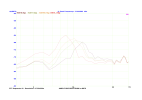
Maybe what he says here is true, but IME the cartridge/tonearm resonance peak will be clearly visible when measured from phono stage output, and will move lower/higher in frequency depending on cartridge compliance. Since the output is what happens in a real world scenario of playing a record, it would seem to me to be way more relevant than what ever you measure with an accelometer on a headshell. Now, my understanding on physics is limited, but it would also seem to me that for what he is trying to measure, he should have the accelometer fastened on inside the cartridge generator on the moving part (at the coils / magnets), since it's the cartridge suspension where the resonance happens. It's the movement that happens inside the cartridge that determines the output voltage.
So again, either I'm confused or he is not measuring what he thinks he is and the conclusions he reaches are not based on relevant data.
You'd also imagine if the whole thing was bogus as mr. Korf implies, someone like Ortofon would have figured it out in the 70+ years they have manufactured cartridges, or that a company like Brüel & Kjær would have found it out in their measurements, but apparently all it took was 15 minutes with an accelometer to prove it was all BS? I'm not buying that, especially since it doesn't align with my findings, which admittedly were not highly scientific and just a curious hobbyist fooling around, but still.
Now, to try to bring this back to topic at least in a loose definition of the word (
 ) I will say subsonic / no-subsonic, there is no free lunch either way, I completely understand why you wouldn't want one in the chain, but I also understand why some people think it a necessity - and in some systems it really might be one. It depends on your system and use case whether you really "need" one or not. So in that sense I'd say it's one of those design compromises that happen unless you are building a "do it all for everyone" device. IME if you don't really need it, you're usually better off without one for subjective sound quality, but if you do need it, then it's quite invaluable.
 Vinyl playback will always have noise in subsonic frequencies, it's of course best if you can deal with it at the source instead of having to rely on filtering. Also things like fluid damping can really help. But there is always going to be noise there, whether it matters for practical purposes depends on many things. Sometimes a sub-sonic filter might be a very good idea though, like if you're using modern stand mount speakers which will typically have very small drivers with a lot of excursion in a bass-reflex design tuned to about 40Hz to 60Hz - with such speakers the bass rolloff will be really steep below the tuning frequency, but the woofers will pump like crazy with any subsonic noise because the speakers are completely undamped at those frequencies. I'd say in such a case the benefits of limiting unnecessary woofer excursion (and resulting rise in distortion) out weigh what ever problems might come with a filter, like some phase shift in audible frequencies.
I recently made a move to such small stand mounts and watching the woofer excursion made me go crazy, I did my best to minimize it at the TT end but not to satisfying enough results, so I ended up building a crude subsonic filter into my phono stage, just a 2nd order passive filter at the output. Since I didn't do needle drops before / after, it's hard to compare, I'd like to think the sound got better but to be honest it was not a huge change either way. But it gave me better peace of mind, knowing my woofers are operating in their happy zone instead of wasting excursion on trying to playback subsonic noise.