

You are using an out of date browser. It may not display this or other websites correctly.
You should upgrade or use an alternative browser.
You should upgrade or use an alternative browser.
Speaker cable gauge considerations
- Thread starter mschool
- Start date

I'm over here using what adds up to 11.5g cables that are about 10 feet long. They're most definitely more clear and articulate that 16g or 12g. 24g? I wouldn't dream of such a thing. View attachment 1666364
And yours is braided besides which also makes a distinct difference ..
And I've kind of had a postulate for years that up to some gauge, a lower resistance should improve transient response ... obviously there's a point at which further improvement isn't noted but I do remember guys messing with 10ga and 8ga back when wire was cheap.
There certainly are a lot of people on this board using 12ga ...
Last edited:

I install A/V for a living..... No need to go any thicker. There’s virtually no voltage drop at such a short distance so going any bigger is just overkill.
You won’t hurt anything if you do other than your wallet and you won’t gain anything sonically.
That statement may be open to question ...
There are a mighty lot of ears that may disagree with you ..
IMHO 50' is a very long run .. a lot of folks consider 10' feet a long run.
Have you experimented with the sonics of different gauges of cable and very long 50' runs versus 6' runs ??

I'm over here using what adds up to 11.5g cables that are about 10 feet long. They're most definitely more clear and articulate that 16g or 12g.
More clear and articulate in a 10.5 run? Yeah, no.
bowtie427ss
Lunatic Member
It's 20 feet of circuit.. a lot of folks consider 10' feet a long run.
I install A/V for a living. I would never use anything thinner than 18AWG for speakers and 18AWG is good for up to 50’. At 6.5’ I would use a minimum of 18AWG and a maximum of 16AWG. No need to go any thicker. There’s virtually no voltage drop at such a short distance so going any bigger is just overkill. You won’t hurt anything if you do other than your wallet and you won’t gain anything sonically.
OOhhh boy! Quoted for truth!
Be careful! Common sense and audio often dont meet!

guest139
Active Member
What I mean is you can use 18AWG up to whatever thickness you want but it’s kind of like putting 93 octane gas in a car that only requires 87. You’re not going to benefit enough for it to justify the extra cost. Put the extra savings into something that WILL make a difference.OOhhh boy! Quoted for truth!
Be careful! Common sense and audio often dont meet!
Last edited:
What I mean is you can use 18AWG up to whatever thickness you want but it’s kind of like putting 93 octane gas in a car that only requires 87. You’re not going to benefit enough for it to justify the extra cost. Put the extra savings into something that WILL make a difference.
LOL I knew what you meant and I agree! But just wait for the shitstorm of butt-hurt that will begin to rain down!
guest139
Active Member
That’s because those people already spent the money on thick cable so they have to argue that it makes a difference. I’ve run 10AWG and even 8AWG in professional arenas for up to 1000’ then splice it with barrier strips/fork lugs and continue the run for a few hundred more feet. THAT’S when you need that kind of thickness.Then when we hook up a TOA ZM104A impedance meter there isn’t much loss. That is if all terminations were crimped or soldered correctly.LOL I knew what you meant and I agree! But just wait for the shitstorm of butt-hurt that will begin to rain down!
Let's keep this going. Last night to try something different, I picked up enough Southwire 12 gauge stranded THHN wire to test out. I have a long run, 28 feet and 23 feet . There is more clarity with this wire - and I was pretty happy with the wire I had (which you all will make fun of, so I ain't sayin' but it starts with an M and ends with an XP).
Is it because it's true 12 gauge copper and not something that looks like 12 gauge and has some sort of dialectic tube running through the middle? I don't know. But what I hear is noticeable, and again, I was happy before - but all this discussion and I had to start playing with wires. Jeesh.
However, this will take some working with. It's stiff and sort of unruly especially in this long of a run. I may try braiding them as well.
THHN is intended to be pulled through conduit; if you want to try something similar but different that is essentially electrically the same but easier to handle, see if your local hardware sellin' emporium sells 12/2 extension cord stock off the spool and try that (e.g. SJ, SJO, or anything beginning as such) alternately 12AWG lamp cord (they probably won't, 16AWG is pretty standard.) The conductors will be the same cross section but will be made of more, smaller strands and so will be more flexible.
Actually if this were available in 16AWG this would look really cool with an old tube amp. Maybe try to find some with two color braided cover, like an old iron cord? https://www.amazon.com/Electrical-FadimiKoo-Twisted-Industrial-Projects/dp/B01LWNZ18M

imral3
Enjoy the musics!!
Made these because I had the 12g wire laying around and I was bored:
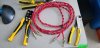
And when asked about their sound...
And when asked about their sound...
The bass has doubled!! The mids have tripled!! The highs are so clear I can see through them!! There's colors swirling around the room!! Could be the shrooms, though.
Made these because I had the 12g wire laying around and I was bored:
View attachment 1666537
And when asked about their sound...
I am sitting in a lab waiting for a blood draw and everybody looked at me when I started laughing at your post!
guest139
Active Member
I have some Belden 16AWG speaker wire. I also have some 10AWG Belden speaker wire. I will use a 10’ length of each kind. Using a 1.5V AA alkaline battery first I’m going to measure the voltage of the battery with my DMM and write it down. Then I will connect the battery at one end of the 16AWG and measure the voltage at the opposite end and write it down. Then I will do the same for the 10AWG. Does anyone disagree that this wouldn’t be a valid test to determine voltage drop between the two different gauge wires?
guest139
Active Member
Lol.I am sitting in a lab waiting for a blood draw and everybody looked at me when I started laughing at your post!

Bill Ferris
Lunatic Member
I have some Belden 16AWG speaker wire. I also have some 10AWG Belden speaker wire. I will use a 10’ length of each kind. Using a 1.5V AA alkaline battery first I’m going to measure the voltage of the battery with my DMM and write it down. Then I will connect the battery at one end of the 16AWG and measure the voltage at the opposite end and write it down. Then I will do the same for the 10AWG. Does anyone disagree that this wouldn’t be a valid test to determine voltage drop between the two different gauge wires?
It would only be a valid test if you had a load of some type at the other end of the cable from the battery end, then you could measure the voltage drop(I/R loss) between the 2 different ga. cables..