• The move to the new server is done. There are some software and database maintenance updates in process. This has us passing the hat around to help out. We appreciate any donations. Seriously, even a dollar helps. The payment page may be found here - https://www.audiokarma.org/support.html

The 80s, when and why did it all go wrong?

So, you have tested them?

Build quality isn't even close. All the knobs on the A-91D are solid, the only solid knob on the SA-9800 is the volume control- all the rest are aluminium over plastic- cheap.


As I stated earlier,I've listened/compared both and couldn't say one was better than the other SQ wise. In fact,they both share the same sound signature.

With regards to build quality,the SA-9800 has 10 all metal toggle switches which can unscrew into two parts,the A-91D mostly has simple flat metal push buttons. Also,it only has two caps inside compared to the four in the SA-9800.
With inflation taken into account they would've cost near enough the same in their respective years. One mustn't forget either...that some of the production cost in the A-91D went into the digital input/optical side of it.
As for the extra weight...I guess the plywood sides weigh in at around 2 kg each.
 
Mustn't forget to add that in my opinion both aren't as awesome sounding or as well built as the 1979 Sansui AU-X1 and Kenwood KA-907 amps :thmbsp:
 
??? I can change the belt on my 09 Challenger in 5 minutes on the side of the highway. Need one tool (1/2 drive ratchet or pull bar. Compared to doing anything to my 67 Firebird it's a cinch. Modern Muscle from all three domestics are truly amazing and I for one am amazed that we have them in this age!

As to the 70 Chevelle remark, first there is no 2013 Hemi Cuda unless he's talking of a Challenger with some cuda stickers applied. If the Chevelle is street legal, I'd be happy to line up with him. I run the quarter mile, road course, and standing mile events. Of course at the track, I don't participate or condone street racing.

My bad it was a Hemi Challenger.
 
Panasonic Thrusters,,, I had a pair of those in 1979 when i was in the army. Gee i thought i was cool back then,,, LOL
 
The story about the coke-addled salesmen at the three-martini lunch had me laughing. Wonder if those guys made it to retirement with their septums intact?
 
Not a chance. Firstly, there hasn't been a Cuda in 40 years. Secondly, "Only a few mods" would not get a 70 Chevelle SS anywhere close to a 2012 Mustang on the track. They are pretty well a wash in straight line speed, with the Mustang having a much higher top speed, but the Mustang corners and stops so much better, that there really is no comparison whatsoever. It would take a complete restomod, that is a completely different suspension and braking system, plus a lot of structural mods, to make it anything like competitive. Effectively a new car, with an old body.

The hottest performance cars of today will run and hide from the fastest of the muscle car era.

This kind made me laugh a bit because today's performance cars are waaayyy ahead of the classics in performance. A Chevelle on a race track beating a GT my ass. BTW, the GT isn't exactly a great handler. I'm put money on a Honda S2000 smoking a Chevelle around the ring modded or not.

A few years back I recall going to a park and all these guys hovered around a 55 chevy admiring it's "powerful" 350. My wife asked me why I wasn't fawning over it since I'm a "car guy" I laughed and said to me it's kind of pathetic that the 5.7L dinosaur puts out the same power as my 1.3L Rotary. Technology has moved on why worship the obsolete. Modern V8s are putting out some amazing numbers BTW, so are modern 4 cylinder turbos...never thought I'd see the day.
 
Last edited:
^ strangely enough I've had an el camino SS and a rotary at the same time. Threads long since buried in the wheels section of this forum. Still have the Mazda but who knows where my elky ended up. I'm a dyed in the wool classic car fan but new iron stomps on it in every regard but looks. A ford fiesta st would blow away most classics on the track and still yield good mpgs.

Back to topic I think 80's gear is still pretty great and welcome decent pieces from any era. There was some awesome gear and clunkers too even in the same range. I had a Yamaha r7 receiver that was just ok but nothing to write home about but I also used to have a Kx1200 cassette deck that was awesome. If anything to
Me the 90's were much worse in the general quality of gear. Whose fault was it? The general consumer.
 
The story about the coke-addled salesmen at the three-martini lunch had me laughing. Wonder if those guys made it to retirement with their septums intact?

I doubt it as that was in 1980 when the decade of decadence was just getting rolling.
 
For most of the early to mid-70's, dollar vs yen exchange rates were generally between 300 to 350 yen/dollar. Slide on up to about 1978, and the rate fell to under 200 yen/dollar. This had a profound effect on the build quality of consumer audio goods leaving the far east.

The really good stuff was still out there, but came with a surprising price tag for those who were used to buying something from Japan for $650 that compared favorably to something built in the US or Europe for $1500.

ditto. :yes:
 
I'm pretty sure this is the thread where my beloved Kenwood KR-V106R get's sandbagged..

I'm listening to it now (fidelify > FiiO E07K/E09K > Kenwood KR-V106R > Monitor Audio Silver S1 ) and it sounds amazing.. and yes I've said it i love all the g** d*** buttons on it..nary a knob in sight not a one lol.. and it is well built no BPC at all has a metal face plate even ..

 
In the very late 70's components were king, but say five years later the growth was in personal cassette players.

I think your memory is suffering from selective reconstructive history. For every boffo component-based system, there were 50 systems featuring speakers along the lines of Panasonic Thrusers (and those were at the top end of the spectrum).
 
Have fun changing a belt on one of those modern muscle cars.:D
And I'm gonna have disagree with ya on that last statement.A friend of a friend had a 70 Chevelle SS that he raced and he destroyed a 2013 Hemi Cuda and a 2012 Mustang GT. with only a few mods to the suspension and engine.I'm talkin laps around a racetrack not just a 1/4 mile.

He would have had to put the Chevelle body on a new Camaro chassis. No way I believe that EXPECIALLY against the Mustang
 
My pioneer Elite c90 /m90a separates are from late 80s. Cutting corner should be clearly visible when compare to 70s. So lets See some pics.
Pioneer spec 1 and 2

s-l640.jpg
pspec12.jpg


These are from 70s. Some say its high end. And build quality? Single transformer in power amp and preamp. Huge cutting corners visible here. But chassis is build like tank. Pity that Inside build quality isnt better

Now, King of kings pioneer sx 1980
images.jpeg

What we have here? King of kings, prices for this receiver are very high and build quality? Single transformer for everything, tuner, amp, preamp, lights etc. Huge cutting corners here. Why is this "King" with Such a mediocre build quality?

Now amplifier from late 80s. Pioneer Elite c90a /m90a
ippkb4mgbpm2104-760x700.jpg

90d1250e59f8e4b3bcdbb787108ffa62.jpg
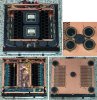
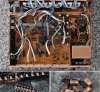
This is combo from late 80s. Cutting corners should be clearly visible. But what we have here? Power amp: 2 oversized transformers. Dual mono construction. Copper plated chassis. High grade components used here, brass cap resistors, film capacitors. OFC wiring, 70um thick pcb tracks. Preamp looks a bit messy. But still preamp has 3 transformers which was unusual even in the 80s. Phono stage has 2 step up transformers also unusual even in the 80s. Even in the 70s step up transformers in phono wasnt standard. High grade components used in preamp like mylar Capacitors, polystyrene film capacitors, polypropylene capacitors, mica capacitors, brass cap resistors. OFC wiring
Front panels are not plastic but its aluminum.
Of course there are down sides. Chassis construction is Less sturdy than Spec build quality. ICs are used which are custom and unavailable today. Plexi is used instead of Glass. But it doesnt have effect on sound.

But still pioneer Elite looks much better over all than these amps from 1970s

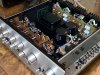
And pioneer sa 9800
pioneer_sa9800_integerated_amp_1642736572_5ec71907_progressive.jpg

This is the best build quality? Single transformer? Kinda huge cutting corners visible here. Pioneer Elite c90a /m90a has 5 transformers and separate power supplies. Sa 9800 weights 39 lbs, pioneer Elite c90a/m90a weights 70 lbs!
Pioneer Elite c90a/m90a build quality is much better than są 9800. Its no contest here.

Pioneer in the 80s was making very good amplifiers, even better than some amps from 70s.

Pioneer są 9800 cost in 1979 was 750 USD. Its 3100 USD after inflation adjust.
Pioneer Elite c90a/m90a cost in 1988 was approx 2750 USD. Its approx 6900 USD in today money

SA 9800 was much cheaper than pioneer Elite c90a /m90a combo.

 

Attachments

  • images.jpeg
    images.jpeg
    12.3 KB · Views: 4
The A-91D is streets ahead of the SA-9800 in performance, usability, looks, build quality (another 10kg heavier) and on the bench it is able to deliver over twice as much power into low impedances.
Top of the Line pioneer Elite amps are as good or even better than these from 1970s like są 9800,sx 1050,sx 1980 etc
 
Computers. They became popular in the early 1980s and had a twofold effect. First they allowed designers to build pieces less robustly, but still spec out, and generally streamlined the R&D process. Items weren't overbuilt to exceed their useful life.

Secondly, calculations could be done with a few strokes of the keypad, rather than repeatedly longhand or via slide rule or calculator. When I was in business school in 1982 we had a computer lab with about 20 IBM XT machines in the basement of a building. When the savvy techies like me started using the word processors and spreadsheet programs and showed up with triple spaced group papers that could be edited and reprinted in minutes, rather than retyped in hours, and spreadsheets with formulas that could refer back to a cell and calculate 20 year NPVs of cash flows with a few key strokes, rather than summing 20 individual calculations, or instantaneously show the effect of a single input on all sorts of spreadsheets, it spread like wild fire. In less than a year it grew from a single basement room open 8 hours, to a huge hall in a dorm open 24/7 with dozens of workstations and printers.

Computers are something we take for granted these days, but they revolutionized business, engineering, and science in the 80s by streamlining the tedium of calculation and printing, so we could better evaluate issues in far less time.
 
Last edited:
My pioneer Elite c90 /m90a separates are from late 80s.

This is the best build quality? Single transformer? Kinda huge cutting corners visible here. Pioneer Elite c90a /m90a has 5 transformers and separate power supplies. Sa 9800 weights 39 lbs, pioneer Elite c90a/m90a weights 70 lbs!
Pioneer Elite c90a/m90a build quality is much better than są 9800. Its no contest here.

Pioneer in the 80s was making very good amplifiers, even better than some amps from 70s.

Pioneer są 9800 cost in 1979 was 750 USD. Its 3100 USD after inflation adjust.
Pioneer Elite c90a/m90a cost in 1988 was approx 2750 USD. Its approx 6900 USD in today money

SA 9800 was much cheaper than pioneer Elite c90a /m90a combo.

Of all the things that you would attribute to an amplifier/integrated amplifier/receiver performing well, how significant is the quantity of transformers? Is an amp and preamp sharing a transformer that has separate windings for each much different than separate transformers?
 
Of all the things that you would attribute to an amplifier/integrated amplifier/receiver performing well, how significant is the quantity of transformers?

The power supply in Elite preamp is split for the individual stages and uses a total of three mains transformers; together with a «bimonoaural» construction (ie an exaggerated electrical separation of the two channels), it allows maximum stereo separation and immunity from intermodulation.

The same applies to pioneer Elite m90a, where there are 2 separates power supplies, dual mono construction which also allows to greatly decrease intermodulation and increase Channel separation That affects sound quality. Thats much better construction than single transformer for everything, pre, amp, tuner, lights etc

The discussion is about 1980s and when did it all go wrong. But as we See some 1980s high end amps has much better construction than these from 1970s

Definitely it affects sound greater than lots of metal knobs, Wood cabinet, or more robust chassis etc
 
Last edited:
Back
Top Bottom