• The move to the new server is done. There are some software and database maintenance updates in process. This has us passing the hat around to help out. We appreciate any donations. Seriously, even a dollar helps. The payment page may be found here - https://www.audiokarma.org/support.html

The Advent Loudspeaker

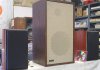
What a difference a grille makes....

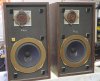
These are LARGE bookshelves. Compare to Karma Indignias under development:

attachment.php


So, are these "correct" -- fried egg tweeters, masonite frames, concave foam surrounds, etc.?

attachment.php


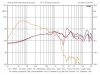
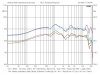
So much for looking at the drivers. Installing the grilles "fixes" the anomalies at 2 kHz and 3 kHz.

attachment.php


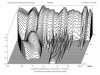
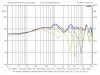
Set on "Extended," response approaches flat, on axis. Grilles "mask" the anomalies is more appropriate, probably, as they are still apparent in the CSD:

attachment.php


attachment.php
 

Attachments

  • Vs. Indignia.jpg
    Vs. Indignia.jpg
    39.4 KB · Views: 1,850
  • Utility Cabs.jpg
    Utility Cabs.jpg
    53.3 KB · Views: 2,186
  • TAL #1 Grilled MLS.jpg
    TAL #1 Grilled MLS.jpg
    55.2 KB · Views: 2,475
  • CSD #1 Grilled MLS.jpg
    CSD #1 Grilled MLS.jpg
    94.1 KB · Views: 1,860
  • SG #1 Grilled MLS.jpg
    SG #1 Grilled MLS.jpg
    33.1 KB · Views: 1,846
Last edited:
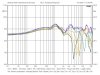
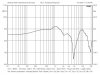
So, how about how we actually listen to them, then, as a pair, spaced apart and some distance back, say ~24° off-axis? Still flatish, 3 - 4 dB "hot" at 1 kHz, and the VHF has rolled off sharply at 14.7 kHz:

attachment.php


Want "sizzle," toe them in toward the listening position:

attachment.php
 

Attachments

  • TAL L&R Grilled & Toed MLS.jpg
    TAL L&R Grilled & Toed MLS.jpg
    54.7 KB · Views: 1,839
  • TAL L&R Grilled MLS.jpg
    TAL L&R Grilled MLS.jpg
    53.1 KB · Views: 1,849
Are they getting any low freq support from room boundaries? That may flatten out the low end further. You are demonstrating something many of us have known since the first listening to that classic system 30 years ago.
 
Are they getting any low freq support from room boundries? That may flatten out the low end further
The nearfield low-frequency response measurement reflects how they would sound in 2-Pi alignment, i.e., with one boundary, such as the floor, or a wall.

I'm listening to them in free space, no boundaries, basically, and the bass is quite good. I can see how they might be perceived as "boomy" if they were against a wall.

So, no, boundaries don't flatten the low end, rather, they accentuate it, which is why it's called "boundary reinforcement...." :yes:
 
Wonder how my Dahlquist DQ-20's with the same woofer would stack up in Zilch world.........:scratch2:
 
Unless I am misinterpeting your curves the systems seem a little rolled off by perhaps by 5db at 50 hz in relation to the midrange. In a real room I think that the low end could be raised a little by moving the speaker a little closer to a boundary. This is the expected placement. the system would then measure very flat +-2db over the whole musical range. Kloss knew what he was doing with that design.
 
Hey those look familiar...:scratch2: Looks like it's time to reinvent the Advent. :thmbsp:
HI, Wired! :D

The major problem seems to be lack of mirror-imaging. They sound nice, but they don't image worth a whit thus far. I'll try more to make that happen before concluding anything, though; I'm just acquiring data on them and presenting it here.

Moving onward with that, now.... ;)
 
Unless I am misinterpeting your curves the systems seem a little rolled off by perhaps by 5db at 50 hz in relation to the midrange. In a real room I think that the low end could be raised a little by moving the speaker a little closer to a boundary. This is the expected placement. the system would then be very flat +-2db over the whole musical range
The MLS measurements are time-windowed, and do not accurately reflect the low-frequency response. See "FreqLO" in the legend? 220 Hz is the maximum resolution of the window I have set to measure the high frequencies accurately, quasi-anechoically.

That's why I also do nearfield measurements, to get a look at the LF response. The MLS response is not accurate down there where you're reading it. You've got to "stitch" the two curves together for the full range response. You can see I've crossed them in the region of 1 kHz to show the bigger picture.

The cumulative spectral delay images are derived from the windowed MLS, and that's why they curve off from 200 Hz as the time gets shorter, as well. It's the mathematics of the measurement process doing that.... :yes:
 
Last edited:
Stack 'em!!

O.K., let's use the Violet curve from #22, above as our standard: grilles on, "Extended" crossover switch position, normal listening alignment with the speakers toed-in for full on-axis VHF response.

Stack them vertically, tweet to tweet, (pic last below,) and move the mic on-axis with the dividing line between the cabs, i.e., smack in the middle between the woofers and tweets. Measure the top and bottom speakers individually (Green, Red,) and then both playing at the same time. The result is the Blue curve, substantially identical to our standard. There's a bit of variance because we're not precisely on axis with either tweeter, but the fundamental frequency response is the same. Cool.

attachment.php


Now, let's move our listening axis up or down in 3" increments from the vertical center:

attachment.php


OR, how about horizontal from 10° to our normal not-toed-in 24°:

attachment.php


So, if you've got them stacked, not toed in, and listening in a "normal" alignment, level between the cabs, here's your frequency response:

attachment.php


Well, y'all KNEW I had an agenda with this.... ;)
 

Attachments

  • Vertical Stack, Vertical Displace.jpg
    Vertical Stack, Vertical Displace.jpg
    55 KB · Views: 1,468
  • Vertical Stack, Horizontal Displace.jpg
    Vertical Stack, Horizontal Displace.jpg
    56.7 KB · Views: 1,444
  • Vertical Stack.jpg
    Vertical Stack.jpg
    55 KB · Views: 1,454
  • Vertical Stack 24°.jpg
    Vertical Stack 24°.jpg
    49.8 KB · Views: 1,450
  • Stacked.jpg
    Stacked.jpg
    22.5 KB · Views: 241
How about stacked with both speakers upright instead of the top one inverted?

Measured about 5 feet away centered.

Doug
 
Is that what comb filtering looks like on a graph?
http://www.jblpro.com/pub/technote/fat_wht.pdf

but... how do they SOUND? :tresbon: or :boring: ?
Used as normal speakers, in free space, they're basically "neutral," as designed, but not all that flat by contemporary standards, as the measurements show. With this model, it's important to have the grilles in place. There's a reason that tweeter opening is just such a small hole up front.

As mentioned above, they could get bass heavy with boundary reinforcement. They're beamy in the VHF, but at least they're not "out of control" like some others I have measured recently. They do not image well; I'm still working with that. Judging from the reactions of visitors to ZilchLab, I'm becoming convinced that not many "listeners" have actually experienced the pleasure of decent imaging.

Stacked, the issues are clear. We have two tweeters displaced horizontally interfering with each other with horizontal movement, and two woofers playing well into the upper midrange displaced vertically interfering with each other with vertical movement. There's only one point in space where the reproduction is as accurate as playing a single pair normally.

How about stacked with both speakers upright instead of the top one inverted? Measured about 5 feet away centered.
Then, you've got the tweeters displaced more vertically, and centered between them is not centered between the woofers which, again, are playing substantially into the upper midrange. As Ray has previously pointed out, that alignment is less sensitive to horizontal movement, but more likely to be "wrong" everywhere. Separating the tweeters is a worse idea.

From the tech note I linked at the beginning of this post:

When two sound sources producing identical program are displaced relative to
each other, they will combine to produce a unique interference pattern that
depends on the observer's location. The interference pattern is a result of the
different arrival times from the two sources.

There are rational approaches to stacking. Slapping Advents (or any other speakers, for that matter,) on top of or beside one other and playing them full range is not among them....

 
http://www.jblpro.com/pub/technote/fat_wht.pdf
...
There are rational approaches to stacking. Slapping Advents (or any other speakers, for that matter,) on top of or beside one other and playing them full range is not among them....

I knew what was coming. But I don't think you will convince many with their own opinion. I really like my advents. Although mine are stacked due to space reasons, I only have one pair and listen to them while asleep.

Bill
 
Zilich you stated : "They do not image well; I'm still working with that." What did you mean ?

I have been enjoying my "new" pair of Advents and found the imaging to be very nice. Are you working with the location of the speakers, or are Advents not good imaging speakers ?

Maybe I have not heard good imaging ? If not I have something to really look forward too !
 
Zilich you stated : "They do not image well; I'm still working with that." What did you mean ?
Spacing and orientation, primarily. I have other non-mirrored systems which image better than these. I'd like to discover what is the problem; there's something else going on in this respect worth understanding.

These are borrowed, and unmolested, as best I have been able to determine, so I can't dissect them as I typically would. Even a recap would violate their integrity, though I have a spare set of crossovers I could substitute for testing and comparison purposes. I might also notch out the 1 kHz hump to flatten the response. If that helps, I'll post how to do it.

The second set of cabs I have (post #1) will get "Zilchified," and A/B'd with these originals.... :thmbsp:
 
Back
Top Bottom