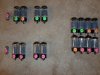
The Back Eight Plus Drivers
The remaining eight output tubes were tested, with all tubes testing GOOD. This batch produced the strongest tube of the whole bunch (103.8% of ANPO), and the weakest of the 15 good tubes (86.7% of ANPO). If you (obviously) throw out the bad one, and then throw out the single highest and lowest performing tubes from the 15 good tubes, then the remaining 13 tubes averaged 97.5% of ANPO, which is excellent.
However, this last batch also produced three tubes requiring notably more negative control grid voltage to produce the target 50 ma of quiescent current draw in the PO tube tester. Therefore, these tubes clearly have the potential to run hot in an amplifier like this Bogen, where the negative control grid voltage is not adjustable -- or at least hotter than the other tubes in this amplifier.
Still, out of the 15 good tubes, eight tubes were able to be mated up that allow for no more than a 10% match variation between the best and worst tube in the bunch, based on cumulative variations of BOTH required negative control grid voltage, AND power output delivered. Within each category, the negative control grid voltage had a variation 4.8%, while power output varied 5.1% between the best and worst performing tubes. This is a very good match considering the small pool of tubes to work from, and likely approached the match Bogen required from its vendor for this amplifier. They should certainly allow the 200A to show off its stuff when asked to.
Finally, the driver tubes were tested in my Gm tester for characteristic compliance. Unlike conventional Gm testers, this tester tests a DUT according to the conditions published by RCA and others for their tubes. Therefore, from the RCA RC-30 Receiving Tube Manual, with 250 volts on the plate, and the grid bias voltage adjusted for the plate current given, 7247 tubes should produce a Gm of 1600 and 2200 micromhos in Unit 1 and Unit 2 respectively.
The tubes provided are RCA labeled 12DW7s, which are direct replacements for the 7247, and produced 1675 and 1700 micromhos for Unit 1, and 2100 and 2175 micromhos for Unit 2 respectively in my tester.
Because this tester also tests under very tightly regulated conditions for plate, grid, signal drive, and heater voltage, the tolerance for acceptability is much tighter than with conventional Gm testers. In this tester, the English scale is such that any tube that can produce 90% or greater of the published Gm is GOOD. Any tube that produces a Gm of < 90%, but at least 80% of published value is considered as WEAK, while any tube that produces < 80% of published Gm is considered as BAD. Both sections of both driver tubes tested well into, and even over the published values for their sections. Remember that a Gm test is testing a characteristic of a tube, and from that then, condition is extrapolated. Gm testing is particularly appropriate for testing Med Mu small signal tubes (Unit 2 of the 7247), and is good for High Mu tubes as well (Unit 1).
Pics include:
1. Those that made the final cut. The eight tubes are arranged in matched quads going across, with best pairs matched up within the quad. The discard pile is on the right. The driver tubes were mated with the output tubes for each amplifier based on phase inverter section condition, versus output tube drive voltage need.
This overall effort has produced a set of tubes that should allow both amplifiers to produce well matched performance between them, and also allow the Bogen overall to perform to the best of its capabilities.
2. Driver tubes under the microscope. Panel meters indicate B+, heater, and grid bias voltage levels, as well as plate current, and Gm.
With this step of the effort now complete -- and with a successful outcome as well -- attention will now focus on the unit itself, getting it ready ultimately for base line performance testing. It is unknown how long it has been since this unit saw active duty, or even simply had power applied, so it will be treated as if it was before the creation of mud.
More as it becomes available.....
Dave