• The move to the new server is done. There are some software and database maintenance updates in process. This has us passing the hat around to help out. We appreciate any donations. Seriously, even a dollar helps. The payment page may be found here - https://www.audiokarma.org/support.html

The Mighty Bogen MO-200A

Just to clarify a few things. The amp that Dave is so graciously reworking is from me. I am presently using a pair of Dynaco Mk III's in my main system. I came across a pair of the MO 200a by actually doing a favor for a friend of the family. Long story. Anyway, I had read through Bricktops thread, had looked over the schematics and read what I could find about these amps. I had also seen where Dave had not refuted the ability of the Bogen to perform at a high level as a Hifi amp, but had mentioned not a lot of hard data to prove what many folks ears were saying... these Bogens are very capable of high quality hifi.

After my research, I had to decide if this was a project I wanted to take on, or needed to farm the work out to someone else. Since I had 2 of these amps, I had a variety of options. Sell them, restore to a pair of very powerful monos, convert one or both to stereo amps, sell one to fund the other work, trade, you get the idea. Lot's of options.

Being presently satisfied with my Dynacos, I felt that anything I ended up with, really needed to best my Dynacos for performance. To be slipped into my main system. For the most part, 50-60 wpc is adequate for me. I really felt no need for a pair of 200wpc monoblocks, other than some bragging rights:D. I requested ideas and suggestions from others here at AK, directly and indirectly. I would like to have done the work myself, and quite honestly, I could probably have split the amp into separate channels and recapped it. Tested for some out of spec resistors, but that's about it. As for trying to test it, test and match tubes, make circuit changes and decisions, tune and then optimize it... well that is way beyond my skill set. So I doubted that I would be besting my MK III's by doing it myself.

So after my research, some idea threads and such, I tried to give Dave a bit of a nudge, with the opportunity for him to finally get some really good hard data of this particular model amp. While at the same time, asking that the amp be converted to stereo, with the use of original tubes if the ones provided were adequate. Then doing what's necessary after that to see just what kind of performance he can squeeze out of it. I really have no need for 200wpc, so the stereo conversion seemed the best idea. While the 8417's seemed to be a little more difficult to find, it's certainly not impossible as Jaymanna has communicated. And since I already had 16 (albeit untested) it was worth a try. But with the uncertainty of the quality of the untested tubes, an alternate plan had to, at least, be considered. Therefore the ability to run other tubes, that are more readily available would be the next option. Even if we were able to find enough good 8417s out of the 16, being able to switch output tubes to another type (ie EL34s) down the road would be a great option. Budget wise, there is certainly a limit, and I'm not one to need boutique parts per se. Good, reliable and resonable is what I'm about!

As for cosmetics, that is something that I can do myself, so those ideas are still percolating in my noggin. But wanna make sure that the Bogen is a worthwhile candidate before changing cosmetics.

So after consideration of everything, I had one of the amps layed on Dave's doorstep. Dave and I seem to be thinking on the same track, and I'm comfortable allowing him to do as he see's fit! I thank everyone for your help, ideas, and considerations. Hopefully this will explain a little bit more about Dave's direction. We still don't know exactly how the final product will end up, but I'm pretty sure it will be well documented how he got it there, and how it performs.:yes:. And if it's truly capable of great things, that's where Dave will take it!

Now I'll try and not intrude on your thread too often Dave.
 
Here's my file of Bogen transformer measurements - MO-100/200A is pages 7,8, and 10. First we measured with an 8 Ohm Ohm load on the 25V winding, then with 4 and the proper 6.15 Ohms. Then measured with 8 Ohms on the 7.3 Ohm tap, which actually had the lowest leakage inductance. And finally, measured with the 70V winding in series withe primary to simulate cathode feedback using this winding. The high frequency response would be better than measured, since the cathode winding will be near ground, so its capacitance won't be detrimental.

Link: https://www.dropbox.com/s/m0qkwk63j57vc30/Bogen_xfmr.pdf
 
Thanks so much for that information, Tom. The LF performance of these transformers has really never been in doubt given their sheer size, and the PPP setup feeding them -- it has always been the HF end -- again, due to their sheer size, and the additional windings this transformer affords. The coupling of the NFB winding is a question as well.

Use of the 70 volt winding to facilitate cathode feedback with 8417 tubes should provide about 10 db of NFB on either side of the push-pull connection. But since the effectiveness of push-pull feedback in this type of application is equal to the square of the reduction factor, it would result in 20 db of distortion reduction. And of course, there is the attendant improvement in damping factor that this connection could provide, along with the heavy lifting it would take off a global loop to whip things into shape. OLG would suffer, but this could prove to be a valuable option if the coupling of the winding will allow for it. The phase inverter stage would surely protest as well, but that can be dealt with, too. There is that additional 9 pin socket that surely would allow for a Mullard style front end if necessary.......

Dave
 
Where the Rubber Meets the Road

Today, all internal components were checked to make sure they were in tolerance -- particularly the close tolerance and important matched ones -- and the coupling caps were tested for leakage (none evident). While some components should be changed for long term serviceability, all were nicely within spec, and the output stage coupling caps were even decently matched as well. All were certainly within spec for letting the unit perform to the best of its designed capability.

The power supply caps had previously been formed up, as had the presence of bias voltage verified at each output tube socket. The output tube balance controls were electrically centered, and the level control maxed out. The tubes were then installed in the predetermined matched groups, and an 8 ohm load rated for a continuous 200 watts of dissipation was attached to the 8 ohm output terminals. At the test bench, the unit was powered from a 117 vac source, as this is the voltage specified for the unit. With the test equipment all stabilized at operating temp and connected up, the power switch on the big Bogen was turned on.

This amplifier is well designed for its intended application. It is simple, to promote dependability and stability, and heavy duty, to promote long term service at very high power output levels without failure.

It has special features to support its intended function of sound reinforcement, with hi and low impedance input capabilities, and facilities to parallel itself with other MO-200As for even greater power output when needed. One design feature for example, is the reason that a separate NFB winding is provided in the OPTs. Having a separate winding allows the loaded output windings to operate ungrounded if necessary -- which they often do in the service this unit was intended for. Therefore, this winding was not included so much as a tribute to high fidelity performance (as some transformers (Acro) provide for in their hifi endeavors), but to fulfill a need for its specific application. These windings, together with the common NFB loop components, produce 14 db of negative feedback in each amplifier to improve performance.

An area of great importance is the safety that must be observed when working on/using these amplifiers. Quiescent level B+ voltages are just over 700 volts, and this when operating from the proper AC line voltage. Your first mistake can be you last. Also, if an input ground opens up, a 200 watt blast through your speakers will destroy most anything most of us have, so much extra caution is needed. On the test bench for example, I always ground the device under test to the test equipment with a separate ground lead. That way, I can plug and unplug different test signals at will without sending large transients through the amplifier every time I change an input lead.

The output tubes in this amplifier idle at a total average current of just 13.8 ma each! With 700 volts on the plates, this has each tube dissipating nearly 10 watts each -- still awfully low for tubes rated at 35 watts each. However, this too speaks to the continuous operation design goal of this unit. To be certain, I re-verified that the bias voltage was on target with the published value, and that the unit was operating from the specified AC voltage level. Even with the slightly higher B+ level than published, the unit was operating properly as built, but I was skeptical of such low quiescent current readings. It could be an indicator of weak power tubes, but that was clearly known to not be the case, with many of the tubes installed even being of the Bogen/Sylvania labeling. So, the readings were ultimately taken to be as what they were. Bogen does not specify the quiescent current that each tube operates at, but suffice to say that even with 700 volts running lose in this thing, there was no red plating of any kind, and the quiescent currents between the different tube groups were satisfyingly close. With that, the tests began.

Using the test setup described, the unit was first tested for 1 kHz power output capability. With the unit driven to absolute full power -- defined as the onset of clipping with power supply noise evident, this bad boy developed a whopping 242 watts RMS, and could do so like it was a walk in the park for as long as I cared to drive it to that level. Clearly, it was firing on 8 very healthy cylinders. Backing down the power to eliminate power supply modulation still produced 215 watts. It was concerning however to note that crossover distortion was evident, and began at approximately 155 watts -- this undoubtedly due to the very low quiescent current that each tube was idling at. The rated power output of 200 watts was achieved with an input signal of 1.95 vac, which agreed with Bogen specifications.

Before making any distortion measurements, the output tube balance controls were then adjusted according to Bogen procedures. This produced a 200 watt 1 kHz THD reading of 1.65%, which is within specification, but could no doubt be lower with a slightly elevated output tube quiescent current. As previously mentioned, the bias voltage/quiescent current is not adjustable in this amplifier, and therefore requires matched power tubes with a specific bias range requirement to eliminate crossover distortion artifacts. For the benefit of comparison to a Dynaco MK III, 60 watts RMS at 1 kHz, returned .98% THD.

At 20 Hz, the story changed significantly. Here, the amplifier could produce just 109 watts RMS, with 100 watts returning a significant 6.2% THD at this frequency. At 25 Hz, power improved to 145 watts, with rated power output becoming available at 30 Hz. I should also mention that some slight instability was noted on full power waveforms at 20, 25, and 30 Hz, which is almost to be expected with the paralleled operation of the two amplifiers, let alone the use of very high Gm power tubes. It was not serious, but evident none the less. For comparison, 60 watts RMS at 20 Hz returned 2.1% THD.

At 20 kHz, the results were quite similar. The amplifier produced a maximum of 113 watts RMS, with 100 watts again returning 6.2% THD. At 15 kHz, power output increased to 149 watts, while rated power output returned at 10 kHz. Waveform distress was evident at these frequencies, as is so common in large OPTs, and especially those with multiple output windings. Finally, 60 watts RMS at 20 kHz returned 5.0% THD.

As for Frequency Response, using 1 kHz as a 0 db reference, then:

1. 10 kHz = -.1 db

2. 20 kHz = -.8 db

3. 30 kHz = -1.5 db

4. 40 kHz = -2.25 db

5. 50 kHz = -3.0 db.

This is slightly out of specification, but is of no real consequence. Bogen specifies a response of 8 Hz - 50 kHz +/- 2 db, so by traditional understanding, the last two frequencies are out of spec. However, Bogen doesn't specify a reference frequency, so it is conceivable that by using a non-traditional reference frequency, the unit could be in compliance. But this would be a tortured way of achieving that specification.

Speaking of specifications, I am not sure where these came from:

http://www.montagar.com/~patj/bogenspecs.htm

but the specifications given at this site for Frequency Response, Power Output, and Input Sensitivity would appear to be either grossly in error, or outright bogus. In any event, they do not agree with the information published in the Bogen MO-200A Operating Manual, as supplied to me by Rpampt.

Using the Bogen specifications published in the Operating Manual, this particular unit is in full compliance with published specs, except possibly for that of frequency response as mentioned earlier.

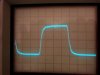
Finally, I also took a peak at a 10 kHz square wave, which was well damped, but clearly showing the results produced from the limited frequency response of this unit. For the intended application however, this performance is quite acceptable.

Pics include:

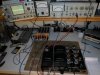
1. All wired up and ready for testing. The stereo load unit was configured as two 100 watt 16 ohm loads in parallel to deal with the prodigious amounts of power this amplifier can develop.

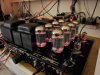
2. All lit up and ready for action. At no time during the testing, did any of the 8417s give any indication of a grumpy or otherwise unacceptable attitude.

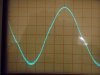
3. Here is a 200 watt 1 kHz sine wave producing about 1.8% THD before the output tube balance controls were adjusted to their optimum settings. A good eye will see the crossover distortion being produced.

4. Here is a 200 watt 30 Hz sine wave. Note the slight instability mentioned earlier, as well as the more obvious effects of crossover distortion.

5. The 10 kHz square wave display.

Next up, my thoughts on these results, and where to go from here.

Dave
 

Attachments

  • Bogen MO-200A Performance Tests 003.jpg
    Bogen MO-200A Performance Tests 003.jpg
    85 KB · Views: 213
  • Bogen MO-200A Performance Tests 001.jpg
    Bogen MO-200A Performance Tests 001.jpg
    69.8 KB · Views: 249
  • Bogen MO-200A Performance Tests 002.jpg
    Bogen MO-200A Performance Tests 002.jpg
    76.6 KB · Views: 197
  • Bogen MO-200A Performance Tests 004.jpg
    Bogen MO-200A Performance Tests 004.jpg
    52.4 KB · Views: 188
  • Bogen MO-200A Performance Tests 006.jpg
    Bogen MO-200A Performance Tests 006.jpg
    33.9 KB · Views: 174
Conclusions

The previous lab tests accurately depict the performance capabilities of the Bogen MO-200A. So with that, what do we have? In my experience, a very good sound distribution amplifier.

Interestingly, it is this classification of amplifiers within vacuum tube amplification that received the biggest boost when dependable SS electronics became available. After all, at these power levels, the output transformer is an enigma: make it too small and LF performance suffers. Make it too big, and HF performance suffers. Remove the OPT, and the problem is gone. It is virtually a law of nature that transformers that can deliver 80 watts RMS into a working load is about the limit if the unit has to perform equally well across the entire audio bandwidth at low distortion: i.e at the 20 Hz and 20 kHz audio extremes, as it does with mid-band frequencies. When the SS option became viable, then sound distribution amplifiers with many times the power of this unit became available, with excellent performance capabilities across the entire audio band. Yes, they needed a transformer to develop 70 volt output capabilities, but that is an entirely different scenario due to the ultra low drive impedance that a SS amplifier can provide.

Continuing on that theme then, probably the highest quality commercial vacuum tube amplifiers I am aware of for use as a sound distribution amplifier would be the Mac 275, and Heath WM-6. I'm sure there are others, but these units can produce full power output across the full audio bandwidth at low distortion, but also have the necessary constant voltage output connections for sound distribution service. And, both bang into that 75-80 watt power output limit (per channel) as well.

So what are the possibilities with this unit?

1. Increasing the quiescent current slightly would undoubtedly reduce distortion. No, it won't bring it down into the .xx range (except at low power levels), but could easily cut it nearly in half.

2. While the distortion can be tamed somewhat, the basic power bandwidth cannot, as that is a function of the OPTs. Interestingly, while we all ooh and aah over their mass, mounting style can be deceptive, as there are definitely bigger transformers out there. The Eico HF-89 -- a 50 watt hifi unit (per channel), has notably larger output transformers. So does the previously mentioned Heath WM-6. I suspect that the Dynaco A-431 (as used in the MK III model) is bigger as well. All of these units can (or are capable of) producing their full rated power output across the entire audio bandwidth at low distortion. That the Bogen's OPT are attached to 100 watt amplifiers, but are smaller in size than these lower powered hifi examples, the drop off in LF performance then would be expected. And, with all the extra windings that send winding capacitance to the moon, so would the drop off in HF performance. Quite honestly, AS JUDGED AGAINST HIGH FIDELITY STANDARDS then, the unit performed about as I expected it to. After all, it is a sound distribution amplifier, not a high fidelity amplifier.

3. None of this is hardly meant to trash this unit. Hardly at all! It is meant to bring a dose of reality as to what it is. If I were designing a unit for the intended application this unit was meant for, with the intended features it has, it would perform much like this one does. Therefore, for what it is supposed to be, it is an excellent unit. The question is then, how well can it be RE-PURPOSED as a high fidelity unit?

For the borderline insane among us who would connect a couple of these beasts up to their Klipsch Cornwalls, there is no doubt that these will perform quite well. Their noise level will need to be tamed, but they will perform well because they are performing so low below their rated capabilities. In that sense then, I have absolutely no doubt that these amplifiers "sound" good. But the question has to be asked: How sane is it to drive your Klipsch with 400 watts of Bogen sound distribution power? I suspect such an exercise is more about the challenge than the sound -- unless you're just enamored with all things Bogen (it happens!).

Ultimately, from a pure technical performance standpoint then -- within the capabilities of what they are -- the Dynaco's -- in stock form -- can outperform the Bogens by a considerable margin. Does that make one better? Nope. It simply means that while the Dynaco makes for a better high fidelity instrument against the Bogen, it would also make for a lousy sound distribution amplifier against the Bogen -- which again brings us to the point that each was designed for a different application. Therefore, trying to compare the two does an unfair service to each since they were each designed from the ground up with uniquely different goals in mind.

Knowing all of this then allows the Bogen to be re-purposed -- if desired -- with absolute knowledge of what it started life as, and therefore what the realistic outcome of any such effort might produce. No doubt it would make an absolutely killer guitar amp. And for those who have those power hungry speakers like Dahlquist and AR, I'm sure these will be a tempting project. In any event, at least the starting line has been clearly drawn now, so that any potential expectations from modification can realistically be set.

Comments welcome!

Dave
 
Last edited:
I feel compelled to mention that Paul Klipsch fave amp for his speakers as related to me in conversation was a 10 watt Brook, IIRC designed by the one and only Lincoln Walsh.
I have no idea why classic Klipsch owners insist on coupling these things to massively overpowered amplification operating at a fraction of it's capacity.
 
I feel compelled to mention that Paul Klipsch fave amp for his speakers as related to me in conversation was a 10 watt Brook, IIRC designed by the one and only Lincoln Walsh.
I have no idea why classic Klipsch owners insist on coupling these things to massively overpowered amplification operating at a fraction of it's capacity.

However to be fair, PWK listened mostly to um-pa-pa marching music. Not a lot of frequency extremes there.

I have four modded Khorns and four tube monoblocks with about 20 watts each. There is, on rare occasion a few times a year, when I play something like Bela Fleck's Flight of the cosmic hippo at insane levels....just to make sure nothing in the walls rattle.
 
However to be fair, PWK listened mostly to um-pa-pa marching music. Not a lot of frequency extremes there.

I have four modded Khorns and four tube monoblocks with about 20 watts each. There is, on rare occasion a few times a year, when I play something like Bela Fleck's Flight of the cosmic hippo at insane levels....just to make sure nothing in the walls rattle.

You rock, Dood!:guitar::rockon:
 
90% of the time it's jazz. But I do see what you were getting at. About the only thing I would gain by running 4 Bogen MO-200's in my system would be a higher electric bill!

And, it's whole lot easier to build an excellent sounding 20 to 30 watt tube amplifier than it is to build a really excellent sounding 200 watter, which I think is what Dave was saying.
 
90% of the time it's jazz. But I do see what you were getting at. About the only thing I would gain by running 4 Bogen MO-200's in my system would be a higher electric bill!

And, it's whole lot easier to build an excellent sounding 20 to 30 watt tube amplifier than it is to build a really excellent sounding 200 watter, which I think is what Dave was saying.

Exactemento! Good reason why a simple straight-forward upgraded console pull can impress on efficient speakers like these.
 
Hiya,

There are times where you only want or can have one set of speakers in a house. And you might like to listen to stuff that is reproduced and amplified via them sand based devices. In those cases you might want some wattage out of that tube setup. Yes of course you can get efficient speakers and they will be fine on both but that can get limiting as to choice.

FYI: We are kinda screwing the pooch so to speak clouding up Daves thread with what we all pretty much know already.

Frannie
 
Last edited:
Hiya,

There are times where you only want or can have one set of speakers in a house. And you might like to listen to stuff that is reproduced and amplified via them sand based devices. In those cases you might want some wattage out of that tube setup.

Frannie

It's all relative to your working conditions. I'm fortunate to have the space and a wife that would probably throw me out of the house if I ever even mentioned getting rid of the Khorns!
 
Added Info

I meant to add that my measurements showed the OPTs to have a 4750 ohm primary winding, based on the turns ratio produced between the primary and full 16 ohm winding in each transformer (remember, the secondary windings of the two transformers are paralleled to produce the 8 ohm terminal connection). As such, with the screen voltages available in this amplifier, these transformers would be appropriate for use with virtually any of the large bottle output tubes.

The feedback winding is basically a standard 10% NFB winding, meaning it develops 10% of the primary winding voltage, providing a feedback signal that is electrically isolated from the load winding.

For experimentation purposes, using the 70 volt winding as a CF winding with PP 6550s, about 7 db of NFB could be developed on either side of the push-pull connection. The amplifier would still develop nearly (if not) 100 watts RMS per amplifier, and the two freed up output tube sockets per channel could be used for a capable 6SN7 based Williamson front end to provide the increased drive level that such an output stage configuration would require. This of course is assuming that the output stage would remain stable with such alternate use of the 70 volt winding.

There is no doubt that the distortion performance of the amplifier can be improved upon to some extent. But the basic power bandwidth is what it is. The bottom line then is if that power bandwidth works for you, then modify to your hearts content -- or -- find yourself a pair of Acro TO-340 output transformers to mount up to this thing, and a small screen choke as well. If you do, look out, because now everything has changed!

Dave
 
Hi Dave,

Thank you for sharing your expertise, and am following this with great interest as I have acquired 4 Bogen MX60A pp8417 amps and have them paralleled like the MO200A, but only at 120w/ch, to drive a set of power hungry Magneplanars.

A couple of questions if I may,

"some slight instability was noted on full power waveforms at 20, 25, and 30 Hz, which is almost to be expected with the paralleled operation of the two amplifiers, let alone the use of very high Gm power tubes. It was not serious, but evident none the less."

I'm curious, Is this a function of all paralleled output transformers or because these particular ones were struggling with the 20-30 hz power output?

The Bogen Manual allows for stacking(Paralleling) multiple amps but doesn't say how many. I suspect there is a practical limit and would this play into it?

Any insight into how big-power amps, such as the high end VAC Statement 450, develop 450 watts yet maintain excellent high frequency response?


I was reading on your site http://www.tronola.com/html/st-70_hotrod.html about the supermods technique and operating the transformers at half-impedance.

Is this something that would be applicable here to boosting the low frequency power output?

Thanks,
Paul
 
What a fascinating thread!

One question: What was the power level of the response meas? I might have missed it but I didn't see any reference to that bit of info. Safe to assume it was @ 8 ohms?

Also, WRT big tube amps capable of high performance, don't forget the Mac MI200 and MI350/MC3500. Both were supposedly capable of meeting basic power and distortion specs at the frequency extremes.
 
By your findings, those amps don't sound like optimal amps for what I was intending them for, a pair of Infinity Kappa 9's or Quantum Line Source 1's. They don't even sound like a good candidate for bass duty or mid/hi duty via biamping. Hi power tube amps capable of driving these speakers are quite expensive and I was hoping for some secret weapon that would be available at a reasonable price, I kind of thought it was a long shot but by your findings it pretty much confirmed they would not be some undiscovered secret.
 
Thanks Steve -- I'm sure (and knew) there were other units capable of high power and performance -- but you see the extent of design and expense that they represent to achieve it. They are all way above the workman level of the Bogen.

Frequency response tests are typically always conducted at a 1 watt power level, and typically (today) across an 8 ohm non-inductive load -- this to make sure that power bandwidth limitations of the unit don't influence the results. My response measurements were also performed at a 1 watt power level across an 8 ohm non-inductive load -- which I should have mentioned, so thanks for bringing that question up.

Dave
 
As an aside, what effect, if any, do you think would things like higher UF caps, tighter tolerance modern metal film resistors, fast recovery diodes, and such have on the specs, transformer limitations aside?
 
Last edited:
Back
Top Bottom