• The move to the new server is done. There are some software and database maintenance updates in process. This has us passing the hat around to help out. We appreciate any donations. Seriously, even a dollar helps. The payment page may be found here - https://www.audiokarma.org/support.html

Thorens TD160 E no low frequencies - Help needed

What about the hum - gone?

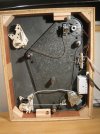
I think you're gonna have to improve on the tonearm cable soldering. The sheath is way too long, and twisted around the core with strands coming apart from it. Not good!

From the picture it looks like it's long enough to bend over and come in contact with chassis. Also, the point of the sheath is to shield the core (from EMI and RF), so you wanna keep the exposed core as short as possible.

I don't want to rain on any parade, and I'm trying to keep this constructive, so lemme just point out that good soldering results in shiny, smooth solder joints, not dull crackly looking blobs. Some lead free solder looks dull and crackly by default, but the usual rosin core 60/40 should result in better looking soldering.
 
So maybe do as @tnsilver suggests and clean up the solder job a bit.

Start with addressing the RCA cables where they are soldered to the terminal block. The "sheaths," which I assume means the cable shielding the main leads.....shorten that, making sure all the strands are joined and none are sticking out. There should be only enough of that to reach the negative post with the main lead inside equally short and shielded right up to about 5mm, just long enough to be soldered properly to the post on the terminal.

Then, I would use some flux and try to re-flow those other posts so the solder forms a nice solid, shiney blob. You'll probably need to add a bit of solder along with that. Don't worry, this takes time to learn and become proficient but you will be fine.....stay with it.

I have a feeling we are going to have to bring all the grounds over to the right channel negative pole and eliminate the jumper.....never liked the looks of that. On my table, there are only 4 posts, none in the center like yours but that really shouldn't matter if things are done right and all the soldering is solid.

So, as was asked above, is the hum still there? If not then you're good.....if it is then......

Maybe @tnsilver can elaborate a bit on the use of the multimeter to help with knowing more about the two ground wires going to the arm pillar? Probably to determine exactly how they are connected so as to make sure there is no loop, because if there is hum, it is likely because there is a loop formed somehow and with what the previous owner did and how it was done I'd say anything is possible. See if you can't get that wiring schematic......this will be the best thing to have so we can see exactly what is supposed to be there, and not, on your table.
 
Last edited:
To figure out the ground leads from the tonearm - detach both from the wiring hub. In continuity mode, with one meter probe on the detached end, search with the other probe different metal parts of the tonearm. These are the wand collar, the tonearm gimbals, and the extension (shutter?) at the bottom of the tonearm. Make a note of the continuity (beeps) at each point. Repeat with the other detached lead end. If the same continuity point is found for both leads - one is redundant. I've come to doubt that.

This is a rather unique variant of a TD-160 with a semi-auto shut-off/lift-up mechanism, that appears based on an optoelectric sensor and a shutter, rather than an induction sensor, such as with the TD-145/146/147. Maybe one of the ground leads from the tonearm, is attached to the shutter down the base. It looks like a bulk metal mass. In that case I'd assume it's stock configuration, and the other lead should ground the wand.
 
Nope! That'll leave the main chassis ungrounded.
I thought one of those leads that was going to the center grounding post on the terminal also went to the main chassis, no? If so, would that not ground the main chassis through the right channel (green) wire if it were attached there? If those other two grounding wires going up through the arm pillar are going anywhere that might make contact with the main chassis, would that not create a ground loop and maybe responsible for the hum? I am wanting to learn here right alongside @ChronoSee so thank you for your patience Tom....
This is a rather unique variant of a TD-160
It sure is, which is why I'm struggling a bit trying to make sense of the wiring schematic as it is different from my 160.....where did you find out about the auto-off/lift-up mechanism? Were you able to source a manual for it?
 
I thought one of those leads that was going to the center grounding post on the terminal also went to the main chassis, no?
The center post is just a rivet in the masonite board, and apparently, it only sums up leads from the tonearm. The extreme tab, with the screw, is the only true chassis ground.
 
where did you find out about the auto-off/lift-up mechanism? Were you able to source a manual for it?
No manual to be found. I can see the solenoid and the mechanism in the pics. I'm just guetimating from experience. It looks like a shutter - and that only goes with a light sensor. I could be wrong. I don't really know this TT.
 
The center post is just a rivet in the masonite board, and apparently, it only sums up leads from the tonearm. The extreme tab, with the screw, is the only true chassis ground.
That's what I was seeing too, and the jumper connects this center post with the chassis ground as it is soldered on where the screw is. That's why your suggestion to find out where those leads from the tonearm go makes a lot of sense.....we'll just have to wait and see once he's done that. Also, we still need an answer if the hum is still there, don't we?
 
Here's what I see, and how I see it:

tje5z1z.jpg
 

I have an idea that will cost nothing and be really easy to test out....even though I know not too much about electronics, I do have a pretty vivid imagination and here there is no danger of anything untowards happening I can think of.

In this image above that you provided showing the ground wire that goes between the main chassis and the subchassis, try disconnecting that wire. No such wire exists in my table and I believe, given that we don't know where the two leads that go into the arm pillar actually terminate, it could be that one or both are somehow connecting to the main chassis, perhaps through some part of the tone arm.

If the hum goes away, you're home free....if not, you aren't any worse off than you are now and you can always re-attach it. Does this make any sense at all? Give it a try and let's see.....no harm no foul......
 
^ the sub-chassis to main-chassis ground lead (typically gray) exists on every single TD-16X, 14X, 150 and 125 variant ever produced, and probably on every subsequent suspended TD model. There's no other way to ground a suspended chassis. If it doesn't exist, the table has been mod'd. Whether it's absence affects ground related hum - remains to chance.
 
^ the sub-chassis to main-chassis ground lead (typically gray) exists on every single TD-16X, 14X, 150 and 125 variant ever produced, and probably on every subsequent suspended TD model. There's no other way to ground a suspended chassis. If it doesn't exist, the table has been mod'd. Whether it's absence affects ground related hum - remains to chance.
Hey Tom, now I'm really confused because I received my TD160 untouched and the only thing I did was replace the RCAs, (sloppy solder job that I improved upon a few days ago) and can see no other cable between sub and main chassis. I don't even see those attachment points with the raised metal where the screws go.....I wonder what might be the case here? Might there have been another way to connect the sub and main chassis? The only grounding wire I can see is the one in the picture, and that just goes back to the right channel negative post on the terminal......hmmmm.....

IMG_4984.JPG
 
It's the gray lead mid picture to the right, screwed to the sub-chassis with a ring terminal, going to the white nylon hub. You've got it too.
 
yep, the tie to the fixed chassis is in the terminal strip itself. I don't remember the fine detail but something about a jumper to the mounting screw I think. Should be able to see it if you look closely at the terminal block though. Tie to the sub-chassis is the wire.
 
It's the gray lead mid picture to the right, screwed to the sub-chassis with a ring terminal, going to the white nylon hub. You've got it too.
Yes, we are saying the same thing and I know that gray wire is the ground to the sub chassis on my table. However, if looking at the OP's model and the picture he provides, there is another wire that connects the sub chassis with the main chassis or that's what I believe I was seeing....see his picture in post #110 (the link I put there will take you to it). The sub chassis itself, as @gadget73 says, is connected to the ground via the screw on the terminal block. I may be all screwed up but that's what I'm seeing.....
 
The sub-chassis/main-chassis lead in #110 has exactly the same function as the gray lead in your turntable, except for a different location. It basically connects the suspended section of the bulk metal mass with the fixed part. In both cases the main chassis is grounded (stray potential is directed out) once, and once only in the terminal block. Now, after the cancellation of the external ground wire, it's exactly the same grounding scheme. Your turntable and the OP's are grounded the same way, with the exception of the double ground leads out the pillar, in his case, which I'm not entirely sure about.
 
Help me understand, the gray lead on my table is only connected to the suspended sub chassis and not the main, fixed part. I don't see where or how the main part (chassis, fixed) is connected to the negative lead on the terminal block. Sorry, Tom, I know this must be frustrating for you but I'm trying to understand.....

My thinking was that if those two leads into the arm pillar, the ones we don't know about, are somehow creating a ground loop with how they are attached on the end we can't see, then I thought that might produce a hum. I've read on AK that connecting a separate ground wire from the table to the phono stage could cause a hum and wondered if this is what might be happening with the OP's situation in some way?

Edit: Which was why I suggested the OP remove that wire between sub and main chassis to see if the hum went away, but at this point I guess we need to hear back from @ChronoSee to find out if the hum still exists. Still, I am curious about it all and am learning....thanks, Tom.
 
Last edited:
Help me understand, the gray lead on my table is only connected to the suspended sub chassis and not the main, fixed part
That doesn't sound right to me. Odd!!!

On the very first TD-160, with the all brass under-knob assemblies, this was the grounding scheme, where the chassis was connected via a metal post (protruding from the chassis) to one of the terminals on the terminal block, which then led to the right channel ground.

This is the easiest variant to understand, since it's crud and elementary:

QxMx6iV.jpg


Subsequent models, mainly those with the plastic knob assemblies, had simply removed the metal tab (which was probably complicating manufacturing) and moved to a lead from the chassis to, pretty much the same terminal, on the terminal block. They then jumpered that terminal to one of the metal chassis mounts, to which the terminal block is anchored. It's rather obscured - but the chassis is always grounded.

Look under the terminal to which the gray lead from the sub-chassis is connected. You should see it.
 
Oh, BTW @Fishead, I've blown your pic to confirm my observation, but it's pixelizing too much. I'm almost sure I can see a metal post, like the very first TD-160 variant. Am I imagining?
 
Tom, you are soooo right!!! I did not see that and didn't remember it from previous encounters but there IS a post, metal tab, that goes to the main chassis off of that ground terminal on the block.....my bad.

Still kinda curious though if the OP ever resolved the hum issue and what those two leads are that go into the arm pillar.....
 
Last edited:
Back
Top Bottom